First Seen
2025-07-20T23:55:43.773938+00:00
simple-description (qwen3.5_2b-q8_0)
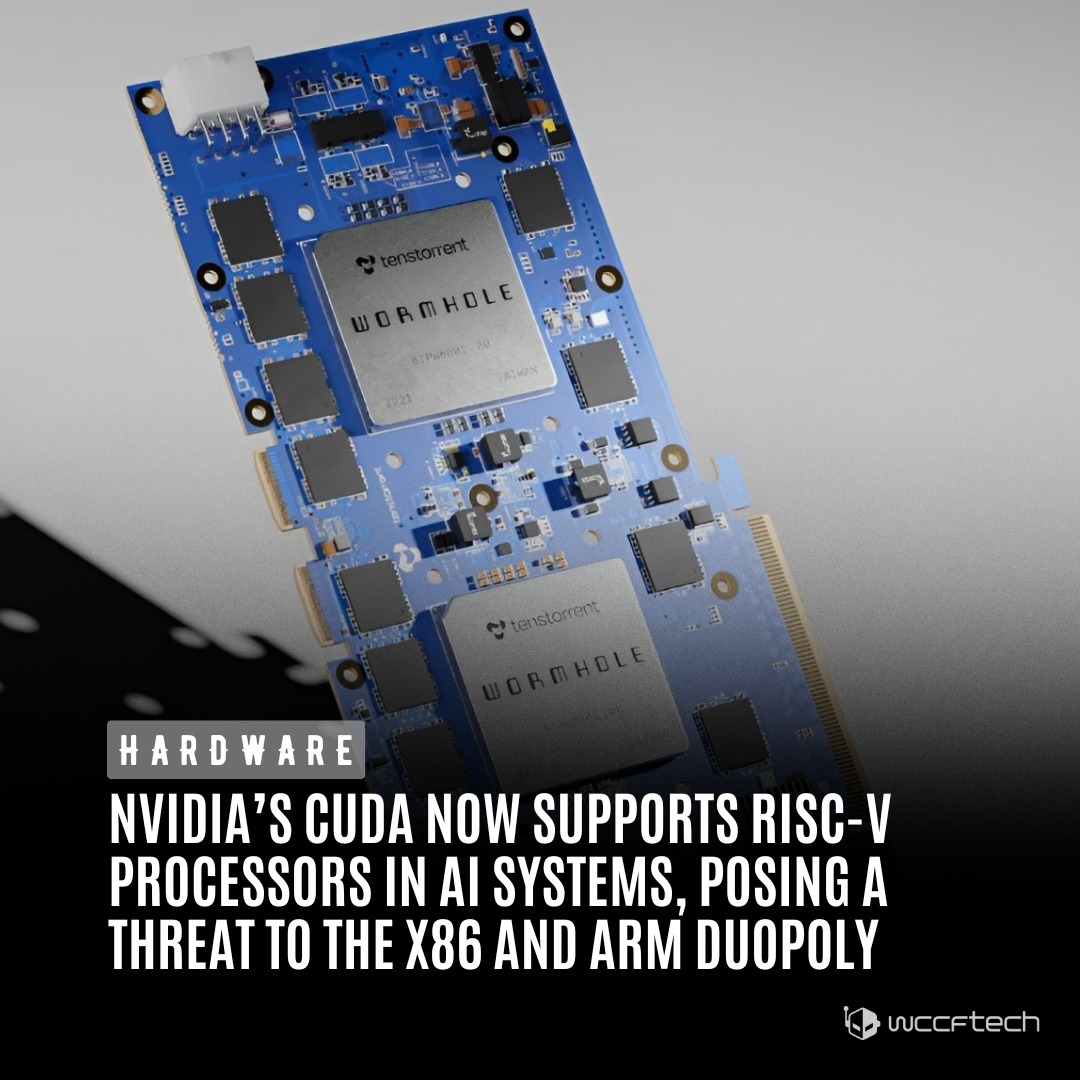
This infographic acts as a visual summary of a significant news headline about computer chips, specifically focusing on the hardware required to run artificial intelligence. It displays a detailed view of a small processing unit (labeled "WORMHOLE") sitting on a blue circuit board, which serves as the physical hardware for these tiny components. The text explains that NVIDIA has finally accepted RISC-V processors—chips often competing with x86 architectures—and this move is causing worry for Apple and Android manufacturers who rely entirely on ARM technology.
detailed-analysis (gemma3_27b-it-q8_0)
Okay, let's break down this image and its accompanying text from a semiconductor industry perspective, employing the requested theoretical lenses where relevant.
Image Description & Context
The image showcases two TensorTorrent "Wormhole" accelerator cards. These are specialized hardware designed for accelerating AI workloads. The key takeaway, as the text clarifies, is that NVIDIA's CUDA – a dominant parallel computing platform and programming model for GPUs – now supports processors based on the RISC-V instruction set architecture (ISA).
This is significant because CUDA has historically been tightly coupled with NVIDIA's own GPUs. Expanding support to RISC-V changes the game. RISC-V is an open-source ISA, meaning anyone can design and manufacture chips based on it without licensing fees. Currently, the semiconductor landscape is heavily dominated by Intel (x86) and ARM (which licenses its designs). CUDA's move to support RISC-V is interpreted as a potential disruptor to this established duopoly.
Foucauldian Genealogical Discourse Analysis
A Foucauldian approach examines the historical development of power relations embedded within discourse. In this context:
- Historical Evolution of Control: The story is one of how control over computing architectures has evolved. Early computing was relatively open. Then, x86 became dominant, and Intel (and to a lesser extent AMD) exerted a significant grip. ARM emerged with its licensing model, creating a different type of control – still commercial, but more distributed. NVIDIA's CUDA created a software control point on top of the hardware (GPUs), essential for AI development.
- Discipline and Normalization: CUDA normalized a specific way of doing parallel computing (on NVIDIA hardware). This shaped research, development, and the skills of engineers. To participate in the most advanced AI, you had to learn CUDA.
- The Challenge to Normalization: RISC-V represents a break in this normalized order. By supporting it, NVIDIA is not necessarily relinquishing control, but participating in a shift toward a more open, potentially decentralized power structure in AI hardware. It’s a fascinating move, potentially allowing NVIDIA to profit from a wider ecosystem while simultaneously undermining the concentrated power of x86 and ARM. This isn’t purely altruistic; it's about anticipating and shaping the future power dynamics.
Marxist Conflict Theory
This situation is rife with the hallmarks of Marxist Conflict Theory:
- Class Struggle (in Hardware Form): We have a clear conflict between established players (Intel/x86, ARM) and a rising force (RISC-V). RISC-V, backed by open-source communities and increasingly by companies seeking to avoid licensing costs, represents a challenge to the existing means of production (CPU design).
- Capital Accumulation & Exploitation: Intel and ARM accumulate capital through licensing fees and chip sales. RISC-V seeks to bypass this model, potentially disrupting their revenue streams. The "exploitation" aspect can be seen in the dependence of developers on proprietary architectures and the costs associated with those architectures.
- Mode of Production: The semiconductor industry represents a specific mode of production – high capital investment, complex manufacturing processes, intellectual property as a central asset. RISC-V's open nature threatens to alter this mode, potentially leading to a more distributed and collaborative production model.
- Superstructure: The CUDA ecosystem is part of the superstructure—the ideological and cultural elements that reinforce the existing economic base. By extending CUDA to RISC-V, NVIDIA is actively engaging with and potentially restructuring the superstructure.
Postmodernism
Postmodern thought deconstructs grand narratives and embraces fragmentation. In this context:
- Deconstruction of the CPU Monolith: The dominance of x86 and ARM has created a narrative of a monolithic CPU architecture. RISC-V challenges this narrative, suggesting that there's no single "right" way to build a processor.
- Simulation and Hyperreality: The AI boom itself can be seen as a form of simulation, creating increasingly complex models of the world. RISC-V becomes another layer of abstraction, a "simulacrum" of the traditional CPU, potentially better suited for these simulated environments.
- The Death of the Author (of Architecture): The open-source nature of RISC-V challenges the idea of a singular "author" of the CPU architecture (like Intel or ARM). It encourages a collaborative, distributed authorship.
Critical Theory
Critical Theory asks how power structures are perpetuated and how they can be challenged:
- Technological Determinism: The initial expectation that NVIDIA’s CUDA would lock developers into its ecosystem is an example of technological determinism – the idea that technology shapes society rather than the other way around. CUDA’s support for RISC-V challenges that determinism.
- Instrumental Reason: The focus on performance and efficiency in chip design often overshadows broader ethical or societal concerns. RISC-V, with its open nature, could allow for greater scrutiny and consideration of these concerns (though it doesn't guarantee it).
- Emancipation: RISC-V potentially offers a degree of emancipation from the control of large corporations. It gives designers more freedom and potentially lowers barriers to entry for smaller companies and research institutions.
In Conclusion:
This news isn't just about a technical update. It’s a move with deep implications for power dynamics within the semiconductor industry and the wider AI ecosystem. From a semiconductor industry perspective, it signals a potential paradigm shift, an opening up of possibilities, and a challenge to established power structures. The image and its associated text are a snapshot of that shift in progress.
simple-description (llama3.2-vision_11b)
The meme is a humorous take on the recent news that NVIDIA's CUDA (Compute Unified ... ) is now supporting RISC-V processors in AI systems, which is a threat to the X86 architecture and the ARM ... . The meme is saying that the X86 architecture is now supported by NVIDIA's CUDA, which is a threat to the X86 and ARM ... . The text "NVIDIA's CUDA now supports RISC-V processors in AI systems, posing a threat to the X86 and ARM ... " is on the image.