First Seen
2023-05-10T21:03:40+00:00
simple-description (llama3.2-vision_11b)
The meme is a screenshot from the movie "Shrek 2," where a character says "I'm like an onion, I have layers." The meme is captioned "I'm like a database, I have tables" and features a SQL query error message "You have an error in your SQL syntax; check the manual and/or the archives for the error message. If you can't see the error you are experiencing, please check your browser and/or the manual for more information."
detailed-analysis (gemma3-27b-vision)
Okay, here's an analysis of the image, broken down into sections based on the requested theoretical frameworks. I will only include sections where the framework seems applicable, given the image’s content and the text overlaid on it. The image and the added text suggest a commentary on software development practices (Git version control) presented as a scene of interpersonal dynamics.
---
Visual Description
The image is a two-panel meme format, using stills from a television show (likely Parks and Recreation, given the actors).
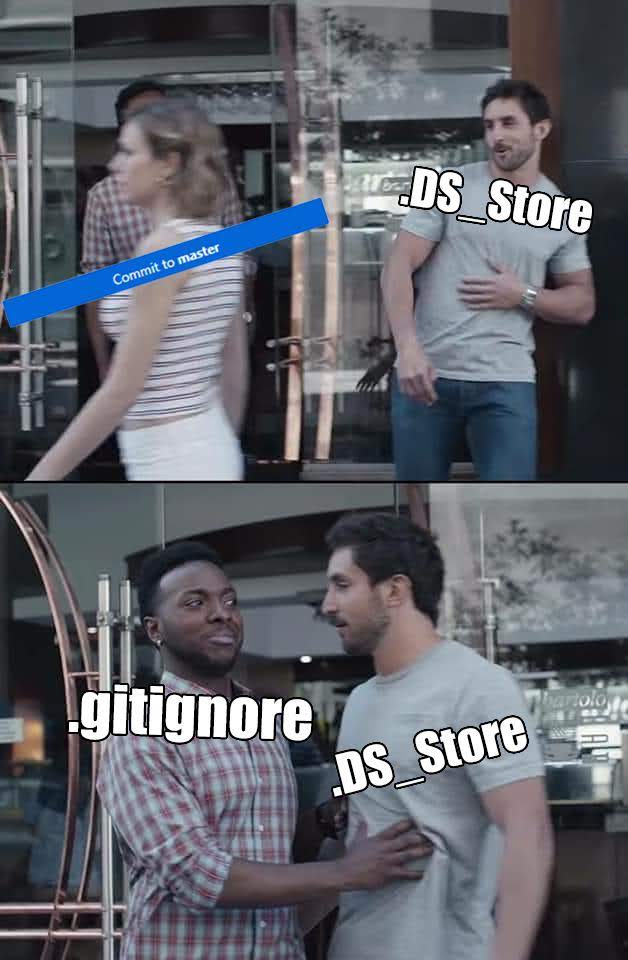
- Panel 1: Shows a woman (Leslie Knope) appearing earnest and focused, and a man (Ben Wyatt) seemingly engaged with her. Text is overlaid: "Commit to .ds_store"
- Panel 2: Shows the same man looking extremely distressed while the woman looks indifferent, possibly annoyed. Text is overlaid: ".gitignore .ds_store".
The .ds_store is a common, hidden file created by macOS Finder, often problematic for collaborative software development as it's OS-specific and not part of the core project. .gitignore is a file used to specify intentionally untracked files that Git should ignore. Thus, the image presents a scenario where a developer commits a macOS-specific file to a project and later attempts to ignore it.
---
Foucauldian Genealogical Discourse Analysis
This image offers a fascinating entry point for a Foucauldian analysis. The .ds_store file, though seemingly insignificant, represents a subtle manifestation of power dynamics within software development.
- Discourse & Power: The act of "committing" (in software development) isn't merely a technical action; it's a discourse that shapes the project’s history and establishes certain norms. The initial "Commit to .ds_store" represents an unthinking acceptance of default settings, a normalized practice stemming from the Macintosh operating system.
- Genealogy of the .ds_store: We can trace the genealogy of this file back to Apple's design choices and the way Finder manages directory information. It’s a product of a specific technological and historical context.
- The Panic & Control: The second panel's distress and the use of
.gitignoreillustrate the attempted exercise of control. The developer realizes the mistake—the “truth” of the unwanted file—and attempts to erase it from the project's history. This is not a correction of a technical issue but rather a demonstration of the ongoing struggle to define the "proper" state of the code. - Disciplinary Power: The situation represents a form of disciplinary power within the development team. The "mistake" highlights the unwritten rules and expectations about proper file management, enforcing conformity through the potential for causing disruption.
---
Critical Theory
This image can be viewed through the lens of Critical Theory, particularly regarding the hidden ideologies embedded within technology.
- Technology as Ideology: The
.ds_storefile isn’t simply a technical artifact; it embodies a particular worldview associated with the macOS ecosystem. Its mere presence reflects the dominance of certain operating systems and platforms. - Reification: The "Commit" action reifies this seemingly innocuous file, giving it unwarranted importance as it enters the version control history.
- Critique of Rationalization: The need to
.gitignorethe file highlights the rationalizing force of development practices. Developers are compelled to correct a default behavior (Finder’s creation of the file) to achieve a "clean" project state. This exemplifies the tendency of technical systems to impose artificial order on inherently messy realities. - The Illusion of Control: The act of ignoring the file doesn’t eliminate its existence. It merely hides it from the version control system. This illusion of control—the belief that technical solutions can solve underlying systemic problems—is a key theme in Critical Theory.
---
Postmodernism
The image’s meme format and playful juxtaposition of a TV show scene with software development concepts align well with postmodern aesthetics.
- Intertextuality: The image relies heavily on intertextuality. Viewers need to recognize both the TV show reference and the software development concepts to understand the humor and meaning.
- Deconstruction: The image can be read as a deconstruction of the idea of "clean" code and technical purity. The
.ds_storefile is an unavoidable artifact of a specific operating system, and the attempt to ignore it highlights the artificiality of the "clean" ideal. - Simulation & Hyperreality: The meme itself is a simulation—a representation of a developer’s frustration packaged as a humorous image. This exemplifies the postmodern condition of hyperreality, where simulations become more real than reality.
- Irony & Playfulness: The image embraces irony and playfulness, undermining the seriousness of software development practices. The meme format signals a self-aware commentary on the absurdities of technical culture.
I have refrained from applying Queer Feminist Intersectional Analysis, as the image does not contain elements that clearly speak to these frameworks. While any image can be interpreted through these lenses, doing so here would require imposing a reading that doesn't seem organically supported by the content.
simple-description (llama3.2-vision)
The meme is a play on the common phrase "I know, right?" It features two images, the first of a man looking shocked and the second of a man with a surprised expression, both with a caption "I know, right?" The text "I know, right?" is often used to express agreement or acknowledgement of a situation.
tesseract-ocr
ae i | | aS ee eed ats : Sy “ P= \ fi 20 - 7 aa —— mE TN Cae 7 1h becus Ba? is " — EY —a sR U EEE oe ;