First Seen
2023-05-10T21:03:39+00:00
simple-description (llama3.2-vision_11b)
The meme is about a person who is sharing a secret about their friend, but the friend is actually someone who is LGBTQ+ and the person is using a euphemism for a gay person. The text "when your friends tell you their 'gay' stories" is a play on words, implying that the person is using the term "gay" to mean someone who is LGBTQ+, but the friend is actually straight. The meme is poking fun at the idea that people often use the term "gay" to mean someone who is LGBTQ+, but in this case, the person is actually straight and the joke is on the person for misunderstanding the term.
detailed-analysis (gemma3-27b-vision)
Okay, here's an analysis of the image and its accompanying text, broken down into sections as requested. Given the nature of the content, I'll be emphasizing how these theoretical frameworks can be applied, rather than claiming it perfectly fits into each one. I will omit topics that do not have a strong fit in this case.
Visual Description
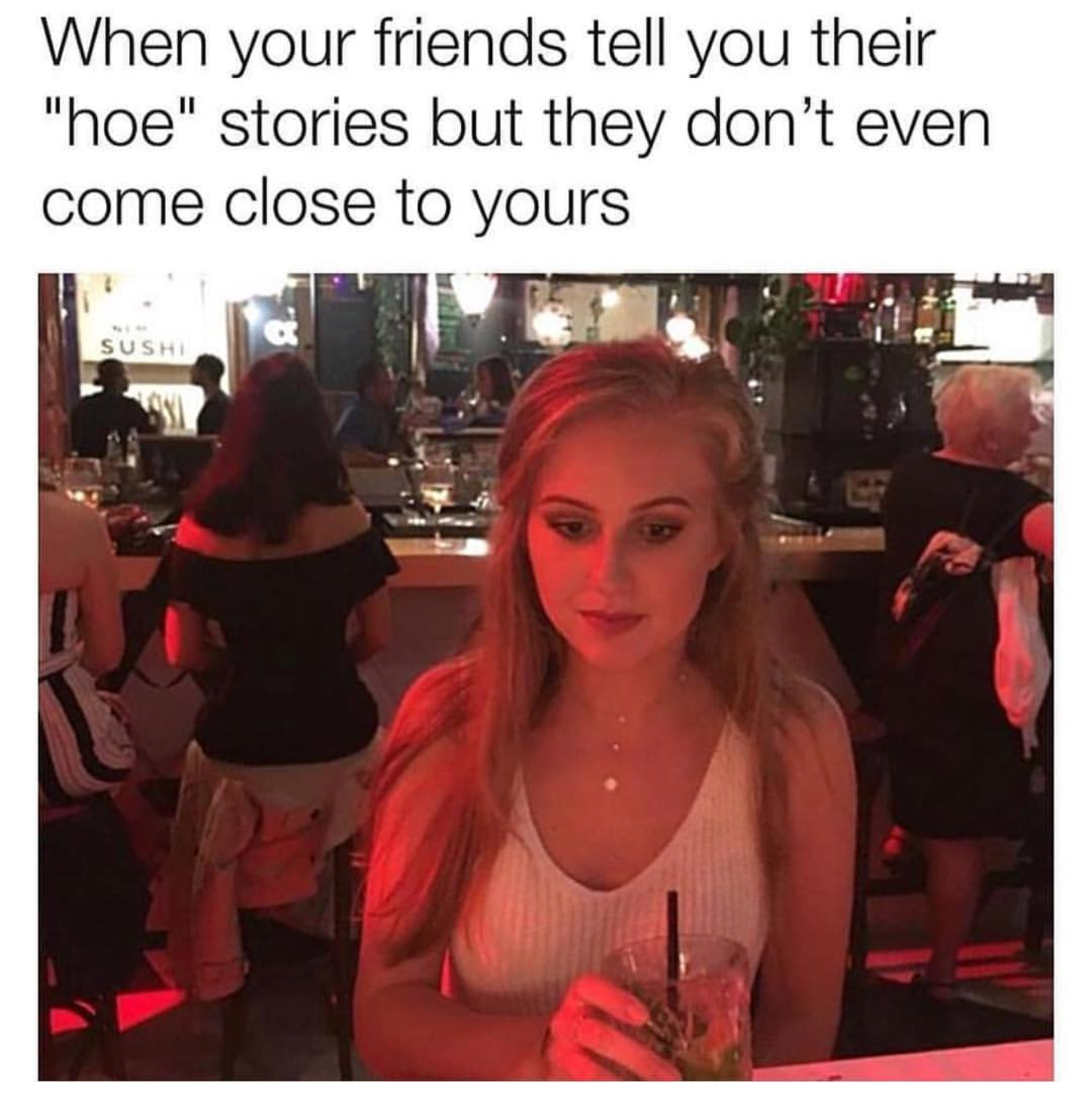
The image is a candid shot of a young woman seated at what appears to be a dimly lit, upscale restaurant or bar (with visible sushi in the background). She is light-skinned with long, wavy blonde hair, and is wearing a white top. Her body language is notably aloof and slightly judgmental. She is looking to the side, a drink in her hand, with a distinct air of boredom or superiority. The lighting is heavily red-toned, creating a mood of heightened drama or ironic detachment. The overall impression is a self-possessed, perhaps cynical, individual observing something she deems less interesting or impressive than herself.
---
Foucauldian Genealogical Discourse Analysis
This image and its text provide a fertile ground for a Foucauldian analysis. The use of the term "hoe" itself is a prime example of how language shapes and constructs power dynamics and acceptable (and unacceptable) sexual behaviors.
- Discourse and Power: The text suggests a competition around stories of sexual experiences. This is a discourse – a system of thought, ideas, and practices - that constitutes sexuality. The woman's facial expression and the claim of her stories being "more" significant imply a hierarchy within this discourse. She positions herself as knowing more about, and perhaps having more authority within, the "hoe" discourse.
- Genealogy: A genealogical approach would trace the historical shifts in how the term "hoe" has been used. It has moved from a deeply derogatory and shaming term to one sometimes reclaimed (and ironically employed) by women to assert agency. However, the underlying power dynamic remains – the term still carries baggage related to societal control over female sexuality. This meme leverages that historical tension.
- Subjectivation: The meme suggests that the woman in the image, and perhaps the person sharing it, are subjectivated by these discourses. She defines herself in relation to her friends' experiences, constructing her identity through comparison and perceived superiority. This reinforces the normalization of comparing sexual experiences and measuring them against some internalized standard.
---
Queer Feminist Intersectional Analysis
This analysis goes beyond simply the "hoe" label to consider how the situation is shaped by broader power structures.
- Intersectional Competition: The meme implies a competition among women based on perceived sexual prowess or "wildness." This can be understood as a manifestation of internalized misogyny and the ways in which patriarchal norms encourage women to compete for male attention or validation.
- Queer Critique of 'Experience': The meme centers on stories of sexual experience. A queer feminist critique would question the very notion of a singular, "authentic" sexual experience. It would challenge the idea that one person's experience is inherently more valuable or "better" than another's, particularly within a heteronormative framework.
- Racial/Class/Gender Dynamics: While not explicit in the image, the implied competition can be seen as layered with other identity categories. Who is considered "wild" or "experienced" is often tied to racist, classist, and/or ableist assumptions. The meme might be unintentionally reinforcing these biases.
- Reclaiming "Slut" vs. Competition: The current reclaiming of the term 'slut' or 'hoe' often centers on solidarity and resistance against shaming. The meme subtly shifts this towards competition, undermining the potential for collective empowerment.
---
Why other frameworks don't fit well:
- Critical Theory: While there's a critique of culture embedded within the meme, it's fairly surface-level. Critical Theory usually requires a deeper engagement with social structures and systems of oppression.
- Marxist Conflict Theory: While competition is evident, the meme doesn't explicitly engage with class struggle or economic disparities. The "conflict" is interpersonal and focused on social capital (perceived sexual prowess) rather than material resources.
- Postmodernism: While the meme plays with irony and subjectivity, it doesn't deeply deconstruct grand narratives or challenge the notion of objective truth. It's a fairly straightforward observation of social dynamics.
In Conclusion:
The image and text provide a rich example of how power operates in everyday social interactions. While it can be analyzed through various theoretical lenses, a Foucauldian analysis focusing on discourse and power, combined with a Queer Feminist Intersectional approach that considers the complexities of gender, sexuality, and competition, offers the most compelling interpretation.
simple-description (llama3.2-vision)
This meme features a photo of a woman with a concerned expression, looking directly at the camera. The text above her reads: "When your friends tell you their 'horrific' stories, but you know they're actually just being dramatic." The image is likely meant to convey a sense of skepticism or annoyance at the friend's exaggerations.
tesseract-ocr
When your friends tell you their "hoe" stories but they don’t even come close to yours Se a Pe oe ma 3 = ksi 4 a