First Seen
2023-05-10T21:03:39+00:00
simple-description (llama3.2-vision_11b)
The meme is a humorous image of a bird with a caption that says "I can read 5 books a year" in a sarcastic tone, implying that the bird is making an absurd claim about its reading abilities. The meme is likely being used to poke fun at someone who is bragging about their reading skills, implying that they are being overly confident or pretentious.
detailed-analysis (gemma3-27b-vision)
Here's an analysis of the image, broken down into sections addressing the prompts. Because the image is so conceptually simple (a bird labeled entirely as "bird"), certain sections will be more relevant/developed than others.
Visual Description
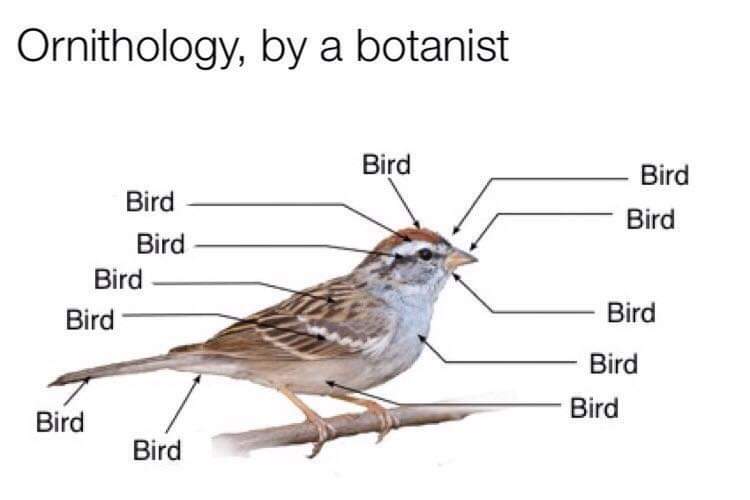
The image is a diagram of a small, brown and gray bird, likely a sparrow. The bird is depicted in profile, perched on a thin branch. The style is reminiscent of a scientific illustration, though presented with a humorous twist. The entire anatomy of the bird – head, beak, wing, tail, body, legs, feet – is indicated by lines leading to the single label “Bird”. The diagram’s simplicity and repetitive labeling are immediately striking and the title suggests a botanist—someone normally focused on plants—is the creator.
Foucauldian Genealogical Discourse Analysis
The image is a fascinating example of how power operates through discourse and categorization. Michel Foucault’s work explores how knowledge isn't neutral, but is constructed through discourse, and how this construction serves to create and maintain power structures. Here, the botanist's reduction of the bird's anatomy to only the label "bird" can be seen as a demonstration of how systems of categorization are imposed.
- Genealogy: A genealogical approach might question the history of bird classification. What historical conditions led to a system where specific anatomical features have names? The image, by ignoring these specificities, destabilizes that history. It asks, "What is lost when we only see 'Bird'?"
- Discourse & Power: The botanist is wielding the power of naming and categorization. Normally, a bird diagram would create categories of knowledge and differentiation—‘wing,’ ‘feather,’ ‘tibia,’ etc. By erasing those distinctions and only labeling “Bird,” they are redefining the discourse. Is this a playful subversion of the power to classify, or an assertion of it? Is this a demonstration of a botanist’s inherent lack of understanding about birds?
- Episteme: The image challenges the episteme – the underlying system of thought – that dictates how we understand the natural world. It’s not what is labelled, but how it’s labelled that’s significant.
Critical Theory
Critical Theory, particularly in the Frankfurt School tradition, often focuses on the critique of ideology and the way it serves to maintain existing power structures. The image lends itself to this:
- Deconstruction of Knowledge: The image is a simple deconstruction of scientific categorization. It questions the assumed neutrality of labels and categories. What does it mean to only know something as “Bird”?
- Critique of Expertise: The image’s title suggests a botanist created this “ornithological” diagram. This immediately introduces a question of authority. Is a botanist qualified to label a bird? The image suggests that expertise is often contingent and subject to arbitrary boundaries.
- Alienation: A bird, like anything else, can become an object of study, distanced from its living, breathing essence. This reduction to a single label could be seen as a metaphor for the alienation of the individual within modern society.
Postmodernism
The image screams Postmodernism! Several key themes are present:
- Rejection of Grand Narratives: The image throws into question the “grand narrative” of scientific categorization. Instead of offering a detailed, comprehensive understanding of the bird, it provides a deliberately incomplete and repetitive one.
- Playfulness and Irony: The image is inherently playful and ironic. The sheer absurdity of labeling everything as "Bird" is humorous and self-aware.
- Simulacra and Simulation: The image can be seen as a “simulacrum” – a copy without an original. It looks like a scientific diagram, but it’s devoid of the detailed information that would usually define it. It is a representation of a representation.
- Deconstruction of Meaning: The image actively undermines conventional meaning. If everything is "bird," the word itself loses its descriptive power.
In conclusion: The image is deceptively simple. Its humor and conceptual approach makes it an effective way to engage with complex theoretical concepts. It is a visual critique of knowledge, power, and the systems we use to understand the world around us. It asks us to think critically about what it means to “know” something, and how that knowledge is constructed.
simple-description (llama3.2-vision)
The meme is a simple image of a bird with a caption "ornithology" (the study of birds) and "by a botanist" (a humorous reference to a botanist, who is typically an expert in plants, not birds). The image is likely a playful joke, poking fun at the idea that a botanist would be an expert in birds.
tesseract-ocr
Ornithology, by a botanist Bird Bird Bird ; / >—— Bi Bird ea id Bird ae Bird See Bird SSS Bird wea aa Bird Bird