First Seen
2023-05-10T21:03:39+00:00
simple-description (llama3.2-vision_11b)
The meme is a photo of two men, one with a shocked expression, with the text "gay men" above them and "trans men" below. The image is captioned "when you finally understand the difference between gay men and trans men". The meme is poking fun at the common misconception that gay men and trans men are interchangeable terms, and is highlighting the importance of using the correct terminology to respect individuals' identities.
detailed-analysis (gemma3-27b-vision)
Okay, let's break down this meme through the lenses you've provided.
Visual Description
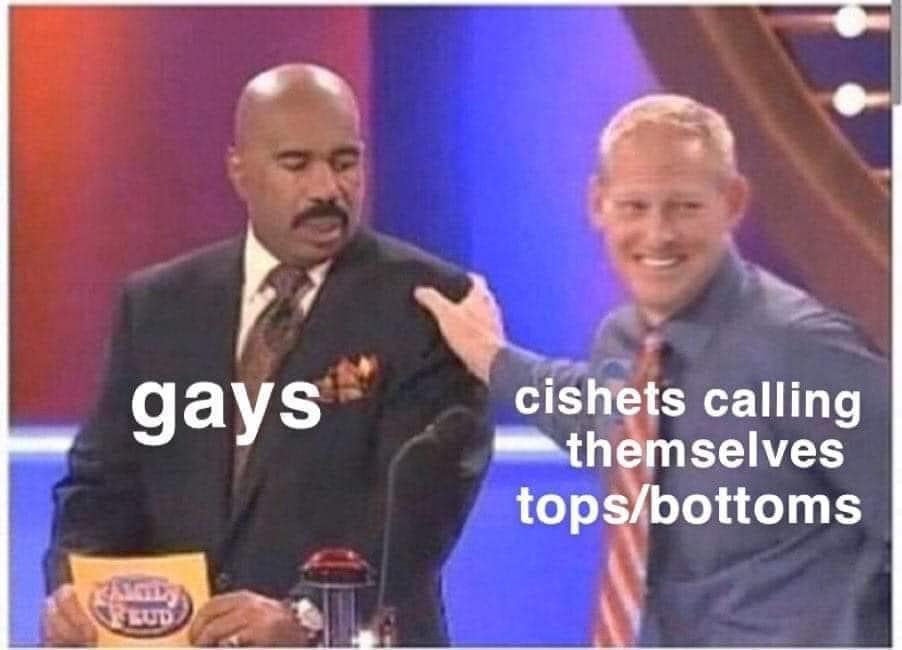
The image is a screenshot from the game show Family Feud. Steve Harvey, the host, is depicted with a disgusted/exasperated facial expression, holding up his hand as if to dismiss something. On the left of the screen, text labels this half of the screen with "Gays." To the right, the other side of the screen features a contestant smiling with text labeling them as "cishets calling themselves tops/bottoms." The background is the typical bright, colorful set of the show. The overall visual cue is one of contrast, pitting two groups against each other with a clear indication of Harvey’s disapproval of the group labeled "cishets."
Foucauldian Genealogical Discourse Analysis
This meme plays on the discourse surrounding sexuality and identity. Michel Foucault's genealogy would examine how the categories of “gay,” “cishet,” “top,” and “bottom” have come to exist as meaningful categories. We can see how the meme is built on a historical unfolding of these terms.
* Power/Knowledge: The terms themselves are not inherently natural; they are constructed through discourse, and become imbued with power. Saying someone is "gay" or "cishet" is an act of categorization, carrying assumptions and expectations. The labels "top/bottom" further codify roles within sexual interactions.
* Disciplinary Practices: The meme suggests there is a perceived “correct” way to identify within the LGBTQ+ community. It implies a sense of policing regarding how people define themselves within queer culture. It's a critique of appropriation or the performance of queerness by those outside the community.
* The Historical Contingency of Categories: Foucault would point out that these categories are not fixed. The meanings of "gay" or "top/bottom" have changed over time, and vary across cultures. The meme relies on an understanding of these shifting meanings.
Queer Feminist Intersectional Analysis
This meme is rich territory for queer feminist intersectional analysis.
* Performance of Identity: The meme critiques what is seen as a performance of queerness by cisgender heterosexual individuals. It highlights the privilege those with heterosexual/cisgender identities have in adopting or “playing with” queer terminology or aesthetics, potentially without fully understanding the lived experiences or risks associated with these identities.
* Co-option & Erasure: The appropriation of terms like "top" and "bottom" can be seen as a form of erasure. It minimizes the historical significance of these terms within queer communities, where they served as a way to navigate power dynamics and find community.
* Power Dynamics: Within queer communities, the terms "top" and "bottom" carry layers of meaning, tied to issues of power, masculinity, and vulnerability. The meme suggests that for cishets, these terms are simply playful labels without the weight of those experiences.
* Intersectionality: While the meme directly focuses on sexual identity, it implicitly acknowledges how it intersects with other forms of identity such as gender and race. The critique of appropriation implies a broader concern with how power imbalances affect all marginalized groups.
Critical Theory
The meme operates as a critique of contemporary culture through a lens that could be considered Critical Theory.
* Ideology: It challenges the dominant ideology around sexuality and identity. By juxtaposing “gays” and “cishets,” it exposes the ways that societal norms shape our understandings of who gets to claim certain identities.
* Domination & Resistance: The meme suggests a power dynamic at play, where those within the LGBTQ+ community may feel marginalized or misrepresented by the appropriation of their language. It is a subtle form of resistance, pushing back against what is seen as cultural appropriation.
* Commodification of Identity: One could argue it speaks to a broader trend of commodifying or “playing with” identities as a form of entertainment or self-expression, without acknowledging the underlying struggles or inequalities.
Postmodernism
While not overtly postmodern, the meme touches on themes relevant to the movement.
* Deconstruction of Categories: It subtly deconstructs the seemingly rigid categories of “gay” and “cishet” by challenging who gets to define themselves as belonging to those categories.
* Irony & Parody: The meme relies on a degree of irony and parody, using the format of a game show to highlight a cultural tension.
* Subjectivity of Meaning: The meme is open to interpretation, acknowledging that meaning is subjective and can vary depending on one’s perspective.
Marxist Conflict Theory
While not the strongest application, we can see elements of conflict theory.
* Power Struggles: The meme implies a conflict between the LGBTQ+ community and those perceived to be appropriating their culture.
* Social Stratification: It highlights how different groups (gays vs. cishets) occupy different positions in the social hierarchy, with the LGBTQ+ community historically marginalized.
* Resource Control: The “resource” in this case isn’t material, but cultural—control over meaning, identity, and representation. The meme suggests that the appropriation of queer language is a form of symbolic control.
Let me know if you’d like a deeper dive into any of these areas!
simple-description (llama3.2-vision)
The meme is a photo of two men, one with his arm around the other, and they're both looking pleased with themselves. The text "gay" is written above the left man, and "straight" is written above the right man. The meme is captioned "gay" "straight" "gay" "straight" with each word being a different font and color, implying a playful and humorous take on the idea of being "gay" or "straight".
tesseract-ocr
-_ a 7 7 te >) cishets callin gars bes 18] Sees tops/bottoms