First Seen
2023-05-10T20:59:59+00:00
simple-description (llama3.2-vision_11b)
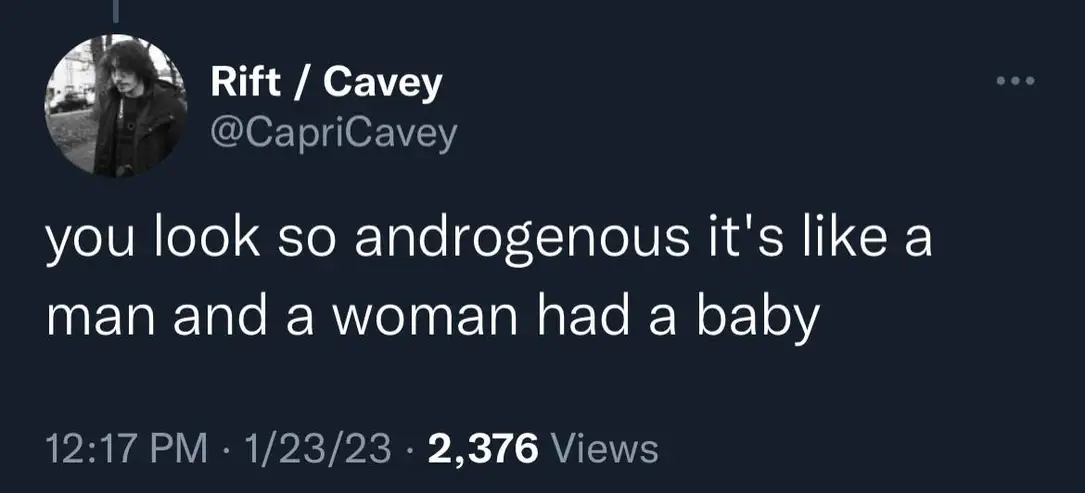
This meme is a commentary on the societal expectations of masculinity and the pressure to conform to traditional norms. The image is a screenshot of a tweet that reads: "you look so androgynous it's like a woman had a baby." The tweet is likely a humorous response to someone's appearance, implying that they are so androgynous that they are even more feminine than a woman having a baby. The tone is playful and tongue-in-cheek, poking fun at the idea that someone's androgynous appearance is so feminine that it's like a woman having a baby.
detailed-analysis (gemma3-27b-vision)
Okay, here's an analysis of the Twitter post, broken down into relevant theoretical sections. It's important to note that some theories will be more strongly applicable than others.
Visual Description
The image shows a profile shot of a person with a dark, textured hairstyle and a dark-toned profile photo. The person’s name is "Rift / Cavey" with the Twitter handle "@CapriCavey". The profile picture is in black and white, adding to a somewhat abstract or mysterious aesthetic. The tweet itself is textual and posted on January 23, 2023, with 2,376 views. The overall aesthetic suggests a potentially artistic or counter-cultural persona.
Foucauldian Genealogical Discourse Analysis
This tweet lends itself very well to a Foucauldian analysis. The core of the comment – “you look so androgynous it’s like a man and a woman had a baby” – is deeply engaged in discourse around sex, gender, and reproduction.
- Power/Knowledge: The statement isn't merely an observation; it's an exercise of power, attempting to categorize and define the person being addressed. The tweet is constructing meaning around the ambiguity of "androgyny" by mapping it onto a binary framework of male/female reproduction. It's an attempt to contain a perceived deviation from the norm within a familiar (and potentially normalizing) structure.
- Genealogy of Androgyny: We can trace the historical construction of "androgyny" as a concept. It hasn't always been understood as it is today. Historically, it's had religious, philosophical, and medical meanings. The tweet pulls from a contemporary understanding of androgyny – a blending of traditionally masculine and feminine traits – but defines it through the lens of biological reproduction.
- Disciplinary Power: The statement, even if intended as a compliment, functions as a subtle form of discipline. It implies that a person's "androgyny" is defined in relation to established categories of male and female, even if they blend those categories. The statement highlights a difference that needs to be explained through the lens of biological procreation.
Queer Feminist Intersectional Analysis
This tweet is rife with potential for queer feminist analysis, especially when considering intersectionality.
- Deconstructing the Gender Binary: The statement directly engages with the gender binary (man/woman) and assumes it is the foundational structure for understanding identity. The tweet inherently reinforces the binary even while acknowledging a "blurring" of lines. Queer theory challenges the very notion of fixed gender categories.
- Androgyny as Deviation: The statement frames androgyny as something outside of the norm, something that needs to be explained through reproductive terms. This implicitly positions androgynous individuals as "other" or "deviant." A feminist lens challenges the normalization of binary gender expression and advocates for diverse expressions of gender.
- Reproductive Essentialism: The comparison to a "baby" of a man and a woman is deeply rooted in reproductive essentialism – the idea that gender and identity are fundamentally linked to biological reproductive capabilities. This is a problematic concept from a feminist perspective, as it excludes and marginalizes individuals who do not conform to traditional reproductive norms.
- Intersectional Considerations: This statement could be interpreted differently depending on the intersection of the person’s identities (race, class, sexuality, disability, etc.). For example, the pressure to conform to gender norms and explain one's appearance may be different for a Black androgynous person than for a white androgynous person.
Postmodernism
From a postmodern perspective, the tweet highlights the instability of meaning and the deconstruction of fixed categories.
- Deconstruction of Categories: The very concept of "androgyny" challenges traditional, essentialized notions of gender. The statement acknowledges this blurring of boundaries, but then attempts to re-contain it within the framework of reproductive biology.
- Simulacra and Simulation: The tweet could be seen as a "simulation" of understanding androgyny. It doesn’t engage with the individual's self-expression, but instead projects a meaning onto them based on a pre-existing cultural script.
- Loss of Grand Narratives: The tweet implicitly suggests a rejection of traditional "grand narratives" about gender and reproduction. It implies that the traditional understanding of gender and reproduction can be played with, blurred, and reconfigured.
In Summary:
The tweet, while seemingly simple, opens up a wide range of critical analysis through various theoretical lenses. It demonstrates how language, even in casual online interactions, can reinforce power structures, challenge social norms, and reveal the complex interplay between identity, representation, and meaning. The most compelling analyses involve Foucauldian discourse and queer feminist intersectionality, as these frameworks directly address the power dynamics and social implications of gender and identity.
simple-description (llama3.2-vision)
This meme is a screenshot of a tweet that appears to be a sarcastic and humorous comment. The text reads: "you look so androgynous it's like a woman had a baby."
tesseract-ocr
yn ra > Rift / Cavey as (Cl @r-Teyg Orin) you look so androgenous it's like a man and a woman had a baby PERV AN RTP PX LRT