First Seen
2026-02-23T22:50:56.688843+00:00
simple-description (qwen3.5_2b-q8_0)
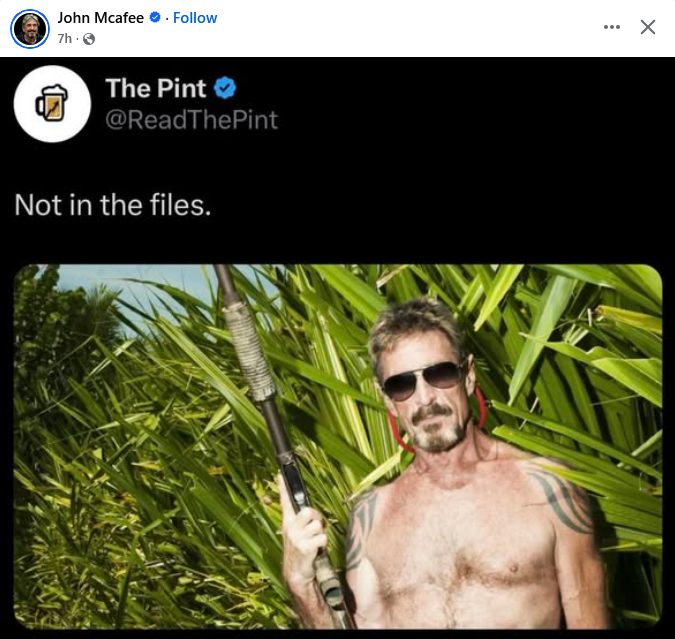
This image features a shirtless man holding a shotgun in lush green foliage, presenting a specific archetype often linked to rugged masculinity. Within queer post-structuralism, this meme deconstructs binary identity by first establishing a rigid "male file" (the shirtless guy with the gun) and then immediately dissolving it with the text "Not in the files." This suggests that the boundaries between social norms and gender roles are not fixed truths but fluid constructs, allowing for a subversion of traditional scripts through humor.
detailed-analysis (gemma3_27b-it-q8_0)
Okay, let's break down this meme of John McAfee (a controversial figure known for his software, eccentric lifestyle, and legal troubles) through the lens of Queer Post-Structuralism. This will be a complex analysis, as the image is loaded with potential meanings. I'll focus on sections that most powerfully apply, while acknowledging where certain approaches are less impactful here. It's important to remember that Queer Post-Structuralism isn't about finding a single "correct" reading, but about destabilizing fixed meanings.
Important Note: I'm interpreting this meme through the lens of academic theory. McAfee's real-life actions and the damage he caused are separate ethical considerations.
1. Visual Description
The image presents a bare-chested John McAfee, standing amidst dense, tropical foliage. He's wearing sunglasses and sports several prominent tattoos. He's holding a long-barreled firearm. The overall aesthetic is deliberately "rough" – a slightly grainy photograph that evokes a sense of being "off the grid," or a deliberate performance of masculinity. The composition is striking – the verdant green of the plants contrasts with McAfee’s pale skin and the dark gun, creating a visual tension. The "Not in the files" caption is crucial, suggesting evasion, a disappearance, or an attempt to operate outside systems of control. The image relies heavily on established tropes and signifiers (masculinity, wealth, danger, freedom, paranoia).
2. Foucauldian Genealogical Discourse Analysis
This is where the analysis gets particularly rich. Michel Foucault’s work on power/knowledge, discourse, and genealogy is highly relevant. Here's how:
- Discipline and Panopticism: The phrase “Not in the files” is a direct challenge to systems of documentation and control, a key theme in Foucault’s Discipline and Punish. Files are the mechanism by which institutions (law enforcement, government, etc.) exercise power. To be "not in the files" is to attempt to evade the Panoptic gaze—to exist outside the surveillance apparatus. McAfee, in life and in this image, seems to be actively trying to escape categorization, a system which is how power is wielded.
- Genealogy of Masculinity: The image powerfully evokes a specific genealogy of masculinity: rugged individualism, frontier spirit, gun ownership, and an apparent rejection of societal norms. This masculinity isn't natural; it's constructed through historical discourses. The tattoos, the bare chest, the gun – these are signifiers that map onto a particular lineage of power and dominance, often linked to colonial exploration and anti-establishment ethos.
- Power/Knowledge & The “Madman”/Outlaw: McAfee's image can be seen as embodying the figure of the “madman” or “outlaw” – someone existing outside the established order. Foucault argued that these figures are often seen as simultaneously dangerous and possessing a certain truth because they operate outside the normal structures of discourse. McAfee’s public persona and eventual legal troubles feed into this narrative. He's framed as a destabilizing force.
3. Postmodernism
The meme embodies several key aspects of Postmodernism:
- Simulacra and Simulation: McAfee is a simulation of a character—a self-made persona. The image presents a carefully constructed image (the pose, the setting, the attire) which is a copy of a copy, increasingly divorced from any "original" reality. The “Not in the files” caption reinforces this, suggesting a fabricated or obscured reality. He performs a rebellious identity.
- Deconstruction of Grand Narratives: Postmodernism questions overarching narratives (e.g., the American Dream, progress, rationality). McAfee's story actively disrupts such narratives. He built a tech empire, then seemingly rejected the values associated with it, embracing a life of perceived freedom (and legal chaos).
- Irony & Parody: The meme has a strong sense of irony. McAfee, a tech entrepreneur, attempting to portray a rugged, off-the-grid existence is inherently self-parodying. The caption highlights the absurdity of his efforts.
4. Queer Feminist Intersectional Analysis
This is where things get complex and perhaps less directly applicable, but still potentially insightful:
- Subversion of Gender Norms: While McAfee embodies hyper-masculinity, the image also presents this masculinity as performative and somewhat unstable. The self-conscious posing and the deliberate “eccentricity” can be read as a queering of traditional masculine norms. It’s a caricature of masculinity, making it ripe for deconstruction.
- Intersectional Power Dynamics: The image's power dynamics are rooted in the intersection of several factors: wealth (McAfee’s fortune), race (McAfee’s whiteness, particularly in a tropical setting that historically evokes colonial power), gender (his performance of masculinity), and (potentially) national identity (given his anti-government stance). The gun represents the capacity to exert control.
- The Gaze and Objectification: The image itself participates in the objectification of McAfee’s body. He is presented for viewing, inviting a gaze that analyzes his performance of masculinity. While he attempts to control his image, he is still subject to the scrutiny of the audience.
Overall Interpretation (within a Queer Post-Structuralist Framework):
The meme isn’t about McAfee as a person, but about the signifiers he embodies and the discourses they activate. It uses a very specific visual language to destabilize power structures, challenge conventional norms, and highlight the constructed nature of identity. The caption “Not in the files” acts as a destabilizing force, disrupting the mechanisms of control and suggesting a resistance – even if that resistance is ultimately a performance. The image isn't making a statement about McAfee; it is a statement about the ways in which power, identity, and reality are constructed and contested. It’s a postmodern, queerly inflected critique of dominant ideologies.
Disclaimer: This analysis is based on theoretical frameworks and is open to interpretation. It's intended as a demonstration of how these concepts can be applied to understanding a contemporary meme.
simple-description (llama3.2-vision_11b)
The meme is a screenshot of a tweet from The Pint, a beer-focused Twitter account. The tweet features a photo of a shirtless, bearded man holding a spear-like object, with the text "Not in the files." The image is likely a humorous reference to a popular internet meme or meme culture.