First Seen
2025-11-01T02:00:52.192479+00:00
simple-description (qwen3.5_2b-q8_0)
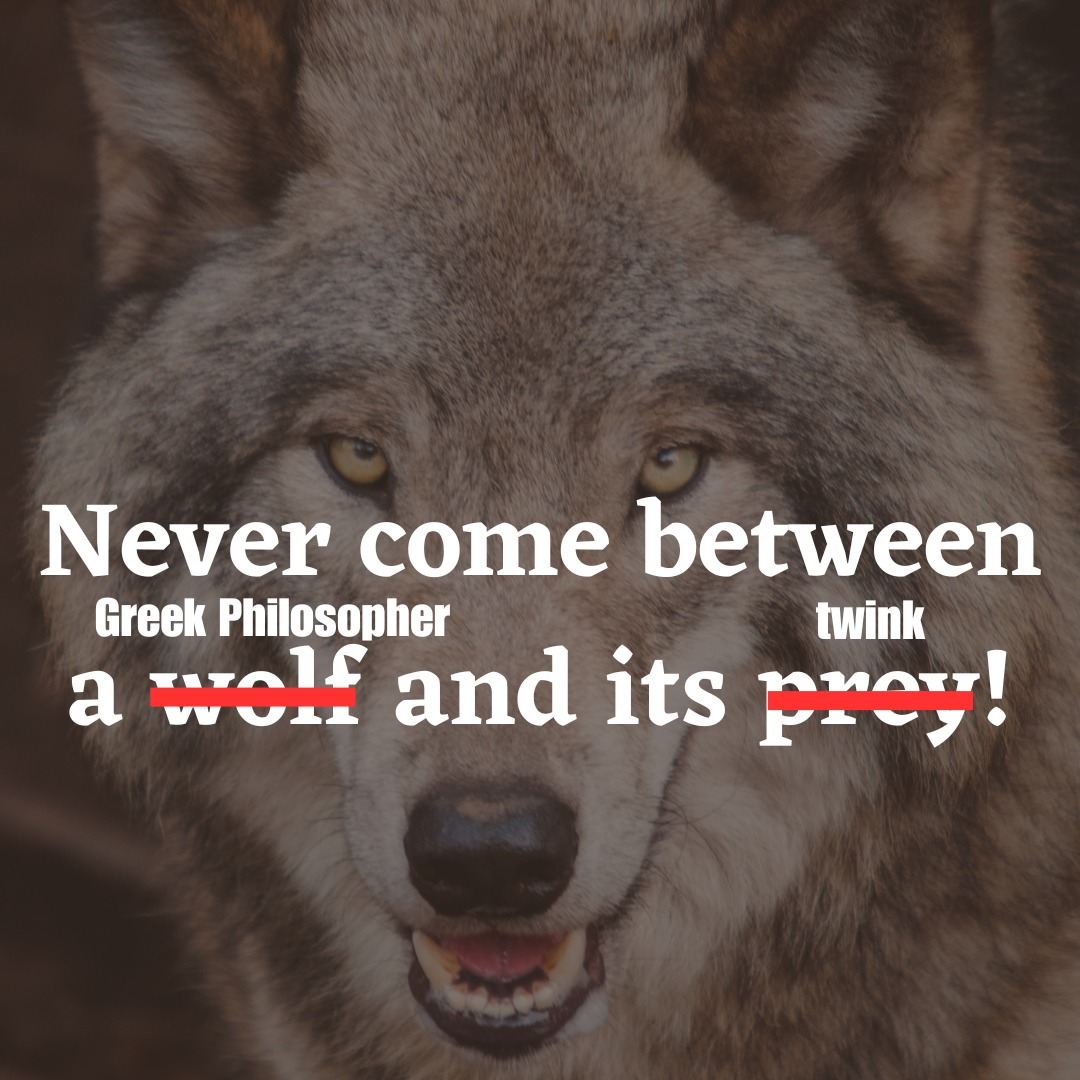
From a queer-post-structuralist perspective, this meme operates as a playful deconstruction of rigid social categorization. It subverts the traditional "man/wife" binary often found in internet riddles by replacing it with fluid concepts—human philosophy ("Greek Philosopher"), animal biology ("wolf"), and slang anatomy ("twink")—presenting them without a clear hierarchy or fixed meaning. The visual arrangement mimics an answer key, suggesting that these terms define the context of the image while simultaneously highlighting how identity is difficult to pin down to a single binary box.
detailed-analysis (gemma3_27b-it-q8_0)
Here's an analysis of the meme through the lens of Queer-Post-Structuralism, broken down into relevant sections.
Visual Description
The image features a close-up of a wolf, snarling and exhibiting its teeth. Its eyes are intensely focused, suggesting aggression. Overlaid on the image is text: "Never come between a wolf and its prey!" with the words "wolf" and "prey" visually crossed out and replaced with "Greek Philosopher" and "twink" respectively. The additional text "twiink" appears above "prey". The composition intends to create a jarring and humorous juxtaposition.
Foucauldian Genealogical Discourse Analysis
Michel Foucault’s work on power and discourse is vital to understanding this meme. The "wolf and prey" dynamic isn't just a literal animalistic scenario, but a metaphor deeply embedded in discourses of power. Traditionally, the wolf (as a powerful predator) represents authority, desire, and dominance, while the prey signifies vulnerability, passivity, and objectification.
The meme disrupts this discourse. It replaces the animal roles with "Greek Philosopher" and "twink." This act of substitution immediately destabilizes conventional power dynamics. The "Greek Philosopher" traditionally represents patriarchal, intellectual authority—a figure historically associated with control and knowledge. The "twink," in queer slang, often represents youth, beauty, and (historically) a degree of vulnerability.
However, the choice of "twink" is particularly potent. Contemporary queer culture has reclaimed and even empowered the “twink” aesthetic. It's a figure often associated with agency and a playful manipulation of desire. Therefore, the meme doesn't simply flip the power dynamic but questions the very terms of power and vulnerability. The addition of "twiink" (a common misspelling online, signaling ironic or camp engagement) further demonstrates this disruption, pointing to the constructed nature of desire and identity.
Foucauldian genealogy shows how this meme challenges the historical construction of power relationships and the discourses that uphold them. It pulls apart the assumed naturalness of these dynamics and reveals them as culturally produced.
Postmodernism
Postmodernism, with its rejection of grand narratives and essential truths, plays a key role here. The meme operates on the level of pastiche – a playful, ironic imitation of a common idiom ("between a wolf and its prey"). It doesn’t offer a serious argument but instead deconstructs the phrase, highlighting its inherent absurdity when applied to this new context.
The meme’s humour arises from the juxtaposition of high culture (“Greek Philosopher”) with queer subculture (“twink”). This collapsing of categories disrupts expectations and exposes the artificiality of cultural hierarchies. The meme doesn’t propose a "correct" reading of power or desire; it revels in the ambiguity and instability of meaning.
The ironic tone and playful manipulation of language are hallmarks of postmodern sensibility. It's a rejection of seriousness and an embrace of the fragmented, contradictory nature of experience.
Queer Feminist Intersectional Analysis
From a Queer Feminist intersectional perspective, the meme touches on issues of power, desire, and the social construction of both masculinity and sexuality. The "Greek Philosopher" represents a historically dominant figure—often white, male, and intellectually privileged. This figure has traditionally held power over bodies and has been the subject of desire. The "twink" represents a queer subject, potentially embodying marginalization based on sexuality and age.
The meme, by framing the relationship as a possessive "between…and its prey," highlights the dangers of predatory dynamics within queer communities, particularly those involving power imbalances (age, status, intellectual authority). This is a relevant critique considering the ongoing discussions within queer circles about safety, consent, and boundaries.
The meme’s disruption of the wolf/prey analogy subverts the idea of a “natural” order of desire. It suggests that desire is not inherent but is socially constructed and mediated through power relations. The "twiink" also gestures to the performance of identity and the playful subversion of conventional norms, a key theme in queer feminist thought.
In essence, the meme, viewed through the lens of Queer-Post-Structuralism, is a witty and complex statement about the fluidity of power, the constructedness of desire, and the ongoing deconstruction of traditional hierarchies. It uses irony and juxtaposition to challenge assumptions and invite critical reflection on how power operates within cultural discourses.
simple-description (llama3.2-vision_11b)
The meme is a playful take on the concept of post-structuralism, a philosophical movement that challenges traditional notions of meaning and reality. The image features a photo of a wolf, with the text "Never come between a wolf and its prey" - a phrase that is intentionally misspelled to sound like "never come between a wolf and its prey". This is a reference to a famous phrase from the philosopher Jean-Paul Sartel's book "The Sartel” and is a play on the idea of a wolf and its prey.