First Seen
2025-05-29T06:33:35.058570+00:00
detailed-analysis (gemma3_27b-it-q8_0)
Here's an analysis of the meme, viewed through the lens of Queer Post-Structuralism, broken down into relevant sections.
Visual Description
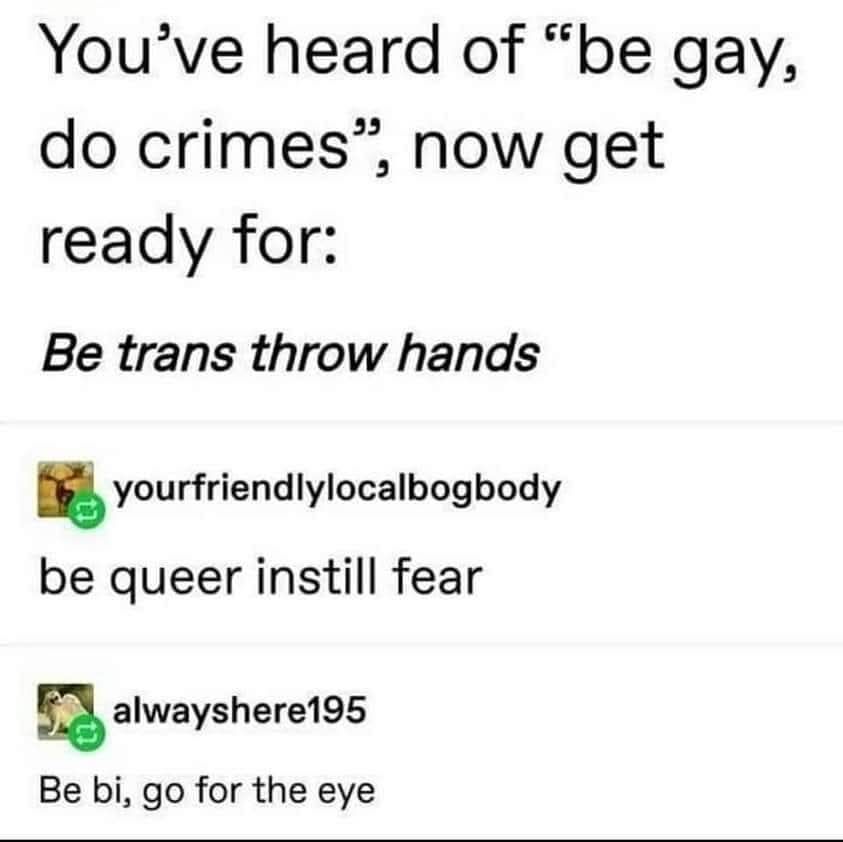
The meme is a text-based image, appearing to be a screenshot of a series of online posts (likely from Twitter). It begins with the phrase "You've heard of ‘be gay, do crimes’... now get ready for," setting up a playful, subversive structure. Beneath this introductory line, three further phrases are presented: “Be trans throw hands,” “Be queer instill fear,” and “Be bi go for the eye.” Each phrase is accompanied by a small profile picture. The use of a playful, list-like format suggests a shift or expansion in perceived queer behaviors.
Foucauldian Genealogical Discourse Analysis
This meme is deeply rooted in Foucauldian concepts, particularly regarding discourse, power, and the construction of ‘the normal’. Michel Foucault explored how power isn’t just top-down, but productive. It creates categories and definitions through discourse.
- Discipline & Normalization: The initial phrase, “be gay, do crimes,” already operates as a subversive reclaiming of a historical discourse. Historically, homosexuality was pathologized and criminalized, associating queerness with deviance and law-breaking. The phrase ironically embraces this association, flipping it into a point of pride.
- Genealogy & Disrupting Origins: The meme’s structure disrupts the presumed “origin” or defining characteristic of each identity. It moves beyond a singular association (gay/crime) to multiple, often exaggerated, actions associated with different queer identities (trans/physical confrontation, queer/intimidating presence, bi/strategic manipulation). It's not suggesting these are inherent to the identities, but rather playfully exploring the tropes and expectations projected onto them.
- Power/Knowledge: The meme highlights how what we "know" about queer identities (and the behaviors associated with them) isn’t neutral but deeply entangled with power dynamics. It is a play on the expectations people have of those who identify within the queer community.
Postmodernism
The meme embodies several postmodern characteristics:
- Playfulness & Irony: The tone is deliberately ironic and playful, challenging the seriousness and essentialism often associated with identity politics. It doesn’t offer a “truth” about what it means to be these things, but rather plays with the possibilities.
- Deconstruction: The meme implicitly deconstructs the idea that queer identities are monolithic or easily definable. It rejects the notion of a fixed “queer essence” and instead presents a fluid, performative interpretation.
- Meta-Commentary: The meme comments on itself and the very idea of categorization, referencing a prior meme (“be gay, do crimes”) and expanding the paradigm. It’s a commentary about how we talk about queer identities.
- Simulacra & Simulation: The phrases don't represent reality, but are rather a representation of representations, a simulacrum. They play with stereotypes and expectations.
Queer Feminist Intersectional Analysis
The meme touches upon intersectionality in its acknowledgement of differences within the queer community. While “be gay, do crimes” is a broad statement, the meme then specifies distinct behaviors linked to trans, bi, and broader queer identities.
- Reclaiming Agency through Exaggeration: The hyperbolic nature of the phrases (“instill fear,” “throw hands,” “go for the eye”) can be interpreted as a reclaiming of agency. Historically, queer individuals, particularly trans women of color, have been subjected to violence and powerlessness. The exaggeration is a way to disrupt that power dynamic.
- Performativity & Identity: Drawing on Judith Butler’s concept of performativity, the meme suggests that queer identities aren’t innate but are constructed through repeated performances and acts. The phrases suggest these performances aren’t necessarily “authentic” to an inner identity, but are rather a playful manipulation of expectations.
In summary: This meme functions as a postmodern, queer critique of identity and power. It acknowledges the historical oppression of queer individuals, disrupts normative expectations, and embraces playful subversion. It’s not about defining what it means to be queer, but about exposing the constructed nature of those meanings and reclaiming agency through performance and ironic exaggeration.
simple-description (llama3.2-vision_11b)
The meme is a humorous take on the phrase "be the change you want to see in the world" by replacing it with a queer-themed phrase. The text reads: "You've heard of 'be gay, do crimes', now get ready for: 'be trans, throw hands'". This meme is a playful subversion of the original phrase, replacing the phrase "be gay, do crimes" with a queer-themed phrase, implying that the original phrase is now being replaced with a queer-themed phrase.
detailed-analysis (gemma3-27b-vision)
Okay, here's an analysis of the image, broken down into the requested sections. It's a complex piece that touches on many theoretical areas, so it's a detailed response.
Visual Description
The image is a screenshot of a social media post, likely from Twitter/X, given the usernames and format. The post is text-based, utilizing a humorous and provocative call to action. The initial line references the internet meme "Be gay, do crimes," and then transitions to a series of similar phrases. Each line pairs a queer/LGBTQ+ identity marker ("trans," "queer," "bi") with a violent or aggressive action ("throw hands," "instill fear," "go for the eye"). Below the lines are two cartoon turtle head icons. The text is against a light green background. The overall aesthetic is intentionally edgy and aimed at a younger, internet-savvy audience.
---
Foucauldian Genealogical Discourse Analysis
Michel Foucault's work on discourse, power, and knowledge is extremely relevant here. This image isn't simply about literal violence; it's about how the association of queerness with deviance and criminality is constructed through historical discourse.
- Genealogy: The post draws upon a genealogy of associating queer bodies with moral failings and criminal behavior. The initial reference to "Be gay, do crimes" is a reclamation of a historically used accusation as a form of defiance. However, the expansion to other identities (trans, bi, queer) and actions reveals a pattern. It’s not just about acting out, it’s about the perception of queer people as inherently threatening or dangerous.
- Power/Knowledge: The image plays with the interplay of power and knowledge. For centuries, dominant discourses (legal, medical, religious) have constructed queerness as abnormal and therefore subject to control. This post attempts to subvert that power by re-appropriating the association with "crime" and even escalating it to suggest active aggression. It asks us to consider how our understanding of these terms are produced and maintained.
- Discipline and Biopower: While not overtly disciplinary, the image points to the historical ways queer bodies have been subjected to surveillance, regulation, and even violence in the name of social order. By presenting queer identities as inherently aggressive, the post implicates the structures that seek to control queer behavior.
---
Critical Theory
From a Critical Theory perspective, particularly drawing on the Frankfurt School, the image can be seen as a form of resistance against the “culture industry” and the normalization of oppressive power structures.
- Critique of Domination: The post directly challenges the dominant narratives that attempt to define and contain queer identities. It’s a refusal to be assimilated or normalized within a heteronormative system.
- Enlightenment Critique: Critical theorists like Horkheimer and Adorno critiqued the Enlightenment's promise of reason and progress. This image, while not explicitly philosophical, implicitly rejects the notion of a rational, universally applicable morality that condemns queer expression. It suggests that what is considered “crime” or “deviance” is often a matter of power and perspective.
- Negative Dialectics: The post doesn’t offer a positive vision of queer life. Instead, it revels in the disruptive and potentially dangerous aspects of queer identity. This aligns with Adorno’s concept of negative dialectics, which emphasizes the limitations of thought and the impossibility of complete reconciliation.
---
Queer Feminist Intersectional Analysis
This image is deeply embedded within queer feminist thought, particularly regarding the reclamation of agency, subversion of norms, and acknowledgement of intersectional oppressions.
- Reclamation and Subversion: The meme-like structure is a form of reclamation. It takes an initial offensive statement (“Be gay, do crimes”) and expands it, challenging the idea that queer people are inherently criminal or dangerous. However, the expansion to include aggressive actions is complex, as it potentially reinforces negative stereotypes.
- Performance of Identity: The image highlights the performance of queer identity, not as an internal essence, but as a constructed response to societal pressure. The aggressive actions ("throw hands," "instill fear") can be interpreted as a way of asserting power and challenging the forces that seek to marginalize queer people.
- Intersectionality: While not explicit, the image implicitly acknowledges the intersectional nature of oppression. Trans and bi identities, for example, are often subjected to unique forms of discrimination and violence. By including these identities in the post, the author acknowledges the complex web of power dynamics at play.
- Critique of Victimhood: It challenges the notion of the “passive victim.” By presenting queer identities as active agents capable of aggression, the post rejects the idea that queer people should simply accept their marginalization. However, this also raises ethical questions about the glorification of violence.
---
Postmodernism
Postmodern thought is also relevant, particularly regarding deconstruction, simulacra, and the questioning of grand narratives.
- Deconstruction: The image deconstructs the very idea of “normal” and “deviant.” By juxtaposing queer identities with violent actions, it challenges the assumed connection between morality and social order.
- Simulacra and Simulation: The meme-like format relies on the repetition of signs and symbols, creating a sense of hyperreality. The “crime” aspect isn’t necessarily about actual criminal behavior; it’s about the idea of crime and how it’s constructed through media and culture.
- Rejection of Grand Narratives: The image rejects any attempt to impose a universal morality or definition of “good” and “evil.” It embraces ambiguity and challenges the notion that there is a single, objective truth.
- Playfulness & Irony: Postmodernism often embraces irony and playfulness. The image uses humor to challenge authority and disrupt conventional thinking.
Important Note: While these theoretical frameworks can help us understand the complexities of the image, it’s important to remember that interpretations can vary. The image is provocative and open to multiple readings. The question of whether the glorification of violence is empowering or harmful remains a central point of debate.
simple-description (llama3.2-vision)
This meme is a humorous take on the popular phrase "be gay, do crime" and is now being modified to include the phrase "be gay, do crime, but also be trans and have a sense of humor about it." The meme is a lighthearted and playful way to poke fun at the idea of being a stereotypical "gay villain" and instead embracing being trans and having a sense of humor about it.