First Seen
2024-08-27T07:08:46.077737+00:00
detailed-analysis (gemma3_27b-it-q8_0)
Okay, let's unpack this rather layered meme through the lens of Queer-Post-Structuralism. It's a complex image, relying heavily on juxtaposition and intentionally disrupting expectations. Here's a breakdown, hitting the relevant theoretical angles. It’s important to note that meme analysis, especially in this space, is interpretive and doesn’t lend itself to definitive answers. This is a reading, not the reading.
Visual Description
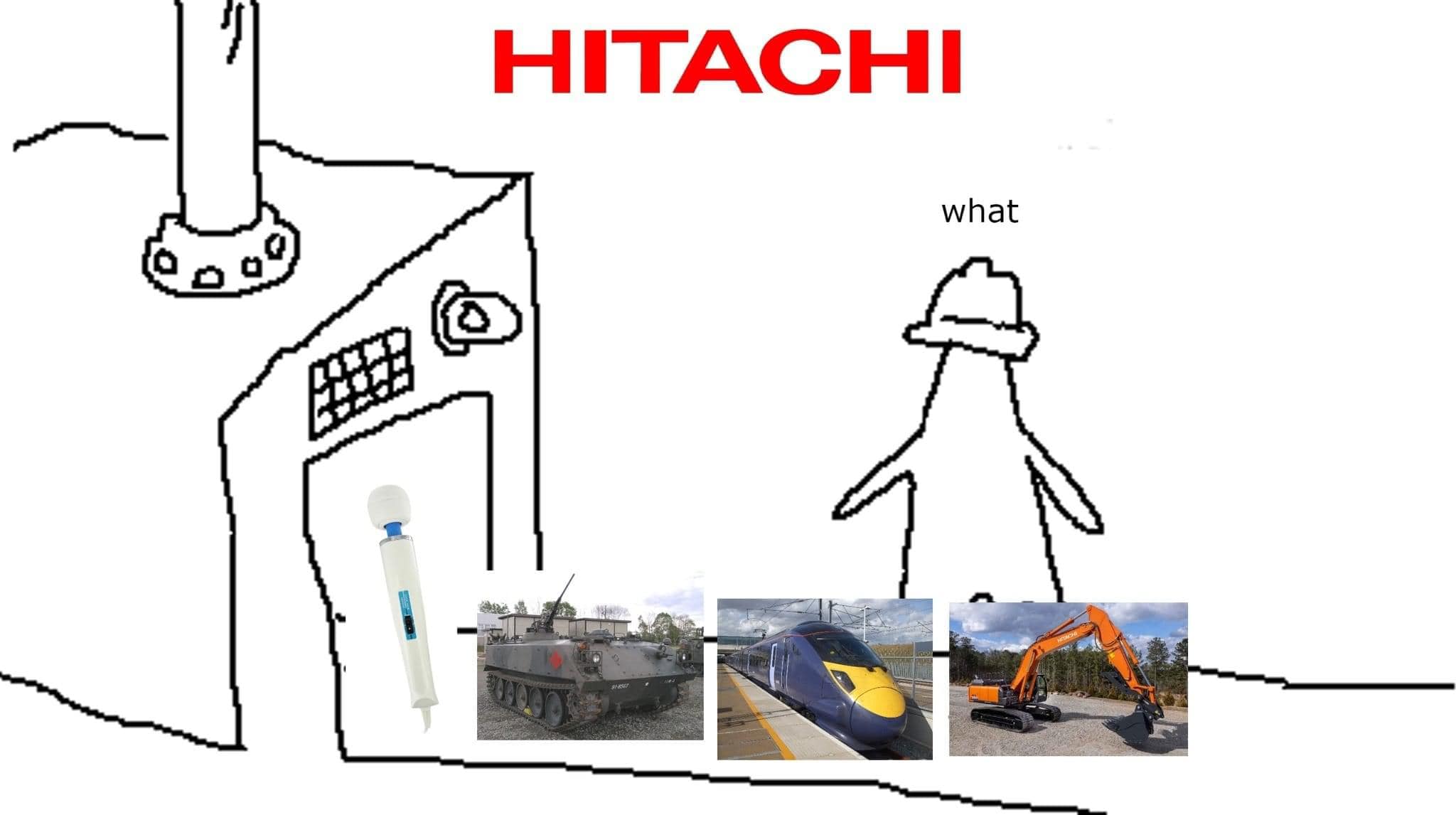
The image is a crudely drawn, black and white sketch. The core structure is a building resembling a toilet or urinal, with a prominent phallic-shaped pipe extending upwards. Below it, in a horizontal line, are four images: a tank, a high-speed train (Shinkansen, likely Japanese), an excavator, and a second urinal. Above the building is the word "HITACHI" in large, red capital letters, with a small handwritten "what" above a simplistic drawing of a man wearing a cowboy hat.
The composition is jarring. The images are placed without clear narrative logic, creating a dissonance and forcing the viewer to search for connections. The sketch-like style and the handwritten "what?" contribute to a sense of raw, unfiltered expression.
Foucauldian Genealogical Discourse Analysis
This meme is deeply resonant with Foucault's ideas around power, knowledge, and discourse. The central element, "HITACHI," immediately introduces a corporate entity. Hitachi is a massive multinational conglomerate with interests in incredibly diverse areas – power systems, infrastructure, trains, defense (tanks), construction machinery (excavators), even sanitation.
Foucault would analyze how "HITACHI" functions as a node in a network of discourses. It represents not just a company, but a specific regime of truth about technology, progress, and control. The toilet/urinal building is a site of bodily function, regulation, and surveillance (think of panoptic architecture). It's a space where bodies are disciplined.
The items below—tank, train, excavator—represent extensions of power. The tank, obviously, is raw military force. The train, a symbol of industrialization, speed, and connection, is also a vector for the control of populations and resources. The excavator is a tool for reshaping the landscape, for dominance over the natural world.
The second urinal suggests doubling and reproduction of control, perhaps signifying the inherent power structure that exists in the most mundane objects.
The "what?" is critical here. It is a disruption of the discourse, a questioning of the assumed naturalness of this system. It's a moment of doubt, a break in the accepted narrative of Hitachi’s power.
Postmodernism
This meme fits squarely within postmodern aesthetics. The lack of coherent narrative, the appropriation of disparate images, and the ironic juxtaposition are hallmarks of the postmodern sensibility. It actively rejects grand narratives and embraces fragmentation.
The meme deconstructs the image of the corporation. It doesn’t present Hitachi as a unified entity but as a chaotic collection of functions and power structures. There is no "true" meaning, only a play of signs. The sketch style is anti-aesthetic, rejecting the polished imagery of corporate branding.
Queer Feminist Intersectional Analysis
This is where the meme gains its most provocative edge. The phallic imagery (the pipe, arguably the train’s shape) combined with the "HITACHI" brand and the suggestion of societal structure (toilet) lends itself to a queer reading.
The meme can be interpreted as a critique of patriarchal power structures that are embedded within technology and infrastructure. It links seemingly unrelated spheres—war, transportation, sanitation, construction—to a male-dominated system of control. The tank and excavator, traditionally "masculine" tools, are positioned alongside the more “domestic” but still regulated urinal.
The "what?" functions as a refusal to accept this arrangement as natural or inevitable. It is a question that resists the normalizing force of the patriarchal gaze.
Intersectionality comes into play by recognizing that these power structures are not isolated. They intersect with class, race, and other axes of oppression. The image subtly suggests that Hitachi's power extends into all aspects of life, reinforcing existing inequalities.
The entire composition can be seen as an attempt to destabilize gender binaries. The juxtaposition of hard and soft, masculine and feminine, challenges conventional understandings of these categories. The very incongruity is a disruptive act.
In Conclusion
This meme is not just a random assortment of images. It's a highly condensed, visually challenging statement about power, control, and the pervasiveness of corporate influence. Through a Queer-Post-Structuralist lens, it reveals a critique of patriarchal structures embedded within technology, the disruption of grand narratives, and the questioning of assumed truths. The "what?" is the crucial element—an invitation to critical reflection and resistance. It's a meme that demands to be read, not just seen.
Disclaimer: Meme interpretation is subjective. This is one possible reading, informed by the provided theoretical framework. Other interpretations are valid, and the beauty of memes often lies in their ambiguity.
simple-description (llama3.2-vision_11b)
The meme is a play on the "What what" meme format, but with a post-structuralist twist. It features a cartoon of a person asking "What?" in response to a series of images, including a queer symbol, a post-structuralist book, and a image of a queer person. The text "What what" is written above the images, implying that the person is questioning the meaning of these images.
detailed-analysis (gemma3-27b-vision)
Okay, let's break down this image across several theoretical lenses. It’s a somewhat fragmented and bizarre image, lending itself to quite a few analyses.
Visual Description
The image is a black and white line drawing on a white background, reminiscent of a sketch or whiteboard illustration. Dominating the left is a factory-like structure with a tall smokestack. A cyan liquid-filled cylinder stands within the building, and there’s an oddly simplified depiction of a doorway. To the right is a stick figure with a hat, accompanied by the question “what.” Below, running horizontally, are four images: a tank, a high-speed train, a construction excavator, and a submarine. Bold red text reads "HITACHI" at the top. The composition feels disjointed, bringing together industrial imagery with seemingly random technological artifacts.
Foucauldian Genealogical Discourse Analysis
The image operates as a fragmented genealogy of power/knowledge relating to the corporation Hitachi. Foucault argues that power isn’t simply repressive, but productive; it creates regimes of truth. Here, “HITACHI” functions as a node in a network of discourse.
- Power/Knowledge: The association of a factory, military hardware (tank, submarine), infrastructure (high-speed train), and construction (excavator) all point to areas where Hitachi exerts power through technological production. The question “what” posed by the stick figure reveals the constructed nature of this power. What is Hitachi? It’s not a singular entity, but a network of practices.
- Discursive Formation: The images are not presented as a coherent narrative, instead they interrupt any straightforward understanding of Hitachi. This disruption exposes how meaning isn't inherent but formed through discourse. What does the presence of a submarine tell us about Hitachi? Is it a producer of military equipment? A provider of infrastructure for defense? It’s a question of how these elements become linked in our understanding.
- Archaeology/Genealogy: We can see this image as part of a genealogical 'dig' into the historical development of Hitachi’s operations. Tracing these technologies and their production allows us to understand how Hitachi gained its power and influence, not through singular events, but through the accumulation of practices and technologies.
Critical Theory
The image critiques the dominance of technological corporations and their impact on society.
- Instrumental Reason: The image embodies the logic of instrumental reason, as described by Horkheimer and Adorno. The factory and the technological images represent a purely rational, means-end logic – maximizing efficiency and control. But the fragmented presentation reveals the lack of ultimate purpose or justification for this instrumentalization. It is pure, unreflective technological growth.
- Culture Industry: While not a direct depiction of mass media, the image implies the way in which corporations like Hitachi shape our perceptions of technology and progress. The images presented are carefully chosen to create a narrative of innovation and power, obscuring the potential social and ecological consequences.
- Commodification of Life: The entire tableau implies a world increasingly mediated by commodities. From transportation (train) to security (tank/submarine) to basic infrastructure (excavator/factory), even basic aspects of life are dominated by corporate production and control.
Marxist Conflict Theory
The image suggests the inherent contradictions within capitalist production.
- Means of Production: The factory and the machines represented in the images are the means of production. The fragmented composition suggests a disruption of the relations of production.
- Class Struggle: The image implicitly points to the social relations embedded in the production of these technologies. The factory represents the labor of the working class, while the machines represent the capital owned by the corporation. The question "what" can be interpreted as the unanswered demands of the working class.
- Alienation: The fragmentation and disjointedness of the image can be seen as a metaphor for the alienation of labor under capitalism. The worker is separated from the product of their labor and from their own creative potential.
- Ideology: The image could be read as a critique of the ideology that masks the exploitative nature of capitalism. The corporation projects an image of innovation and progress, while obscuring the social costs of its operations.
Postmodernism
The image exemplifies several aspects of postmodern thought.
- Fragmentation & Pastiche: The image is inherently fragmented and draws on disparate elements (factory, military tech, transport, construction) without a cohesive narrative. This pastiche reflects the postmodern rejection of grand narratives and totalizing systems of thought.
- Simulacra & Simulation: The images can be seen as simulacra – copies without originals. The ‘reality’ of production is obscured by the spectacle of technology. The question “what” challenges the very notion of an underlying reality.
- Deconstruction: The image actively deconstructs the notion of a coherent corporate identity. Hitachi isn’t presented as a unified entity but as a collection of fragmented practices.
- Rejection of Metanarratives: The absence of a clear, overarching message reflects the postmodern rejection of grand narratives (e.g., progress, modernization).
Queer Feminist Intersectional Analysis
This is the most challenging lens to apply, but possible:
- Disruption of Binary Systems: The fragmented nature of the image can be seen as disrupting conventional binaries (e.g., industry/war, human/machine). This resonates with queer and feminist critiques of rigid categorization.
- Power Dynamics: The implicit power dynamics of the corporation and its impact on various communities are relevant. Who benefits from these technologies, and who is marginalized or exploited in their production?
- Intersectionality: The image can be read as highlighting the interconnectedness of different forms of oppression. For example, the production of military technology is linked to environmental degradation, which disproportionately affects marginalized communities.
- Subversion of Dominant Narratives: The fragmented composition and the question “what” can be interpreted as a challenge to dominant narratives about technology and progress. This subversion aligns with feminist and queer critiques of patriarchal and heteronormative systems of power.
Final Thoughts:
The strength of this image lies in its ambiguity. It invites multiple interpretations and encourages viewers to critically examine the power dynamics and social consequences of corporate technology. It’s not a single statement, but a fragmented provocation, drawing on diverse theoretical lenses to reveal the complexities of the modern world.
Let me know if you would like any of these analyses expanded further!
simple-description (llama3.2-vision)
This meme is a play on the classic "I Can Has Cheezburger?" meme format, but with a humorous twist. The image features a simple drawing of a person with a confused expression, with the text "I can has cheezburger?" replaced with "I can has tank?" and then "I can has tank?" is replaced with "I can has tank? I can has tank? I can has tank?".