First Seen
2024-07-30T19:53:37.459289+00:00
simple-description (llama3.2-vision_11b)
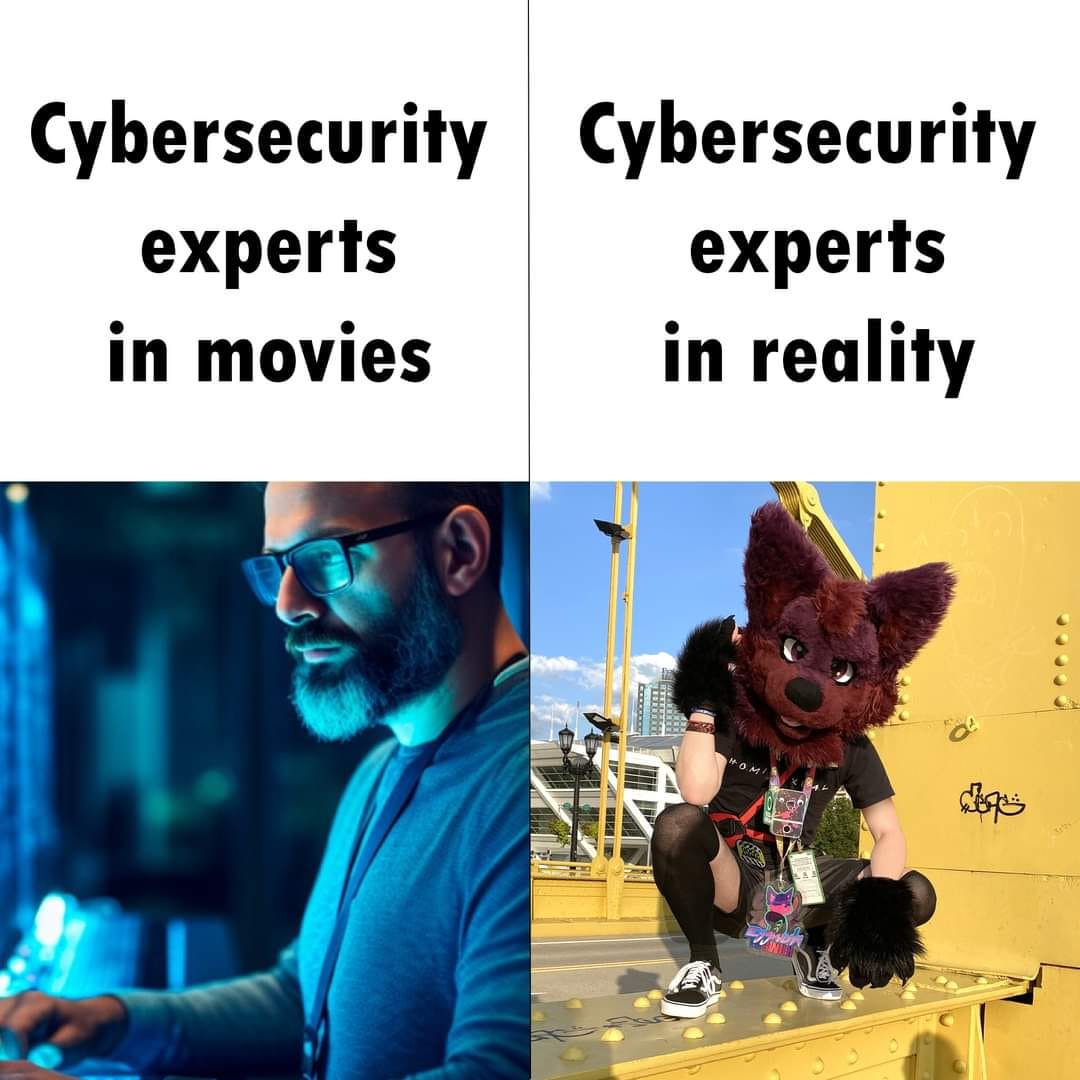
This meme juxtaposes the stereotypical, over-the-top portrayals of cybersecurity experts in movies with the reality of what cybersecurity experts actually do. The image on the left shows a stereotypical "cyber expert" from a movie, with a serious expression and a futuristic computer setup. The image on the right shows a real cybersecurity expert, who is actually a furry (a type of fan of anthropomorphic animals) and has a very different appearance and personality. The text above the images reads "Cybersecurity experts in movies" and "Cybersecurity experts in reality".
detailed-analysis (gemma3-27b-vision)
Okay, let's break down this meme comparing cinematic depictions of cybersecurity experts to their "reality" through the lens of several theoretical frameworks.
Visual Description
The meme is a side-by-side comparison.
- Left Panel (Movies): A dramatically lit close-up of a man, likely intending to portray a cybersecurity expert. He has a beard, is wearing sunglasses, and is intently focused on multiple computer screens emitting a blue glow. The lighting is very high contrast, creating a sense of mystery and intense concentration. The overall aesthetic is designed to be "cool" and "techy" – the archetype of the hacker/expert in Hollywood films.
- Right Panel (Reality): A person dressed in a full furry costume (a brown bear-like creature) is standing outdoors in a public space. They appear to be posing, sitting on a ledge, and are partially obscured by their costume. The background includes a cityscape. The lighting is natural and much less dramatic.
Foucauldian Genealogical Discourse Analysis
This meme is a compelling example of how power operates through discourse. Foucault argued that knowledge and power are inextricably linked, and that "truths" are constructed through discourse (language and systems of thought).
- The Cinematic Discourse: Hollywood films have constructed a specific discourse around cybersecurity experts. This discourse relies on visual tropes (dark lighting, multiple screens, intense facial expressions) to create a narrative of expertise. It portrays the expert as a solitary, often brooding, figure who is capable of penetrating complex systems. This discourse creates the expectation of what a cybersecurity professional looks like and how they behave.
- The Reality Discourse: The "reality" side subverts that expectation. It challenges the established visual language. The furry costume doesn’t fit the pre-existing cinematic "truth" about what an expert should look like. It exposes the arbitrariness of that visual language and suggests that expertise can exist outside of those conventional markers.
- Power & Normalization: The meme highlights how the cinematic discourse normalizes a particular image of expertise, potentially excluding or marginalizing individuals who do not conform to that image. It subtly asks: does competence hinge on appearance?
Critical Theory
From a critical theory perspective (drawing on figures like the Frankfurt School), this meme exemplifies the power of media to shape perceptions and reinforce cultural ideologies.
- Culture Industry: The "movies" side demonstrates the "culture industry’s" tendency to produce standardized and commodified images. The cinematic cybersecurity expert is a type – a recognizable character that reinforces certain values (e.g., individualism, technical prowess, secrecy).
- Ideology: The meme critiques the ideology embedded in that cinematic representation. It suggests that the image of the "lone wolf" hacker/expert obscures the collaborative and diverse nature of cybersecurity work. It implies that expertise is often performative and tied to superficial signifiers.
- Alienation: The meme indirectly touches on alienation. The cinematic expert is often portrayed as isolated and detached, potentially reflecting anxieties about technology and its impact on human connection.
Marxist Conflict Theory
While not a primary focus, a Marxist lens can offer some insights.
- Symbolic Capital: The cinematic portrayal of the expert represents a form of "symbolic capital" – prestige and recognition gained through the projection of technical mastery. This capital is often tied to a certain class aesthetic (the brooding, individualistic figure).
- Challenging the Hierarchy: The "reality" panel can be read as a subversive act, challenging the established power dynamics. It suggests that expertise is not necessarily linked to outward appearances or social status.
- Labor and Visibility: The contrast implicitly points to the often-invisible labor of cybersecurity professionals. The meme invites us to question whether appearance dictates how we perceive the value of this work.
Postmodernism
The meme embodies key tenets of postmodernism:
- Deconstruction: It deconstructs the established image of the cybersecurity expert. By juxtaposing the cinematic trope with a "real" example, it exposes the constructed nature of that image.
- Irony & Parody: The meme is inherently ironic and parodic. It playfully mocks the exaggerated and often unrealistic portrayal of cybersecurity in popular culture.
- Hyperreality: The cinematic image has arguably become more real than "reality" itself. It’s a hyperreality – a simulation that shapes our expectations. The meme points to the dominance of images in contemporary culture.
- Blurring of Boundaries: It blurs the boundaries between "authentic" expertise and its representation. The meme suggests that performance and image are as important as actual skills.
Queer Feminist Intersectional Analysis
This is where the meme gets more subtle but potentially insightful.
- Challenging Normative Representations: The furry costume, while not inherently queer or feminist, disrupts the normative representation of a "professional." It challenges expectations of how a person should look and behave in a traditionally technical field. It asks us to consider who is often excluded from these spaces.
- Visibility & Marginalization: The person in the costume is making themselves visible in a way that defies conventional expectations. This act can be seen as a form of resistance against dominant norms. It raises questions about the ways in which marginalized groups are often rendered invisible in STEM fields.
- Performance & Identity: The costume is a form of performance – a deliberate construction of identity. This can be interpreted through a queer theoretical lens, as a rejection of fixed categories and an embrace of fluidity.
- Intersectionality: The meme implicitly raises questions about how race, gender, and other social categories intersect with perceptions of expertise. The visual contrast may invite consideration of who gets to be seen as an expert and who is relegated to the margins.
In essence, this seemingly simple meme offers a surprisingly rich layer of theoretical analysis. It is a playful critique of media representation, a commentary on power dynamics, and a subtle challenge to conventional norms.
simple-description (llama3.2-vision)
This meme is a humorous comparison between the way cybersecurity experts are often portrayed in movies and the reality of their work. The image shows a calm, focused man typing away on a computer on the left, with the caption "Cybersecurity experts in movies". On the right, it shows a person in a furry suit, complete with a giant cat head, with the caption "Cybersecurity experts in reality".