First Seen
2024-05-01T06:16:13.500600+00:00
simple-description (llama3.2-vision_11b)
The meme is a photo of a cat looking at its phone with a caption that reads: "I'm not lazy, I'm just on energy-saving mode. I'm not ignoring you, I'm just on do-not-disturb mode. I'm not avoiding you, I'm just on pause. I'm not procrastinating, I'm just on... wait, no, I'm just on my phone." The meme is a humorous take on the common experience of being overwhelmed by the constant stream of notifications and social media updates, and the desire to simply take a break and recharge.
detailed-analysis (gemma3-27b-vision)
Okay, let's break down this meme through various theoretical lenses.
Visual Description
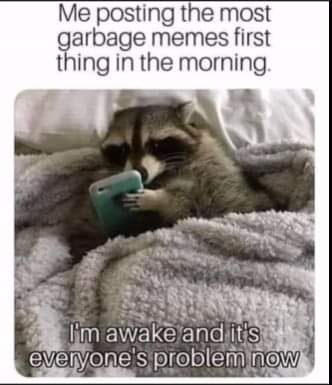
The meme features a photograph of a raccoon nestled snugly in a fluffy, white blanket. The raccoon is holding a smartphone up to its face, appearing to be using it. The raccoon’s expression is somewhat mischievous and concealed, but its eyes are visible as it gazes at the screen. The background is blurred, focusing attention on the raccoon and its comfortable, domestic setting. The text overlay reads: "Me posting the most garbage memes first thing in the morning." Underneath that, a further text proclaims: "I'm awake and it's everyone's problem now." The overall aesthetic suggests a relatable, humorous scenario highlighting the early morning habit of immediately scrolling through and sharing low-quality internet content.
Foucauldian Genealogical Discourse Analysis
This meme subtly engages with the genealogy of ‘sharing’ and ‘content creation’ within a digital context. Foucault’s work asks us to trace the historical shifts in how we understand concepts like ‘sharing’ and ‘information’.
- Power/Knowledge: The raccoon's act of posting "garbage memes" isn't just a personal habit; it's a participation in a system of online discourse. This discourse is shaped by algorithms, platform rules, and the expectations of online communities. The raccoon, as a stand-in for the user, wields a tiny amount of "power" through contribution. However, that contribution is already shaped and limited by the platform's structure. The joke is in the “garbage” quality—the raccoon doesn’t need to create high-quality, thoughtful content to participate; it simply contributes to the noise.
- Disciplinary Power: The statement “I’m awake and it’s everyone’s problem now” implicitly acknowledges the expectation that we always have access to content, and the expectation that one must contribute to this continuous cycle. The meme highlights the disciplinary power of social media—the feeling of obligation to remain connected and "share" even at the very start of the day.
- Genealogy of Memes: One could trace the historical shift in how "humor" or "sharing" operated pre-internet, to the era of early forums, to the current era of algorithmically-driven, instantly-shareable meme culture. The "garbage" quality indicates a flattening of standards, a shift from carefully constructed jokes to readily available, easily digestible, and quickly discarded content.
Critical Theory
From a Critical Theory perspective, the meme critiques the commodification of attention and the normalization of superficiality in the digital age.
- Culture Industry: The "garbage memes" can be seen as a product of the "culture industry" (Adorno & Horkheimer). The meme isn't about intrinsic artistic value; it's about generating clicks, likes, and shares—participation in a system designed to distract and pacify.
- Alienation: The raccoon, and by extension the user, seems to find a temporary sense of comfort or validation in this act of posting—but the quality of the content is inherently meaningless. This could be seen as a form of alienation—a disconnection from genuine creativity and meaningful expression. The raccoon’s comfort is in the act of posting, rather than in the content itself.
- The Spectacle: (Debord) The meme can be interpreted as a critique of the "spectacle"—a society where appearances and images dominate reality. The raccoon is engaged in a performative act of consumption and dissemination of “garbage,” contributing to the ongoing spectacle of online life.
Postmodernism
The meme embodies several key tenets of postmodern thought.
- Irony and Pastiche: The self-awareness implied by the phrase "garbage memes" acknowledges the inherent absurdity of much of online content. The raccoon's comfortable indulgence in this “garbage” is ironic.
- Simulacra and Simulation: (Baudrillard) The meme suggests a blurring between reality and representation. The raccoon’s enjoyment of the content is less about the content itself, and more about the experience of scrolling and sharing. The ‘garbage’ quality reinforces the notion that we are increasingly consuming simulations, copies without originals.
- Fragmentation and Deconstruction: The meme’s structure—a seemingly random image paired with a deliberately nonsensical statement—reflects the fragmented nature of online information and the deconstruction of traditional meaning.
Let me know if you’d like me to elaborate on any of these analyses, or explore other theoretical frameworks!
simple-description (llama3.2-vision)
This meme features a picture of a cat sitting on a couch, looking bored and unimpressed. The text above the image reads, "I'm posting the most garbage memes first thing in the morning" and below it says, "I'm awake and it's everyone's problem now." The meme is likely a humorous take on the idea of a cat being a grumpy morning creature.
tesseract-ocr
Me posting the most greed memes first thing in the morning j ~Z * x va Ne ee, ee * tT oe oa <= Er Gait TimEMehoemtelitis. A Pay o Par evenyone s/problem|nouy