First Seen
2024-01-15T03:24:28+00:00
simple-description (llama3.2-vision_11b)
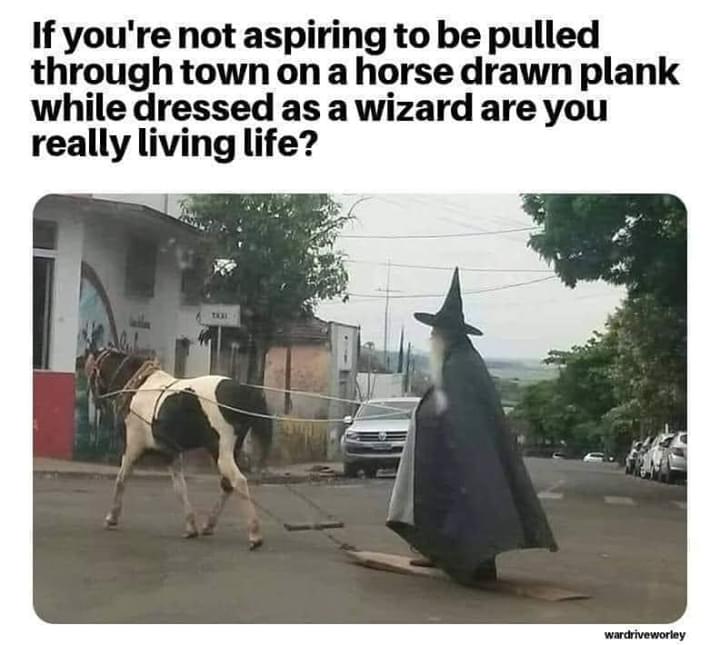
The meme is a humorous commentary on the idea that if you're not living your life in a way that's unconventional and challenging societal norms, you're not truly living. The image depicts a person dressed as a wizard, but instead of riding a horse, they're riding a horse-drawn plow, implying a mundane and ordinary life. The text reads "If you're not living on a horse-drawn plow, you're not living."
detailed-analysis (gemma3-27b-vision)
Okay, let's break down this image and its accompanying text through various theoretical lenses. It's a bizarre image, so the analysis will be correspondingly... involved.
Visual Description
The image depicts a peculiar scene: a light-colored horse wearing a harness, pulling a plank along a paved road. On the plank stands a person fully dressed as a stereotypical wizard—a long, dark robe and a pointed hat obscuring their face. The scene appears to be taking place in a modest urban or suburban setting, possibly in Latin America, judging by the architecture and the writing on the signs. A white car and other vehicles are visible in the background. The image is captioned with the rhetorical question: "If you're not aspiring to be pulled through town on a plank by a horse drawn plank while dressed as a wizard are you really living life?".
Foucauldian Genealogical Discourse Analysis
This image provides rich material for a Foucauldian analysis. The act of being "pulled through town on a plank" immediately conjures historical and cultural associations with punishment, humiliation, and public spectacle. The plank itself is a tool of public shaming and discipline, historically used to parade offenders through communities.
Foucault's concepts of power/knowledge are key here. The wizard, while seemingly fantastical, is being subjected to a visible, performative act of discipline. This discipline isn't necessarily about righting a wrong, but about reinforcing social norms and power structures. The act is productive of those norms by dramatically illustrating the consequences of deviating from them (or at least appearing to).
The humor of the image comes from the absurdity of applying this medieval form of punishment to someone in a wizard costume. This highlights the contingency of power: how seemingly natural or inevitable forms of discipline are actually constructed through historical and cultural practices. The image asks us to question what constitutes "normal" behavior and punishment in our own society. The question is a rhetorical one, challenging us to think about the forms of discipline that structure our lives.
Critical Theory
From a critical theory perspective (drawing on the Frankfurt School), this image can be seen as a commentary on the spectacle of modern life. The wizard being pulled through town is a highly visible event, designed to attract attention. This speaks to Debord's concept of the Society of the Spectacle, where images and performances replace genuine social interaction.
The image could be interpreted as a critique of the performative aspects of identity and the increasing emphasis on visibility in contemporary culture. The wizard, while embodying a fantastical archetype, is forced to perform this spectacle for the amusement or scrutiny of others. This raises questions about the authenticity of identity and the pressures to conform to societal expectations.
The image also touches on themes of alienation. The wizard is separated from the mundane world around them, placed on a platform and paraded through the streets. This can be seen as a metaphor for the alienation experienced by individuals in modern capitalist societies.
Postmodernism
From a postmodern perspective, this image is wonderfully meta and ironic. The sheer absurdity of the situation is the point. It deconstructs traditional notions of purpose, meaning, and reality. The image challenges grand narratives and offers no clear answers or interpretations.
The wizard costume itself is a form of pastiche – a playful imitation of a pre-existing archetype. This reflects the postmodern emphasis on intertextuality and the blurring of boundaries between different cultural references.
The image embraces ambiguity and encourages multiple interpretations. There's no "correct" way to understand it; instead, the viewer is invited to construct their own meaning based on their own experiences and perspectives. This is a classic example of postmodern playfulness and the rejection of traditional authority.
Queer Feminist Intersectional Analysis
This image is surprisingly rich when examined through a queer-feminist intersectional lens. The act of public display and potential humiliation resonates with historical patterns of shaming and control imposed on marginalized groups, particularly women and LGBTQ+ individuals. The planking itself evokes historical examples of public punishments disproportionately inflicted on women accused of transgressing social norms.
The wizard costume, though seemingly neutral, can be read as a form of gender play and performance. The wizard, a traditionally male archetype, is being subjected to a humiliating public spectacle, which could be interpreted as a subversion of patriarchal power structures. The potential anonymity afforded by the costume allows for a temporary escape from the constraints of gendered expectations.
The image also highlights the spectacularization of bodies, particularly those deemed "other" or transgressive. The wizard is placed on display for the amusement of onlookers, which reinforces power dynamics and perpetuates the objectification of bodies. The intersectional aspect comes into play by recognizing that the experience of being subjected to public scrutiny and control is shaped by multiple factors, including gender, sexuality, race, and class.
Disclaimer: These analyses are based on interpretations of the image and its caption. There is no single "correct" way to interpret art, and other perspectives may be equally valid.
simple-description (llama3.2-vision)
The meme features a picture of a wizard riding a horse, but instead of a traditional horse, the horse is a large, white and black spotted cow. The cow is being ridden by a wizard, who is wearing a pointed hat and a long, flowing cloak. The text at the top of the image reads: "If you're not living on a horse drawn plow, you're not living."
tesseract-ocr
If you're not aspiring to be pulled through town ona horse drawn plank while dressed as a wizard are you really living life? I G ! il pn a @ , bic fh = a J ae