First Seen
2023-05-10T21:03:40+00:00
simple-description (llama3.2-vision_11b)
The meme is a screenshot of a quote from the book "The Queer Utopia" by José Esteban Muñoz, which challenges traditional notions of identity and community. The quote reads: "Queer is not about identity, it's about the politics of the body." The meme is using this quote to highlight the idea that "queer" is not just about individual identity, but about the ways in which people are perceived and treated by society.
detailed-analysis (gemma3-27b-vision)
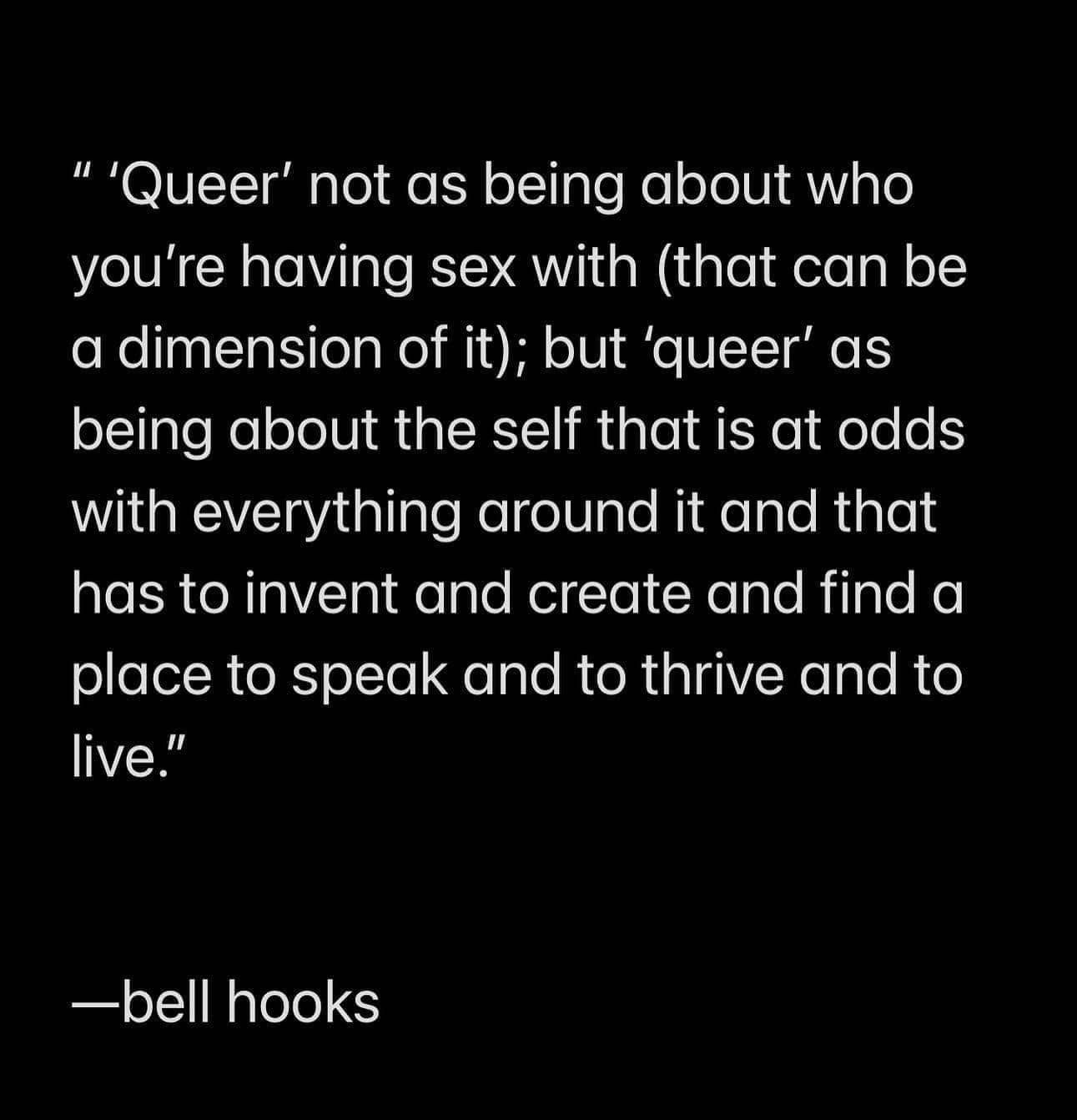
Okay, let's break down this quote by bell hooks, utilizing the requested theoretical frameworks where relevant.
Visual Description
The image is a black background with white text. It's a direct quote by bell hooks. The typography is simple and readable. The focus is entirely on the text, emphasizing its importance. The design suggests a direct statement intended to be contemplated.
Queer Feminist Intersectional Analysis
This quote is strongly rooted in queer feminist intersectional thought. Here’s how:
- Deconstructing "Queer": hooks is directly challenging the common, and often reductive, understanding of “queer” as solely tied to sexual practice. She’s insisting that it's not just "who you're having sex with". This is crucial because it breaks from the idea that queerness is simply about sexual orientation, moving it to a space of resistance, self-definition, and world-making.
- The "Self at Odds": The core of the quote centers on the "self at odds with everything around it." This speaks to the experience of marginalization across multiple axes of identity—race, gender, class, ability, and so on. Those who are positioned as 'other' within dominant societal structures experience a dissonance between their lived experience and the expectations, norms, and structures around them.
- Survival & Thriving: The need to “invent and create” a place to “speak, thrive, and live” is a powerful call for radical self-determination. This goes beyond simply tolerating existence. It's about actively creating spaces (physical, emotional, intellectual, political) where marginalized selves can flourish on their own terms. It requires challenging power structures, building community, and forging new ways of being. This resonates deeply with Black feminist thought, which emphasizes self-definition, liberation, and the importance of Black women’s voices.
- Intersectional Complexity: While the quote doesn't explicitly mention other dimensions of identity, the underlying sentiment strongly implies that this "self at odds" is shaped by the intersection of multiple forms of oppression. Someone who is queer, Black, and working-class, for example, will experience the world differently than someone who is queer and white.
Foucauldian Genealogical Discourse Analysis
This quote can be understood through a Foucauldian lens by examining the ways in which the concept of "queer" has been historically constructed and controlled through discourse.
- Deconstructing Norms: Foucault argued that power operates through discourse—the systems of knowledge, language, and practices that shape our understanding of the world. Traditionally, “queer” was a derogatory term used to marginalize and pathologize non-normative sexualities. This quote actively reclaims the term, disrupting its historical meaning and repositioning it as a source of empowerment.
- Power/Knowledge: The “self at odds” represents a challenge to the dominant power/knowledge structures that define what is "normal" and "acceptable." This self actively creates a counter-discourse, refusing to be defined by the norms imposed upon it.
- Genealogy: The act of "inventing and creating" a space is a genealogical project—a tracing of how the concept of "queer" has evolved and a deliberate effort to create a new, liberatory meaning.
Critical Theory
This statement aligns with core tenets of Critical Theory.
- Challenge to the Status Quo: The "self at odds" embodies a critique of the existing social order. It’s a refusal to passively accept the norms and values imposed by dominant ideology.
- Emancipation: The call to “invent and create” a space is inherently emancipatory. It’s about reclaiming agency, challenging power structures, and striving for a more just and equitable society.
- Subjectivity & Agency: The focus on the "self" and the act of creation emphasizes the importance of individual and collective subjectivity. It suggests that liberation begins with recognizing one’s own agency and actively working to shape one’s own destiny.
Marxist Conflict Theory
While not directly focused on class struggle, elements of Marxist thought can be discerned:
- Oppression & Resistance: The “self at odds” is a product of societal oppression—a result of power imbalances and the imposition of dominant ideologies. This aligns with the Marxist understanding of social conflict.
- Creating Alternative Spaces: The call to "invent and create" a space can be seen as a form of resistance—a refusal to accept the existing conditions and a commitment to building alternative structures that challenge the status quo. This echoes the Marxist call for revolutionary change.
Postmodernism
Postmodernism is less directly applicable, but can be seen in the:
- Deconstruction of Meaning: The quote deconstructs the traditional meaning of "queer", challenging fixed categories and stable definitions. This aligns with the postmodern emphasis on fluidity, ambiguity, and the rejection of grand narratives.
- Subjectivity & Identity: The focus on the "self" reflects the postmodern emphasis on subjectivity and the construction of identity. It suggests that identity is not a fixed essence but a fluid and contingent process.
Hopefully, this analysis helps you to understand the richness and complexity of this quote! Let me know if you'd like me to elaborate on any of these points.
simple-description (llama3.2-vision)
The meme is a screenshot of a tweet from author and activist Bell Hooks, where she responds to a question about her identity as a lesbian. The text reads: "I identify as lesbian. I am a lesbian. I am not a lesbian. I am a black lesbian. I am a black lesbian writer. I am a black lesbian writer. I am a lesbian. I am a lesbian." The meme is likely being used to poke fun at the complexity of identity labels and the challenges of self-identification.
tesseract-ocr
“‘Queer’ not as being about who you're having sex with (that can be a dimension of it); but ‘queer’ as being about the self that is at odds with everything around it and that has to invent and create and find a place to speak and to thrive and to live.” —bell hooks