First Seen
2023-05-10T20:59:59+00:00
simple-description (llama3.2-vision_11b)
This meme is from the "Queer" category, specifically addressing anxiety. It's a humorous take on a common anxiety-inducing experience, where someone is so anxious about something that they become paranoid and start to notice and react to things that others might not even notice or care about. The text "I see dead people" is a reference to the movie "The Sixth Sense," where the main character is haunted by the presence of ghosts.
detailed-analysis (gemma3-27b-vision)
Okay, let's break down this meme through the lenses you’ve provided. It's a surprisingly complex little image!
Visual Description
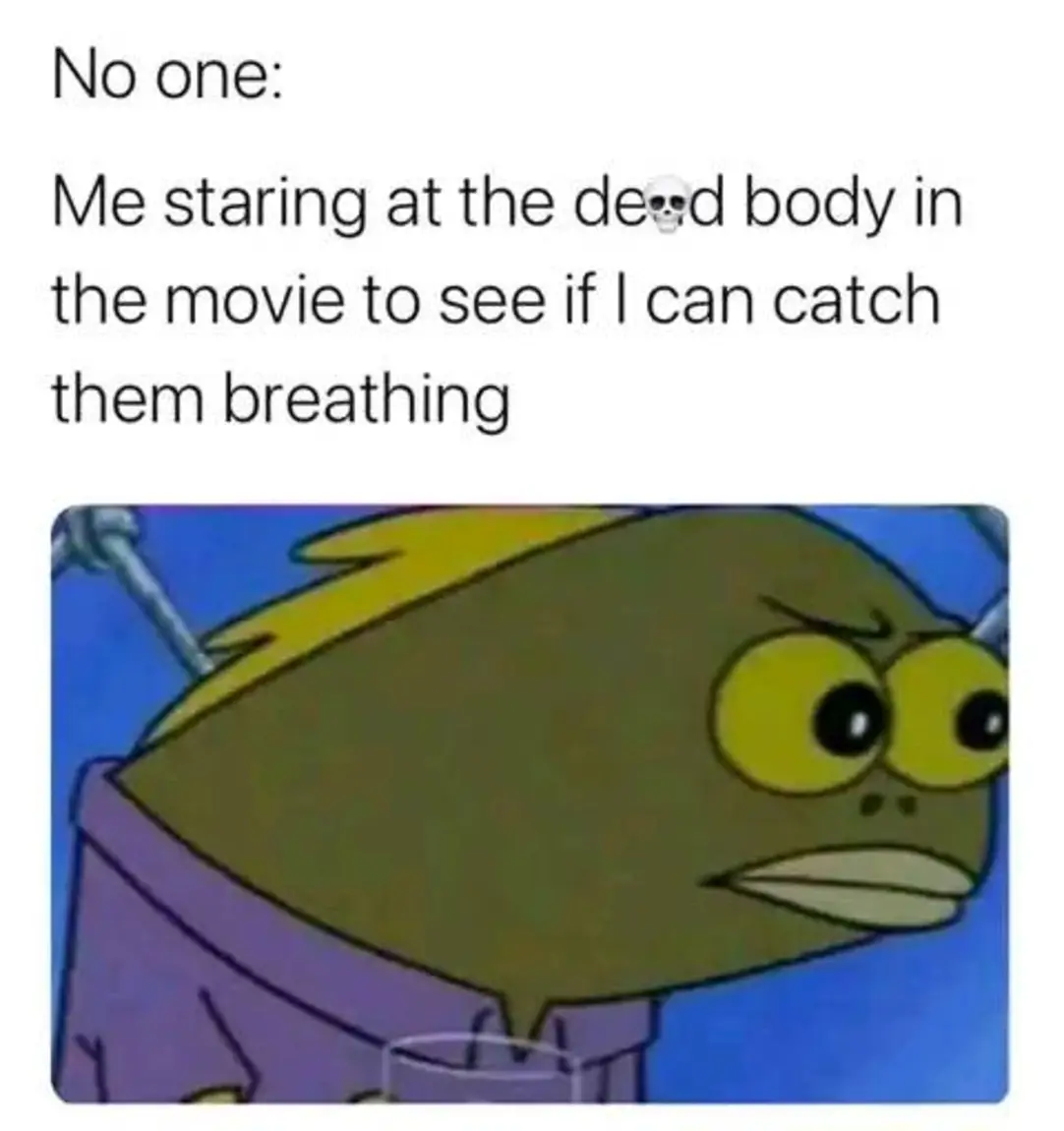
The image is a meme featuring a close-up screenshot of the character Patrick Star from the animated television series Spongebob Squarepants. Patrick is depicted with an intensely focused, almost manic expression. His eyes are wide and bugged out, and his mouth is slightly agape. The color palette is typical of the show – bright and saturated. The meme text above the image reads, "No one: Me staring at the de*d body in the movie to see if I can catch them breathing." The text is purposefully highlighting a relatable, slightly unsettling, and potentially morbid impulse.
Foucauldian Genealogical Discourse Analysis
This meme touches on interesting power dynamics related to the gaze and what constitutes “life” and “death”. Foucault's ideas about power being dispersed and enacted through discourse are relevant.
- The Medical Gaze: Historically, the medical field has defined and controlled the boundaries of life and death, establishing norms about what constitutes vital signs. The meme's impulse—staring for signs of breathing—is a direct echo of this medical gaze, but it’s divorced from any medical authority. It's an amateur, obsessive re-enactment of a defining power dynamic.
- The Construction of the Body: Foucault argues bodies are not simply biological entities but are produced through power relations. By fixating on the body, this meme implicitly acknowledges the body as a site of control and observation. The viewer’s obsessive scrutiny suggests a desire to control the narrative of life and death, even if that control is illusory.
- Disciplinary Power: The meme’s humor derives from a taboo – the uncomfortable desire to confirm death. This implies a disciplinary regime that requires us to accept death as final, but also a subconscious (and somewhat perverse) curiosity that challenges that norm.
Critical Theory
From a Critical Theory perspective, the meme exposes a dark undercurrent of anxiety surrounding mortality and the spectacle of death in media.
- The Spectacle: The meme highlights the desensitization to violence and death inherent in modern media consumption. We are bombarded with images of death, and this meme suggests a detached, almost compulsive need to actively observe and potentially deny it. This relates to the concept of the "spectacle" described by Guy Debord, where life is increasingly mediated by images, and our experiences are filtered through the lens of representation.
- Alienation: The meme implies a disconnect between the viewer and the body on screen. The obsessive scrutiny reflects a lack of genuine empathy or connection, and instead, a focus on a purely visual performance of death. This can be seen as a form of alienation, characteristic of capitalist modernity.
- The Anxiety of Control: The meme's humor stems from a desire to control the narrative of death—to prove it isn't real, or to witness a miraculous return. This speaks to a deeper anxiety about our lack of control over life, death, and the uncertainty of existence.
Postmodernism
The meme aligns with many postmodern characteristics.
- Irony and Parody: The meme’s humor is largely based on irony. It takes a taboo impulse (obsessively scrutinizing a dead body) and presents it as a universal, relatable experience. This playful subversion of expectations is typical of postmodern humor.
- The Breakdown of Grand Narratives: Postmodernism challenges traditional notions of truth, meaning, and certainty. The meme undermines any sense of reverence or solemnity surrounding death, presenting it as another spectacle to be consumed and analyzed.
- Hyperreality: The meme suggests a blurring of lines between reality and simulation. We are so accustomed to seeing death depicted on screen that we become detached from its true significance. The meme implies that the image of death has become more “real” than death itself—a hyperreal phenomenon.
Queer Feminist Intersectional Analysis
While this is a bit of a stretch, a Queer Feminist Intersectional reading can offer some interesting insights.
- Deconstructing the Gaze: Feminist film theory (Laura Mulvey) highlights the male gaze and how women are often objectified in media. The meme’s focused gaze (regardless of the body's gender) can be interpreted as a deconstruction of this power dynamic, exposing the inherent violence of the gaze itself.
- Mortality and Vulnerability: Feminists have long addressed the ways in which women’s bodies are subjected to social control and surveillance. The meme's focus on a vulnerable, lifeless body can be seen as a commentary on the precariousness of the body and the societal anxieties surrounding it.
- Intersectional Vulnerability: Depending on the movie, the body in question may highlight particular forms of vulnerability linked to race, class, or gender, adding layers of complexity.
In conclusion:
This meme is surprisingly rich in potential interpretations. It is a darkly humorous commentary on modern anxieties surrounding death, the spectacle of media, and the power of the gaze. Its simplicity belies a complex web of social, psychological, and philosophical issues.
Let me know if you would like me to elaborate on any of these interpretations or apply other theoretical frameworks.
simple-description (llama3.2-vision)
This meme is a humorous reaction to a situation where someone is startled or frightened. The text "In 2-3 sentences, describe this meme for someone who cannot see it. Include any text that appears in the image." is ironic and self-referential, as it's asking someone to describe a meme that they can't see. The meme itself appears to be a cartoon character with a shocked expression, and the text "I'm dead" is likely written in the image, implying that the person is so startled or frightened that they feel like they've died.
tesseract-ocr
No one: Me staring at the dessd body in the movie to see if | can catch them breathing <8 |