First Seen
2024-04-06T18:50:11+00:00
simple-description (llama3.2-vision_11b)
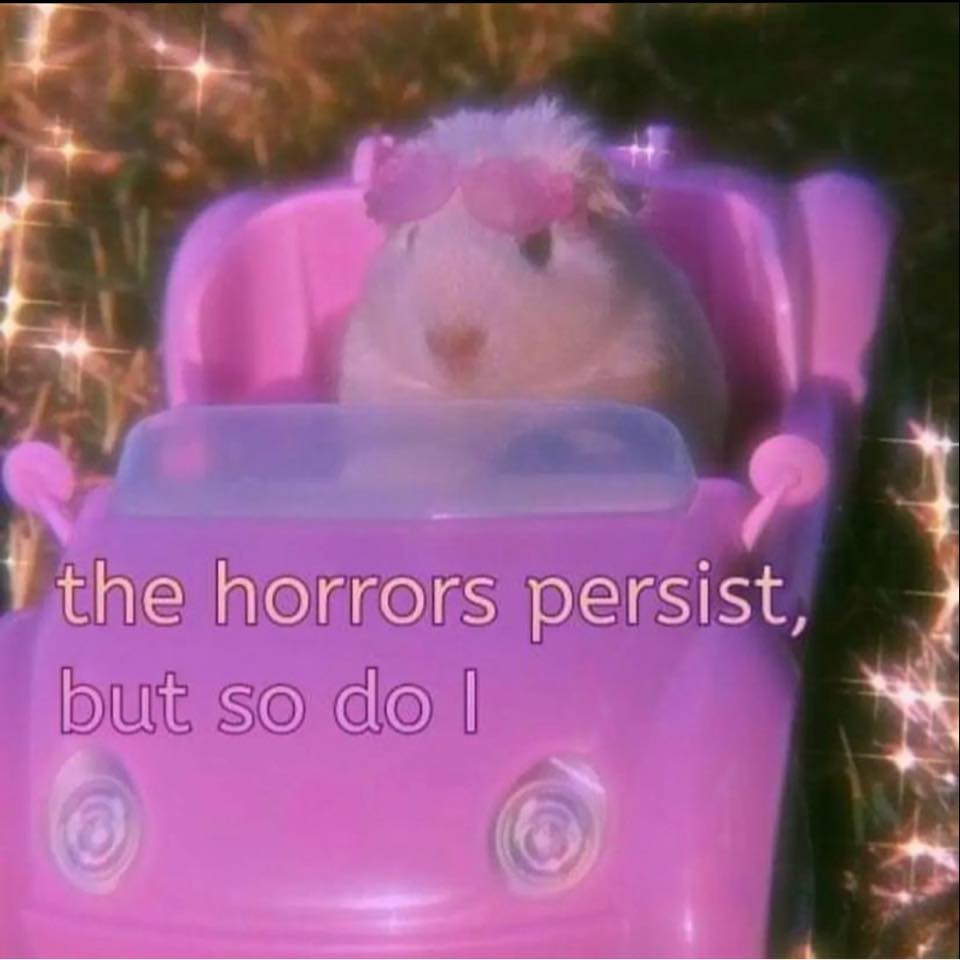
The meme features a cartoon image of a person in a mental health clinic, with a caption that reads "the horror... the horror... of being a queer person in a mental health clinic". The image is a humorous take on the anxiety and stress that can come with navigating the healthcare system as a queer person. The meme is likely intended to poke fun at the challenges of seeking mental health support while also being mindful of one's identity.
detailed-analysis (gemma3-27b-vision)
Okay, here's an analysis of the image broken down into sections, addressing the requested theoretical frameworks. I'll indicate where a section doesn't apply. It's a delightfully strange image, lending itself to multiple readings!
Visual Description
The image features a small, fluffy white animal (likely a hamster or similar rodent) sitting in a hot pink, plastic children’s ride-on car (perhaps resembling a miniature BMW). The animal appears slightly forlorn or stoic. The entire image is filtered with a strong, bubblegum-pink hue and sparkly glitter effects, creating a distinctly hyper-feminine, artificial aesthetic. Text overlayed on the image reads, "the horrors persist, but so do I." The background is out of focus and dark, contrasting with the brightly lit foreground. The composition gives a slightly unnerving, almost surreal quality.
---
Foucauldian Genealogical Discourse Analysis
This image is ripe for Foucauldian analysis. The text, "the horrors persist, but so do I," can be read as a resistance to power structures despite their enduring presence. Foucault would be interested in how "horror" is constructed through discourse. What is considered horrific? By whom? And how does this discourse normalize certain forms of power and control?
The hamster in a pink car, within this context, is a fascinating element. The car is a symbol of individual agency and mobility, but it’s small and pink – immediately marked by cultural associations with childhood, femininity, and perhaps even containment. The hamster's "persistence" can be interpreted as a refusal to be fully defined or controlled by these discourses. It’s a practice of existing even within the structures that attempt to categorize and limit it.
Foucault wouldn’t see the hamster as inherently "resisting," but would analyze how this image can be read as participating in a genealogy of resistance through its subversion of conventional expectations. It highlights the constructed nature of "horror" and suggests that even within seemingly powerless positions, there is an enduring force of being.
---
Critical Theory
The image speaks to themes of alienation and the commodification of experience, central to Critical Theory. The artificial, hyper-feminine aesthetic—the bubblegum pink, glitter—can be understood as a representation of the “culture industry” (as theorized by Adorno and Horkheimer). It suggests a world saturated with manufactured desires and superficial values. The hamster, seemingly isolated within its pink vehicle, embodies a sense of disconnectedness.
The text "the horrors persist, but so do I" can be read as a lament on the persistence of oppressive structures despite the illusion of progress. The hamster's “persistence” isn’t necessarily about overcoming these horrors, but about enduring them, passively occupying a space within a system that perpetuates them. The image critiques the alienation and anomie that characterize modern life, prompting viewers to question the nature of existence within a consumer-driven society.
---
Postmodernism
This image fully embraces postmodern sensibilities. Its aesthetic—the artificiality, hyper-saturation of color, and glitter—rejects the notion of authenticity and embraces simulation. The image is self-aware and ironic, playing with established conventions and challenging the boundaries between "high" and "low" culture.
The text's ambiguity and lack of clear resolution contribute to its postmodern character. There is no grand narrative or definitive answer. Instead, the image presents a fragmented, subjective experience, reflecting the postmodern condition of uncertainty and relativism. It’s a playful, almost absurd, juxtaposition of elements—a fluffy hamster, a miniature car, and a bleak declaration of enduring horror—that subverts expectations and invites multiple interpretations. The image isn't about finding meaning, but about acknowledging the instability of meaning.
---
Queer Feminist Intersectional Analysis
This section is particularly rich. The intense pinkness, historically associated with femininity and often imposed upon women, can be read as a site of both constraint and reclamation. The hamster, as a small, vulnerable creature, can be seen as representing marginalized identities. Its “persistence” can be interpreted as an act of resistance against societal expectations and systemic oppression.
The image challenges traditional notions of strength and agency. The hamster isn't necessarily overcoming the "horrors," but it is enduring them, quietly asserting its existence in the face of adversity. This quiet endurance can be seen as a form of subversive power.
The image also opens up questions about performativity. Is the hamster "performing" resilience? Is it succumbing to the pink, hyper-feminine world? Or is it using these very symbols to subvert them? This ambiguity allows for a nuanced reading that acknowledges the complexities of identity and the challenges of navigating a world that often seeks to define and control us. Intersectional considerations would note how the hamster’s vulnerability is exacerbated by its assigned “feminine” aesthetic, highlighting the ways in which gender, power, and marginalization intersect.
---
Marxist Conflict Theory (Less directly applicable, but possible)
While not a central reading, a Marxist lens can see the image as a commentary on the alienation of labor within a capitalist system. The hamster, confined within its pink vehicle, can be seen as representing the worker, trapped within the machinery of production and consumption. The "horrors" could be interpreted as the exploitative nature of capitalism, and the hamster's "persistence" as the endless cycle of labor that perpetuates the system. The artificiality and consumerism embodied by the pink aesthetic can be seen as a distraction from the underlying inequalities and injustices of the capitalist system. However, this is a more speculative reading, and the image is more powerfully addressed through the other theoretical frameworks.
Hopefully, this provides a detailed and multi-faceted analysis of the image, incorporating the requested theoretical perspectives!
simple-description (llama3.2-vision)
The meme features a cartoon character, likely from a children's TV show, sitting in a pink convertible. The character is wearing a pink dress and a smile, but their eyes are blacked out with a "X" symbol, implying a dark or evil personality. The text overlay reads: "the horrors I've seen, but so do I"
tesseract-ocr
wi oe ae: an aid . a a Peay * ) the horrors persist, :