First Seen
2024-10-28T05:59:42.976586+00:00
detailed-analysis (gemma3_27b-it-q8_0)
Okay, let's break down this meme through the lens of the "Queer - Anxiety" category, utilizing relevant theoretical frameworks where applicable. It's a complex image, so a multi-faceted analysis is fitting.
Visual Description
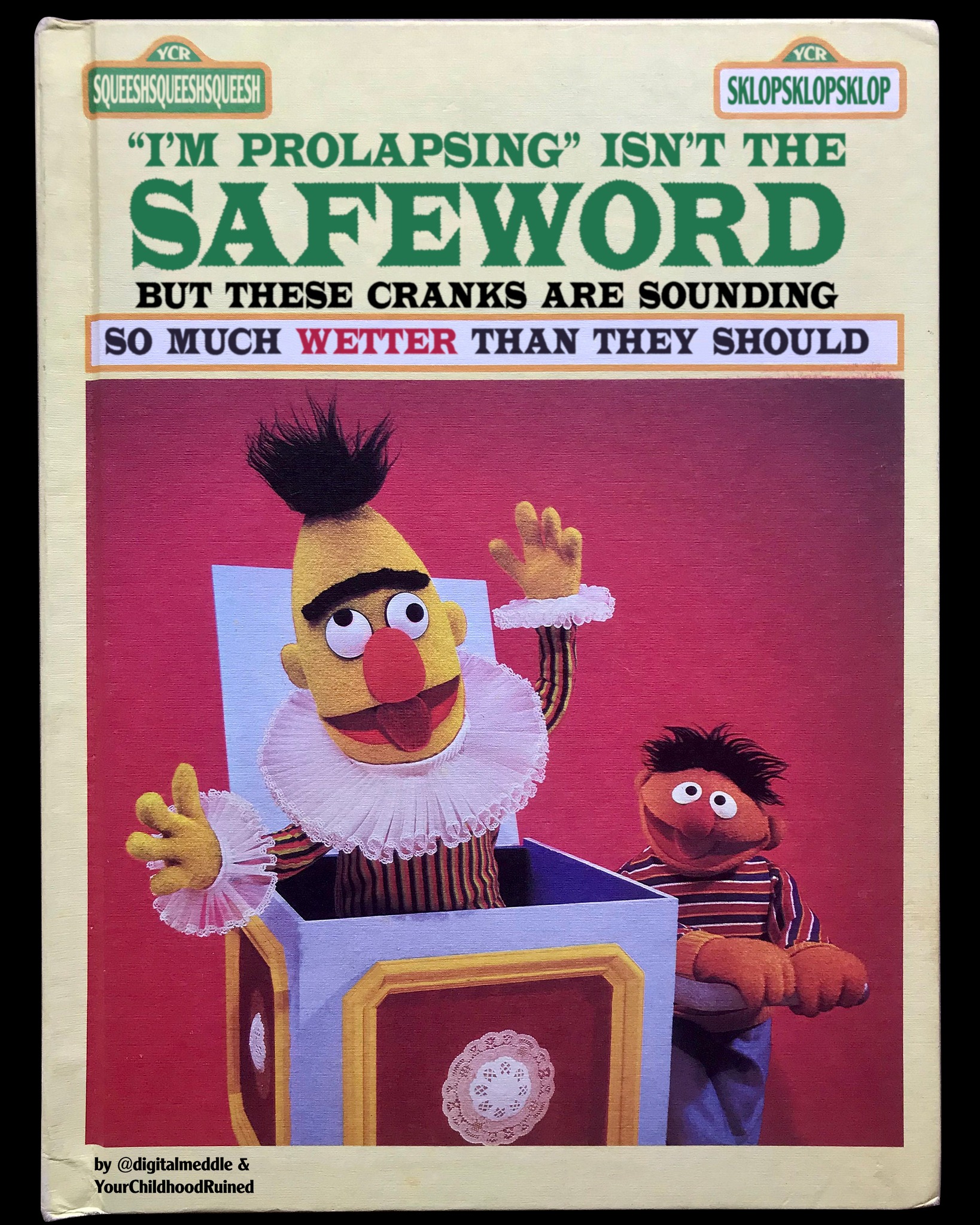
The image is a pastiche of a vintage children’s book cover, specifically mimicking the style of Sesame Street book covers from the 1980s. It features Bert and Ernie. Bert is dramatically presented, emerging from a decorated box with exaggerated gesture and expression. He is wearing a ruffled collar, making him look almost like an operatic performer. Ernie is in the background looking wide-eyed, seemingly horrified or overwhelmed.
The text overlaid on the cover reads: “'I'M PROLAPSING' ISN'T THE SAFEWORD BUT THESE CRANKS ARE SOUNDING WETTER THAN THEY SHOULD.” The text is presented in a style mimicking the book title font, with smaller lines of text mimicking the author and publisher information. A small 'YCR' is placed in both corners, with corresponding text in each corner. The bottom of the image provides credit to the artists @digitalmeddle & YourChildhoodRuined.
The overall aesthetic is unsettling – a familiar, comforting childhood image disrupted by intensely adult and anxiety-laden text. The contrast of the bright, friendly Sesame Street imagery with the disturbing language is deliberately jarring.
Queer Feminist Intersectional Analysis
This is where the meme’s core resonance lies, and where intersectionality is key.
- The “Safeword” and Trauma: The use of the word "safeword" immediately situates this meme in BDSM culture, which, within queer communities, often serves as a space to explore power dynamics, boundaries, consent, and processing trauma. The idea that “I'm prolapsing” isn’t the safeword suggests a situation spiraling out of control, where even the most extreme declaration of distress isn’t being heeded. This can be read as a metaphor for the chronic invalidation experienced by many queer individuals, particularly those who have experienced trauma.
- "Wetness" as a Metaphor: The phrase “wetter than they should” is deliberately provocative and loaded. "Wetness" in this context doesn't refer to literal moisture but to emotional overflow, vulnerability, or intensity of experience. The idea that "cranks" (a term that suggests malfunctioning or broken mechanisms, potentially a metaphor for people) are causing this overwhelming emotional state speaks to experiences of emotional labor, abuse, and the constant need to manage others’ reactions. This is especially relevant within the queer community, where individuals often experience a disproportionate amount of emotional labor to educate, advocate for themselves, and navigate heteronormative/cisnormative spaces.
- Bert and Ernie as Queer Coding: Bert and Ernie have long been a subject of queer interpretation. While Sesame Street has never explicitly confirmed a romantic relationship between them, their close bond has been interpreted by many as queer representation, or at least a queer-coded relationship. By using these characters, the meme taps into the history of queer subtext in mainstream media, and utilizes their existing 'queer' resonance to amplify the anxiety being expressed.
- Anxiety and Dysphoria: For trans and gender non-conforming individuals, the theme of “prolapsing” can also be linked to body dysphoria and the anxieties surrounding physical embodiment. The unsettling imagery paired with the explicit language creates a visceral, disturbing feeling that may resonate with those grappling with such issues.
Foucauldian Genealogical Discourse Analysis
Michel Foucault’s work on power, knowledge, and discourse helps us understand how this meme functions.
- Discourse of Mental Health: The meme challenges conventional discourses around mental health. "Prolapsing" is a medical term usually associated with physical bodies, but here it’s used to represent emotional and psychological breakdown. This disrupts the neat boundaries between the physical and mental, challenging the medicalization of emotional distress.
- Power Dynamics & Boundaries: Foucault argues that power operates through discourse. This meme critiques power dynamics by suggesting an inability to establish healthy boundaries. The failed safeword signifies a breakdown in the negotiation of consent and control. The characters are positioned in a power imbalance, with Bert seemingly ‘performing’ a distress that isn't being acknowledged by Ernie.
- Normalization of Distress: The meme’s use of humor to depict extreme anxiety is a strategy for reclaiming agency. By openly acknowledging and even satirizing distressing experiences, it disrupts the silencing and stigmatization often associated with mental health.
Postmodernism
- Pastiche and Irony: The meme is fundamentally postmodern in its use of pastiche (imitating the style of a previous work) and irony. It takes a beloved childhood image and subverts it with dark, adult themes. This creates a sense of disjunction and challenges our assumptions about nostalgia and innocence.
- Deconstruction of Meaning: Postmodernism emphasizes the instability of meaning. The meme deliberately layers meanings, making it open to multiple interpretations. The "safeword" could relate to BDSM, trauma, or simply a metaphor for overwhelming anxiety. This ambiguity is intentional.
- Hyperreality: The juxtaposition of the innocence of Sesame Street with the disturbing text creates a hyperreal experience - a simulation of reality that is more intense and unreal than the reality it's based on.
In conclusion:
This meme is a potent expression of queer anxiety. It uses a familiar cultural reference point – Sesame Street – to explore themes of trauma, boundary violations, and the struggle for recognition and validation. Its effectiveness lies in its jarring juxtaposition of image and text, its use of layered symbolism, and its ability to resonate with the experiences of those navigating the complexities of queer life. It's a dark, unsettling, and ultimately cathartic piece of internet art that speaks to the challenges and vulnerabilities within the queer community.
simple-description (llama3.2-vision_11b)
The meme is a humorous take on the anxiety of being in a queer relationship. It features a screenshot of a 90s-era video game instruction manual, with a character from the game "Tetris" (a blocky, pixelated character) in a romantic relationship with a character from "Sesame Street" (a character with a Muppet-like appearance). The text reads "I'm not crying, I'm just having a Tetris block" - a play on words referencing the game's block-like graphics, and the emotional turmoil of being in a queer relationship.
detailed-analysis (gemma3-27b-vision)
Okay, here's an analysis of the image, broken down into the sections you requested, with a focus on relevant theoretical lenses. As you can see, several of the sections don't apply strongly to this image, so they'll be brief or absent.
Visual Description
The image is a digitally altered cover of a vintage "Sesame Street" record or book. It features Big Bird and Oscar the Grouch in a humorous and unsettling composition. Big Bird is presented in a flamboyant pose, leaning over a bright yellow box with a visible floral pattern that resembles a toilet seat. He's leaning toward the box and appears to be "operating" it with a large, exaggerated hand. Oscar the Grouch peers out from behind the box with a concerned, perhaps even horrified, expression.
Superimposed on the cover in bold, contrasting colors are phrases. The central text reads "SAFEWORD" in large red letters, with "BUT THESE CRANKS ARE SOUNDING" and "SO MUCH WETTER THAN THEY SHOULD" above and below, respectively. Above the top phrase are the nonsensical strings "SQUEESHQSHEESHQSHEESH" and "SKLOPSKLOPSKLOPSKLOPS." The digital creator's usernames "@digitalmeddle" and "YourChildhoodRuined" are visible at the bottom.
The overall aesthetic is a deliberate corruption of a nostalgic, childlike image. The contrast between the bright, innocent Sesame Street characters and the suggestive, adult language creates a jarring and ironic effect. The quality of the overlay is intentionally made to look like a slightly distressed, vintage product cover.
Foucauldian Genealogical Discourse Analysis
This image lends itself strongly to Foucauldian analysis. The "SAFEWORD" is crucial. Foucault explored how discourse creates power relations and defines norms. A safeword, typically used in BDSM, highlights the negotiation of boundaries and consent within a power dynamic. By placing this term onto a childhood image, the artwork destabilizes this norm.
The genealogy (tracing the history of ideas) points to the appropriation of a term from adult sexuality and its unexpected insertion into the realm of childhood innocence. This disrupts the traditional, rigid separation between these spheres, exposing how our categories of "appropriate" and "inappropriate" are constructed through discourse.
The phrase “cranks are sounding wetter than they should” utilizes a metaphor that implies mechanical dysfunction. This draws upon discourse surrounding bodies and mechanisms – the idea of a body failing or performing unexpectedly. It subtly links sexuality to the material, revealing how our understandings of bodies are shaped by power/knowledge structures.
This image actively troubles the assumed "naturalness" of childhood innocence. It suggests that beneath the surface, there is a potential for disruption, a questioning of boundaries, and a subversion of established power dynamics.
Critical Theory
Following a broader Critical Theory lens, this image critiques the idealized notions of childhood and innocence that are often used to maintain social control. The artwork suggests that even within the seemingly harmless world of children's entertainment, there are underlying power structures, anxieties, and suppressed desires.
It can be seen as a critique of the way culture "represses" (in the Freudian sense) sexuality and desire. By bringing these themes into the realm of childhood, the artwork suggests that they are not absent but simply hidden or disguised.
The image also challenges the idea of a unified "self." The juxtaposition of the innocent characters and the suggestive language creates a sense of fragmentation and internal conflict, hinting at the complex and often contradictory nature of human subjectivity. It suggests that the "innocent" Big Bird may harbor desires and anxieties that are not readily apparent.
Queer Feminist Intersectional Analysis
This section is particularly relevant. The image subverts conventional expectations of childhood gender expression and sexuality. The flamboyant pose of Big Bird, combined with the suggestive language, can be read as a queer performance of gender and desire. It disrupts the heteronormative assumption that childhood is a period of pre-sexual innocence.
The "wetness" metaphor, often linked to female sexuality, is intriguingly placed onto a male character. This challenges traditional gender roles and disrupts the binary opposition between masculine and feminine. It suggests that desire is not limited by gender and that fluid sexuality can be found even in the most unexpected places.
A feminist reading would also consider the objectification of the "cranks" (potentially referring to the mechanics of the box or implicitly to bodies). The language suggests a focus on physical sensation and a potential power imbalance.
The intersectionality comes in by recognizing the layering of these critiques – the challenge to heteronormativity, the disruption of gender roles, and the questioning of power dynamics are all interwoven in this single image. It suggests that social justice requires a dismantling of all forms of oppression, not just one.
Postmodernism
The image exemplifies postmodern aesthetics. The deliberate mixing of high and low culture (Sesame Street characters and adult sexual language) is a hallmark of postmodernism. The irony, pastiche, and self-referentiality (it’s a deliberately altered image of a nostalgic object) also align with postmodern principles.
The image challenges the idea of a fixed meaning. The ambiguity of the language and the unsettling juxtaposition of images create a sense of instability and fragmentation, inviting multiple interpretations. There is no single "correct" reading of this artwork.
The image's rejection of grand narratives and its embrace of subjectivity are also characteristic of postmodernism. It does not offer any easy answers or moral lessons but instead encourages viewers to question their own assumptions and engage in critical thinking.
Marxist Conflict Theory
This is the weakest application. However, a stretched interpretation could posit that the image represents a "rupture" in the dominant ideology. The disruption of childhood innocence can be seen as a challenge to the status quo, a rebellion against the repressive norms of society. The image could be interpreted as a symbolic expression of underlying social tensions and conflicts. It could also be seen as a critique of consumer culture, with the nostalgic Sesame Street image being repurposed for a subversive and transgressive purpose.
I hope this detailed analysis is helpful! Let me know if you'd like me to elaborate on any particular aspect.
simple-description (llama3.2-vision)
The meme is a picture of a character from the children's TV show Sesame Street, Elmo, in a situation that is opposite of his usual cheerful personality. The text "I'M NOT MAD, I JUST HAVE A LOT OF FEELINGS RIGHT NOW" appears above the character. The image is humorous because it takes a typical children's character and puts them in a situation that is usually associated with adults.