First Seen
2025-06-04T04:23:26.861546+00:00
detailed-analysis (gemma3_27b-it-q8_0)
Okay, let's break down this meme through the lens of "Pinkwashing" and the requested theoretical frameworks.
Visual Description
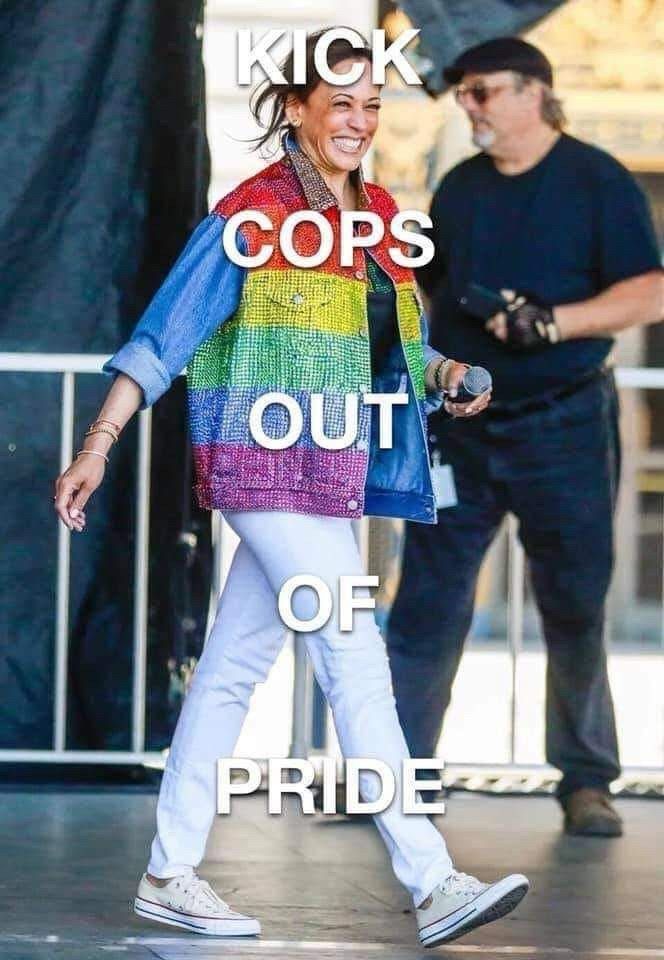
The image shows Kyrsten Sinema, a U.S. Senator, walking in a Pride parade. She is prominently dressed in a colorful patchwork jacket resembling a rainbow flag. The text layered over the image reads “KICK COPS OUT OF PRIDE.” A man with long hair is visible blurred in the background to the right. The bright colors and Sinema’s smile present a seemingly celebratory image, juxtaposed with the text demanding a removal of police presence.
Critical Theory
Critical Theory is central to understanding this meme as an example of pinkwashing. Pinkwashing refers to the practice of using LGBTQ+ rights as a marketing or PR tool to deflect attention from problematic actions or policies, or to present a progressive façade while pursuing other agendas.
- Critique of Power: The meme targets the hypocrisy embedded within the performative allyship of Sinema. She presents herself as supportive of LGBTQ+ rights via her outward appearance and participation in a Pride event, yet she is accused of policies (through her political actions) that actively harm marginalized communities.
- Ideology and Hegemony: The image challenges the idea that simply appearing supportive of LGBTQ+ rights equates to genuine allyship. It suggests that the symbolism is being used to maintain a dominant power structure, masking potentially harmful policies.
- The "Spectacle": Drawing on Debord's concept of the Spectacle, the Pride parade, and Sinema’s participation within it, becomes a carefully constructed image divorced from the material realities of LGBTQ+ individuals, and becomes a spectacle of a falsely progressive image.
Queer Feminist Intersectional Analysis
This meme resonates deeply within a Queer Feminist Intersectional framework.
- Interlocking Oppressions: It recognizes that LGBTQ+ liberation is not simply about gaining visibility or individual rights, but about dismantling all forms of oppression. The demand to remove police from Pride directly addresses concerns about state violence, police brutality, and the historical and ongoing discrimination faced by LGBTQ+ people (particularly LGBTQ+ people of color).
- Critique of Representation: The meme highlights the issue of who represents the LGBTQ+ community. Sinema's participation, seen as inauthentic or contradictory to her legislative actions, becomes a point of contention. It questions whether representation is meaningful if it doesn’t translate into concrete policy changes that support the well-being of queer communities.
- Policing and Queer Bodies: The request to remove police recognizes the history of policing as a tool of oppression against queer people, particularly queer people of color and trans people. It acknowledges that police presence at Pride can be alienating or even dangerous for some members of the community.
- Trans Exclusionary Radical Feminism (TERF): Sinema has been critiqued for potential TERF leaning. This adds another layer to the meme, as it indicates her outward support of Pride may not be genuine if she does not prioritize and fight for the rights of trans and nonbinary people.
Marxist Conflict Theory
While not the most prominent theoretical angle, a Marxist reading can still provide some insight.
- Power Dynamics and Class: The meme implies a conflict of interests. Sinema, as a representative of the ruling class (a Senator), is accused of using LGBTQ+ rights as a shield to deflect criticism and maintain her position of power while potentially enacting policies that benefit other powerful interests.
- False Consciousness: The seemingly celebratory image of Sinema at Pride could be interpreted as an attempt to create a "false consciousness" among LGBTQ+ individuals, leading them to believe that their interests are being represented when, in fact, they are not.
- Ideology as Justification: Pinkwashing can be seen as an ideological tool used to legitimize the current power structure, obscuring the material inequalities and injustices faced by LGBTQ+ people.
Foucauldian Genealogical Discourse Analysis
This framework helps dissect how the discourses around LGBTQ+ rights and policing have developed historically.
- Discourse and Power: The meme interrupts the dominant discourse around “LGBTQ+ inclusion” by exposing the power dynamics at play. The phrase "KICK COPS OUT OF PRIDE" challenges the normalization of police presence as a symbol of safety and acceptance.
- Genealogy of "Pride": The meme invites a genealogical inquiry into the history of Pride itself. The original Pride movements were largely formed in response to police brutality and marginalization. The meme suggests that the presence of police at modern Pride events represents a deviation from the radical roots of the movement.
- Biopower: Police represent an aspect of biopower – the state's control over the bodies and lives of its citizens. The demand to remove police can be seen as a resistance to this form of control, asserting the right of LGBTQ+ individuals to self-determination and freedom from state surveillance and violence.
Postmodernism (less directly applicable, but present)
- Deconstruction of Signifiers: The meme deconstructs the simplistic connection between the rainbow flag (a symbol of LGBTQ+ identity) and the actions of a politician. It challenges the notion that wearing a rainbow-colored outfit automatically equates to genuine allyship.
- The Death of Grand Narratives: The meme rejects the idea of a singular, unified narrative of “progress” regarding LGBTQ+ rights. It suggests that progress must be critically examined and that celebratory displays of inclusion can be deceptive.
In conclusion: The meme functions as a powerful critique of pinkwashing, exposing the potential hypocrisy of performative allyship and challenging the normalization of police presence at Pride events. It draws on several theoretical frameworks to illuminate the complex power dynamics at play and advocate for a more radical and intersectional approach to LGBTQ+ liberation.
simple-description (llama3.2-vision_11b)
The meme is a photo of a person, likely a celebrity, wearing a rainbow-colored outfit and holding a microphone. The text "KAMALA HARRIS KICKS OFF PRIDE MONTH WITH A PINKWASHING TWEET" is overlaid on the image, implying that the person is using their platform to promote LGBTQ+ rights but is actually hiding or downplaying their own LGBTQ+ identity.
detailed-analysis (gemma3-27b-vision)
Okay, here's an analysis of the image, broken down into the sections you requested, applying those theoretical frameworks where applicable. Please note that these are complex theories, and an image can only offer a snapshot for interpretation. I’ll try to be comprehensive, acknowledging limitations.
Visual Description
The image depicts a person—likely a performer or speaker—at a Pride event. They are mid-stride, seemingly walking or dancing on a raised platform, possibly a stage. The person is smiling brightly, exhibiting joy and confidence. Their clothing is a central element: a brightly colored, rainbow-patterned jacket worn over a denim shirt and white pants with a pair of black Converse sneakers. The jacket is a clear visual reference to LGBTQ+ Pride flags, symbolizing inclusivity and celebration.
Behind the subject, slightly out of focus, is another person wearing a dark shirt and a baseball cap. They appear to be in the background and not directly engaged with the subject.
Overlaid onto the image is text that reads "KICK COPS OUT OF PRIDE" in large letters. This text is highly significant as it frames the visual element with a political message. The event appears to be outdoors, possibly in a park or public space.
Foucauldian Genealogical Discourse Analysis
Foucault’s genealogical approach would examine the history of the discourses around policing, Pride, and how those discourses have shaped our understanding of both. Here's how it applies:
- Discourse of Policing: Historically, policing has been linked to maintaining social order, often at the expense of marginalized groups (including LGBTQ+ people). Foucault would be interested in how the idea of “policing” evolved, how it became normalized, and how it functions as a power structure. The presence of police at Pride events, while sometimes framed as providing security, can be seen as a continuation of this history of control and surveillance.
- Discourse of Pride: The idea of a Pride celebration emerged as a response to historical oppression and discrimination. The movement’s initial focus on visibility and claiming space transformed over time. Foucault would analyze how these shifts occurred, how different voices and perspectives were included or excluded, and how the concept of "Pride" itself has become a discourse with specific power dynamics.
- The Text as Interruption: The "KICK COPS OUT OF PRIDE" text interrupts the traditional discourses surrounding both policing and Pride. It asserts a counter-discourse, questioning the legitimacy of police presence at a historically counter-hegemonic event. It challenges the notion that security necessitates the presence of those historically associated with oppression.
Critical Theory (Frankfurt School)
Critical Theory, developed by thinkers like Adorno and Horkheimer, would examine the image as part of a broader system of domination and ideology.
- Culture Industry: Pride events, even as they celebrate liberation, can be seen as commodified and integrated into the larger "culture industry." The image, with its colorful aesthetic, could be interpreted as part of this process, potentially masking deeper inequalities.
- Instrumental Reason: The presence of police at Pride could be seen as an example of "instrumental reason"—the application of logic and efficiency to achieve control, regardless of ethical implications. The image challenges this logic by suggesting that such control is unacceptable within a space designed for liberation.
- Ideology and Counter-Ideology: The image presents a direct challenge to the dominant ideology that justifies police presence as necessary for public safety. The "KICK COPS OUT OF PRIDE" text actively counters this ideology, advocating for a different vision of public space and security.
Marxist Conflict Theory
From a Marxist perspective, the image reveals inherent class and power struggles.
- Oppression and Resistance: The LGBTQ+ community has historically faced economic and social oppression. Pride events represent a form of resistance against this oppression.
- The Role of the State: The presence of police—agents of the state—at Pride events highlights the relationship between power structures and marginalized groups. The image suggests a conflict between those who seek liberation and those who enforce the status quo.
- Ideological Struggle: The "KICK COPS OUT OF PRIDE" text represents a clear articulation of an oppositional ideology. It challenges the dominant narrative that equates police presence with safety and security, framing it instead as a form of control and oppression.
Queer Feminist Intersectional Analysis
This framework is particularly well-suited to interpreting the image. It draws on queer theory, feminist theory, and intersectionality to understand how multiple forms of oppression intersect.
- Queer Resistance: The image celebrates queer identity and resists the norms of heteronormative society. The joyous expression of the person in the image is a direct challenge to the historical marginalization and discrimination faced by LGBTQ+ individuals.
- Feminist Critique of Power: A feminist analysis highlights how power structures are often patriarchal and oppressive. The image can be seen as a rejection of these power structures, advocating for a more equitable and just society.
- Intersectionality: The image recognizes that experiences of oppression are complex and shaped by multiple factors, including race, class, gender, and sexual orientation. The "KICK COPS OUT OF PRIDE" text underscores the fact that police brutality disproportionately impacts marginalized communities, including LGBTQ+ people of color. It argues that a truly inclusive Pride event must actively challenge police violence and advocate for systemic change.
- Decriminalization and Abolition: The text itself points to a more radical stance, potentially advocating for police abolition or at least a significant restructuring of policing practices to ensure accountability and community safety.
Postmodernism
From a postmodern perspective, the image deconstructs traditional notions of identity, power, and truth.
- Deconstruction of Grand Narratives: The image challenges the "grand narrative" of policing as solely benevolent and focused on public safety. It disrupts this narrative by questioning the legitimacy of police presence at a space dedicated to liberation.
- Emphasis on Subjectivity: The image celebrates the individual expression of the person in the frame. This emphasis on subjectivity aligns with postmodernism's rejection of universal truths and its embrace of multiple perspectives.
- Playfulness and Irony: The use of bright colors and the bold text can be seen as a form of playful irony, challenging conventional norms and inviting viewers to question their assumptions.
In conclusion, the image, alongside the overlaid text, functions as a complex cultural artifact with multiple layers of meaning. The theoretical frameworks outlined above offer different lenses through which to analyze its significance, revealing how it engages with issues of power, oppression, and resistance. It's a visual statement that actively challenges the status quo, advocating for a more just and inclusive society.
simple-description (llama3.2-vision)
The meme features a photo of a person in a humorous, exaggerated pose, likely with a playful expression. The text overlay reads "Kamala Harris: I'm not a morning person" and "I'm not a night person".