First Seen
2025-09-20T00:43:31.054132+00:00
simple-description (qwen3.5_2b-q8_0)
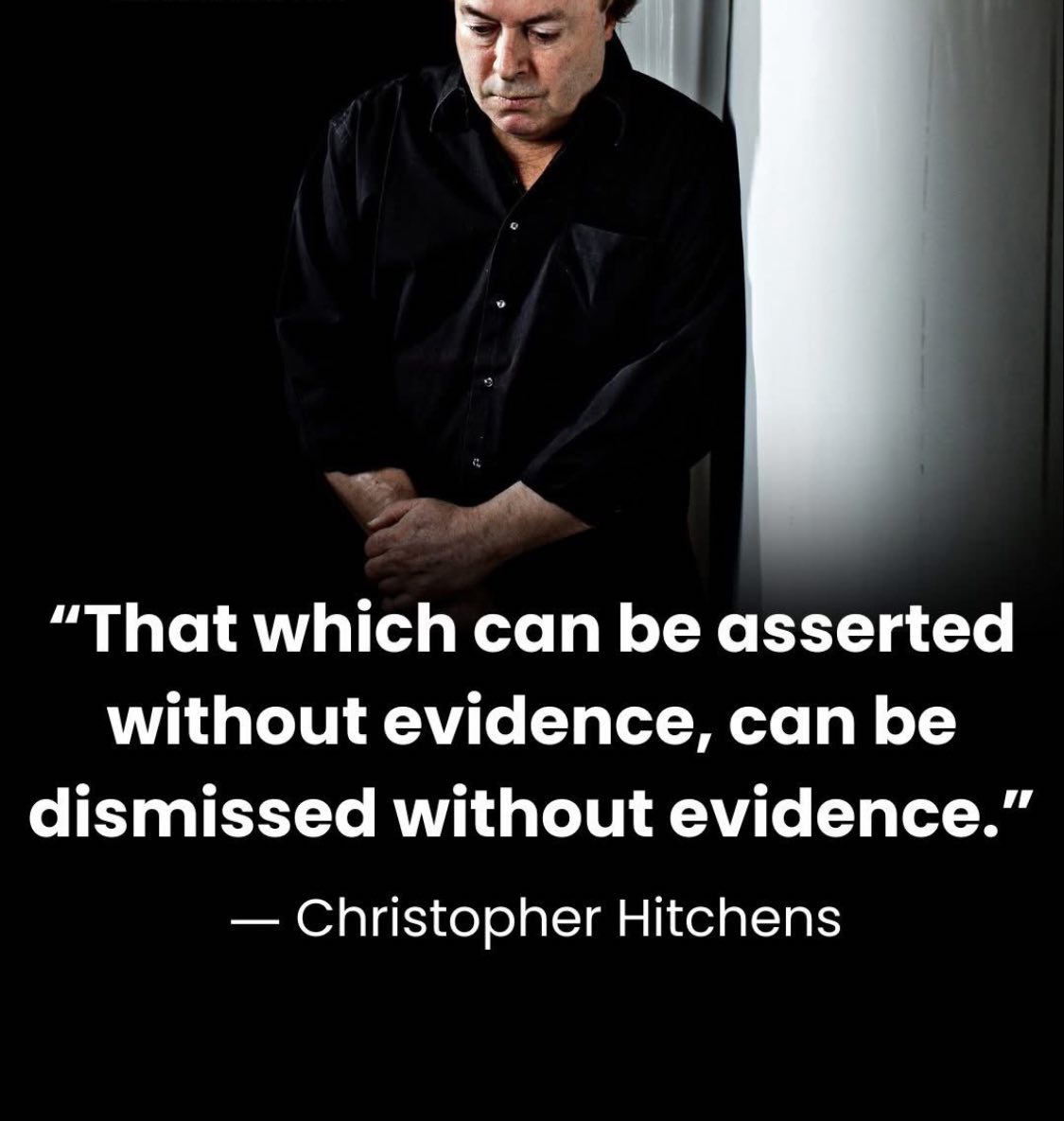
This image presents a core argument from epistemology—the branch of study concerned with how we acquire knowledge—suggesting that you shouldn't trust someone simply because they insist on it being true. The text, written by the radical skeptic Christopher Hitchens, states that making a claim without evidence is just as arbitrary as dismissing one. Consequently, it serves as a reminder to demand proof and justification for any proposition before accepting it.
detailed-analysis (gemma3_27b-it-q8_0)
Okay, let's break down this meme featuring Christopher Hitchens' quote through the lens of Philosophy, specifically focusing on Epistemology, and exploring its resonance within different critical theoretical frameworks where relevant.
Visual Description
The image depicts Christopher Hitchens, a British-American author, journalist, and intellectual, in a somewhat shadowed, contemplative pose. He is wearing a dark, buttoned-up shirt. The lighting focuses on his face, emphasizing a serious expression. The dark background suggests seriousness or a solemn tone. This visual representation immediately evokes a figure associated with intellectual rigor and critical thought, enhancing the impact of the quote. The somber visual tone, paired with Hitchens' known confrontational style, suggests a deliberate challenge to unsubstantiated claims.
Epistemological Analysis
At its core, this meme centers on a fundamental epistemological principle: the burden of proof. Epistemology is the branch of philosophy that deals with knowledge – its nature, scope, and limits. Hitchens' statement directly challenges the idea that a claim automatically gains validity simply because it's made. Instead, it asserts a symmetry between assertion and dismissal. If someone proposes a claim without backing it with evidence, then one is equally justified in rejecting that claim, again without needing to provide evidence against it.
This aligns with a core principle of scientific methodology and rational skepticism: the null hypothesis. In science, one doesn't prove something is true; one attempts to disprove it. The onus is on the claimant to offer evidence supporting their assertion. Hitchens is effectively extending this principle into all domains of belief and discourse.
This quote is a firm rejection of faith-based or authority-based arguments. It’s a demand for justification and a defense of reason.
Foucauldian Genealogical Discourse Analysis
Michel Foucault's genealogical approach to knowledge would find this quote interesting. Foucault wouldn't necessarily evaluate the truth of the statement (he largely rejected the idea of universal Truth), but would examine the power dynamics inherent in the very act of making and dismissing claims.
- Discourse & Power: Hitchens’ statement implicitly challenges existing power structures that rely on unquestioned assertions. Institutions, authorities (religious, political, etc.), and ideologies often maintain power through assertions that are accepted without scrutiny. By demanding evidence, Hitchens disrupts the accepted discourse and challenges the authority that produces it.
- Genealogy of Knowledge: Foucault would ask how the concept of “evidence” itself has become a dominant criterion for validity. He’d trace its historical development, revealing how it's tied to specific social, political, and cultural conditions – particularly the rise of scientific thought and the Enlightenment. The notion of “evidence” is not neutral; it's historically constructed.
- The Will to Know: Foucault would see Hitchens' position as an expression of the "will to know" – a drive to dissect, analyze, and understand the underlying mechanisms of power embedded in knowledge systems.
Critical Theory
Critical Theory, arising from the Frankfurt School, would view Hitchens’ quote as having potential for critical engagement with ideologies and social structures.
- Ideology Critique: Hitchens' statement provides a tool to deconstruct ideologies. Ideologies often operate through unchallenged assertions that maintain the status quo. Demanding evidence exposes the lack of rational basis for these claims, revealing their ideological function.
- Reason and Emancipation: Critical theorists believe reason is crucial for emancipation from oppressive systems. Hitchens’ quote emphasizes the role of reason in questioning and challenging existing power dynamics.
- Limits of Rationality: However, some critical theorists might also caution against a naive faith in “evidence.” They would argue that evidence is often interpreted through the lens of existing biases and interests. The act of selecting what counts as “evidence” is itself not neutral.
Postmodernism
Postmodernism’s relationship to Hitchens’ quote is complex and potentially conflicted.
- Rejection of Metanarratives: Postmodernism rejects the idea of universal truths or grand narratives. It emphasizes the subjective and constructed nature of reality. A postmodernist would challenge the notion that there's a single, objective standard of "evidence."
- Deconstruction of Knowledge: They'd deconstruct the concept of “evidence” itself, arguing that it's always situated, partial, and dependent on specific contexts and perspectives. What counts as evidence for one person might not for another.
- Potential for Relativism: However, Hitchens’ statement seems to presuppose a shared standard of rational justification, which postmodernism often questions. If all knowledge is fundamentally relative, the demand for evidence could be seen as an imposition of one perspective over others. However, a nuanced postmodern perspective would acknowledge the usefulness of asking for evidence even while recognizing its limitations.
Conclusion
Christopher Hitchens' quote is a powerful epistemological statement that has resonated across intellectual communities. It champions reason, skepticism, and the burden of proof. The meme taps into a deep desire for intellectual honesty and a rejection of unsubstantiated claims. While different theoretical frameworks offer diverse perspectives on its implications, it remains a valuable tool for critical thinking and challenging authority.
simple-description (llama3.2-vision_11b)
The meme is a quote from philosopher Christopher Hitchens, which humorously highlights the irony of a philosophical argument that is self-contradictory. The quote is written in bold white font, contrasting with the dark background of the image, which features a photo of Christopher Hitchens. The quote reads: "That which can be asserted without evidence, can be dismissed without evidence."