First Seen
2025-05-21T23:47:23.152476+00:00
detailed-analysis (gemma3_27b-it-q8_0)
Okay, let's break down this meme through the lens of Permaculture, and the applicable theoretical frameworks you’ve requested. It’s a surprisingly rich image when viewed that way!
Visual Description
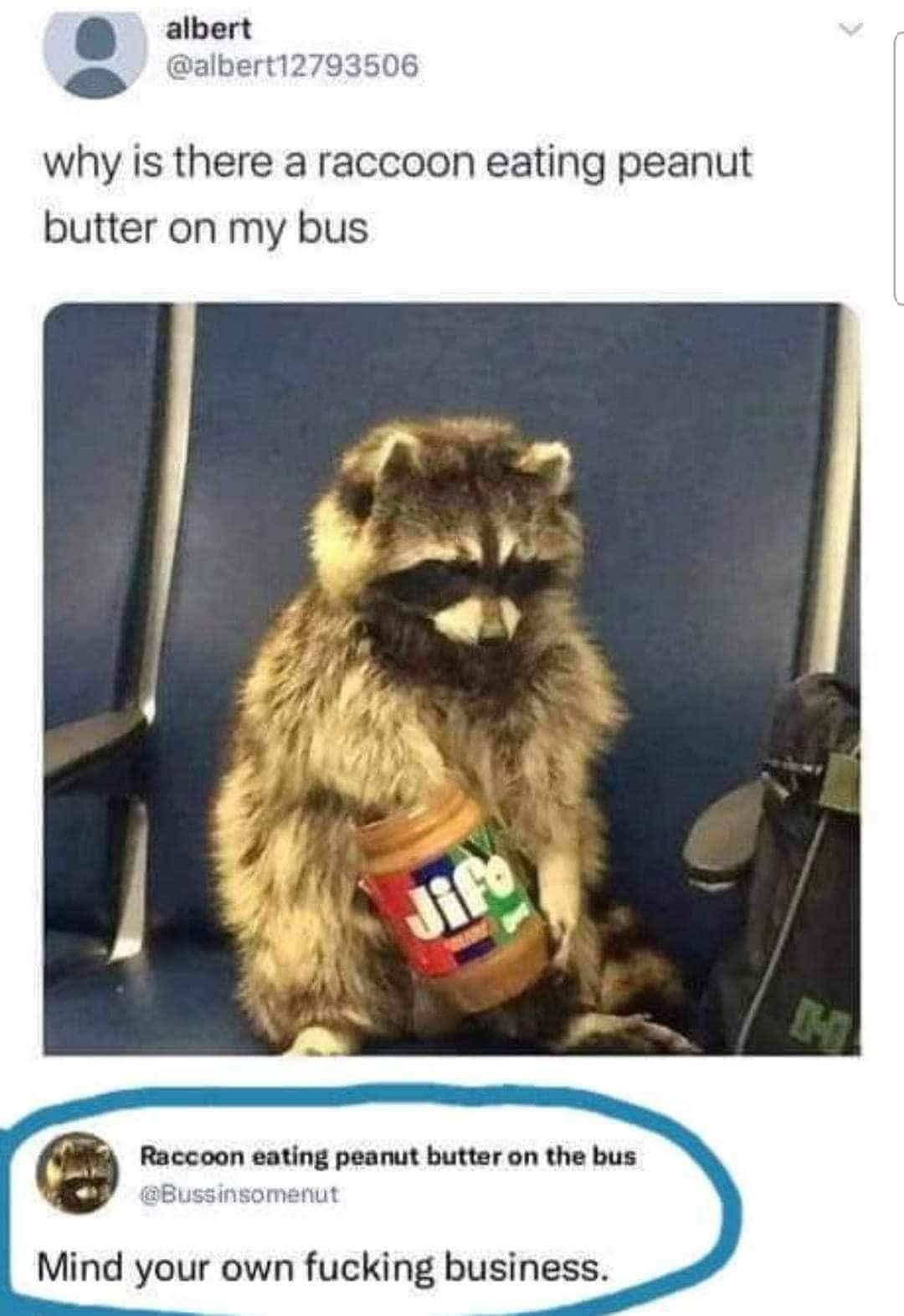
The image depicts a raccoon comfortably seated on what appears to be public transport (a bus), actively consuming peanut butter directly from a jar of Jif. The raccoon is looking directly at the camera, seemingly unconcerned by its surroundings or the peculiarity of its behavior. There are bags near it, suggesting a typical commuter situation. The background is a bit blurry, giving the impression of being snapped quickly. The stark contrast of the situation (wild animal doing a very human thing in a public space) is what makes it immediately striking.
---
Permaculture Perspective
At its core, Permaculture is a design philosophy rooted in observing natural patterns and applying those patterns to human systems. The meme resonates with permaculture principles on several levels:
- Edge Effect: The raccoon is the edge. It's a wild creature operating in a human-designed system. Permaculture values "edges" because they are highly productive spaces – places where different systems meet and interact. This raccoon embodies that productivity: it’s accessing resources (the peanut butter) where they wouldn’t normally be found, creating an interaction between the wild and the domestic.
- Stacking Functions: The raccoon is fulfilling multiple functions simultaneously: acquiring food, utilizing a (accidental) resource, and providing amusement (or disturbance) to the observer. Permaculture aims to design systems where each element has multiple benefits.
- Observation & Adaptation: The raccoon observed a resource and adapted its behavior to obtain it. This is the heart of permaculture – understanding the existing environment and finding ways to work with it, not against it.
- Resourcefulness: The raccoon isn't waiting for permission or following conventional rules; it’s simply taking what it needs (or wants) from its environment. This speaks to a certain level of resilience and independence valued in permaculture.
- Unconventional Solutions: The raccoon does not care what society thinks about its actions, which aligns with thinking outside the box to solve problems.
---
Foucauldian Genealogical Discourse Analysis
This framework examines how power relations shape our understanding of the world, tracing the historical development of discourses (ways of talking and thinking) around specific topics. Here, the raccoon challenges discourses of “proper” behavior and space.
- Normalization: Our expectation of where animals "belong" is a normalized construct. We expect raccoons in forests, not on buses. The raccoon disrupts this normalization, making visible the arbitrary nature of such boundaries.
- Discipline & Surveillance: The original tweet ("why is there a raccoon eating peanut butter on my bus?") demonstrates a desire to discipline the raccoon—to bring it back into line with acceptable behavior. It's also a form of surveillance—reporting on an anomaly.
- Power/Knowledge: The act of questioning the raccoon's presence reveals a power dynamic. The questioner assumes the right to demand an explanation for a behavior that is perfectly logical from the raccoon's perspective, but unacceptable according to human norms.
- Genealogy of the 'Bus': One could trace the history of the bus as a site of control—a space designed to move humans efficiently according to specific rules. The raccoon’s presence throws this control into disarray.
---
Critical Theory
Critical theory examines how social structures, power dynamics, and ideologies maintain inequality.
- Alienation: While a stretch, the raccoon could be seen as a symbol of alienation from nature, forced to seek sustenance in a human environment. It’s taking a processed food (Jif) in an unnatural location.
- Commodification of Nature: The peanut butter itself is a commodity – a product of industrialized agriculture. The raccoon's reliance on it symbolizes the increasingly pervasive reach of capitalist systems into the natural world.
- Critique of Order: The raccoon’s act is a disruption of the expected order of things. Critical theory would view this disruption as potentially liberating—challenging the status quo.
---
Postmodernism
Postmodernism questions grand narratives, embraces subjectivity, and highlights the instability of meaning.
- Deconstruction of Categories: The meme deconstructs the categories of “wild” and “domestic.” The raccoon doesn't fit neatly into either box.
- Irony and Playfulness: The situation is inherently absurd and ironic. It mocks the idea that there is a "right" way for things to be.
- Subjectivity: The response "Mind your own f*cking business" is a powerful assertion of subjectivity – a rejection of the observer's attempt to impose their worldview on the raccoon.
---
Queer Feminist Intersectional Analysis
This lens examines how different social categories (gender, sexuality, race, class, etc.) intersect to create unique experiences of oppression and privilege. While this might seem far-fetched, it can be applied:
- Resisting Norms: The raccoon’s disregard for social expectations parallels queer resistance to heteronormative structures. It's a refusal to conform.
- Reclaiming Space: The bus is a traditionally public (and often gendered) space. The raccoon's presence can be seen as a reclaiming of that space, a disruption of the expected users.
- Intersectionality of Species: Thinking about the raccoon's position alongside human concerns highlights an intersectionality that includes non-human animals. The response "Mind your own f*cking business" can be interpreted as a feminist refusal to be scrutinized or controlled by the observer.
In conclusion, the "raccoon on the bus" meme, when viewed through a Permaculture and these various critical lenses, becomes a surprisingly potent symbol of resistance, adaptation, and a challenge to our preconceived notions of order and control. It’s a furry little icon of doing your own thing and not apologizing for it.
simple-description (llama3.2-vision_11b)
This meme is a play on the phrase "I can read your mind" and is used to imply that someone is being overly sensitive or assuming they know what someone else is thinking. It's often used in a humorous or sarcastic way to express that someone is being overly paranoid or assuming things that aren't true. The image is likely a photo of a person with a thought bubble above their head, but the text "I can read your mind" is written in a playful, cartoonish font, implying that the person is being a bit too sensitive or assuming things that aren't true.
detailed-analysis (gemma3-27b-vision)
Okay, let's break down this delightfully absurd image and its accompanying responses through several theoretical lenses. It's a surprisingly rich little meme!
---
1. Visual Description
The image is a slightly grainy photograph taken indoors, likely on a public bus. The primary focus is a raccoon, perched on a padded seat, apparently in the process of consuming peanut butter directly from a jar of Jif. The raccoon is centered in the frame and partially obscures the background. The bus interior is visible—padded seats, metal poles, and some indistinct shapes suggesting other passengers. The lighting appears somewhat dim and fluorescent. The raccoon's expression is one of focused absorption, completely unconcerned with its surroundings. The juxtaposition of a wild animal eating a processed food product in a commonplace public space creates a comedic and surreal effect.
---
2. Foucauldian Genealogical Discourse Analysis
Foucault’s concepts of discourse and power/knowledge can be applied here. The “question” “why is there a raccoon eating peanut butter on my bus?” establishes a discourse of order and normative expectations. It assumes a certain order to public transport, and that this order has been disrupted by the presence of the raccoon.
The response "Mind your own f***ing business" is a radical rejection of that discourse. It asserts a right to operate outside the boundaries of acceptable behavior. It refuses to participate in the surveillance and control inherent in the original question.
Tracing the genealogy of this moment reveals an interesting tension. The question itself reflects a desire to categorize and control—to understand why this anomaly has occurred. The response, on the other hand, seeks to decenter that control, refusing to provide a justification or explanation. The raccoon becomes a symbol of an outside force that resists categorization. The question is based on the power to define “appropriate” bus behaviour, and the response denies that power.
---
3. Critical Theory (Frankfurt School)
From a Critical Theory perspective, particularly influenced by the Frankfurt School, we can see this image as highlighting the alienation of modern life. The presence of a raccoon doing something absurd on a bus is a symptom of a society where the natural world has been commodified and displaced, and where individuals feel increasingly disconnected from it. The Jif jar, a product of mass consumption, acts as a symbol of this alienation.
The raccoon's single-minded focus on peanut butter can be read as a satirical commentary on the consumerist obsession that permeates modern life. The questioner, seeking explanation, reifies the absurdity. The reply asserts a kind of radical freedom from meaning – a refusal to engage with the societal structures that create the conditions for this absurdity. The raccoon, free of societal expectations, simply is – consuming peanut butter.
---
4. Marxist Conflict Theory
While seemingly lighthearted, a Marxist reading can reveal underlying class tensions. The bus, a mode of public transportation, represents the common space accessible (in theory) to all. The raccoon's intrusion can be seen as a disruption of that space, representing the encroachment of "nature" (often exploited and controlled by capitalist forces) into the domain of the working class.
The questioner’s concern (why is this raccoon here?) reveals a possessive attitude towards public space – a sense of entitlement. The raccoon, taking what it needs to survive (peanut butter), challenges that entitlement. The response reinforces this challenge – a refusal to engage with the rules of a system built on scarcity and control. The peanut butter, a commodity, is central to the conflict – a material resource taken by the raccoon from the system.
---
5. Postmodernism
The image is deeply postmodern. It revels in absurdity, deconstructs expectations, and refuses to offer any easy explanations. The presence of the raccoon on the bus is a nonsensical event, a break from the logic of everyday life.
The response “Mind your own f***ing business” further embodies this postmodern sensibility. It rejects the search for grand narratives or universal truths. It is a refusal to engage in the "meta-discourse" of explaining the raccoon's actions.
The image and response operate on a level of simulacra and hyperreality. The raccoon itself is an unexpected element in an already artificial environment (the bus). The whole scene becomes a playful disruption of the “real,” suggesting that reality is fundamentally constructed and open to interpretation.
---
6. Queer Feminist Intersectional Analysis
While not immediately obvious, an intersectional lens can be applied. The raccoon's disruption of the norm can be read as a challenge to societal expectations and heteronormative structures. The raccoon refuses to conform to the expected behavior for a "bus passenger" and, by extension, challenges the very definition of who "belongs" in public space.
The bluntness of the response “Mind your own f***ing business” has a distinctly feminist edge, asserting a right to autonomy and refusing to be subjected to scrutiny or control. It's a forceful rejection of the "male gaze" and a claim to personal space.
Furthermore, the raccoon’s “taking what it needs” (peanut butter) can be seen as a challenge to capitalist structures of ownership and control, which historically have marginalized certain groups. While a stretch, it can be read as a radical act of self-care and survival.
---
Hopefully, this breakdown provides a thorough exploration of this delightfully absurd image through several theoretical lenses! It's remarkable how much analysis can be derived from something so seemingly simple.
simple-description (llama3.2-vision)
This meme is a picture of a raccoon eating peanut butter from a jar on a bus. The image is accompanied by a caption that says "why is there a raccoon eating peanut butter on my bus" and a response that says "in 2-3 sentences, describe this meme for someone who cannot see it. include any text that appears in the image." However, the actual response to the meme is "racoon eating peanut butter on the bus. in the style of a very angry and sarcastic person: 'in 2-3 sentences, describe this meme for someone who cannot see it. include any text that appears in the image.' no, just this: 'why is there a raccoon eating peanut butter on my bus'".