First Seen
2024-01-15T03:45:36+00:00
simple-description (llama3.2-vision_11b)
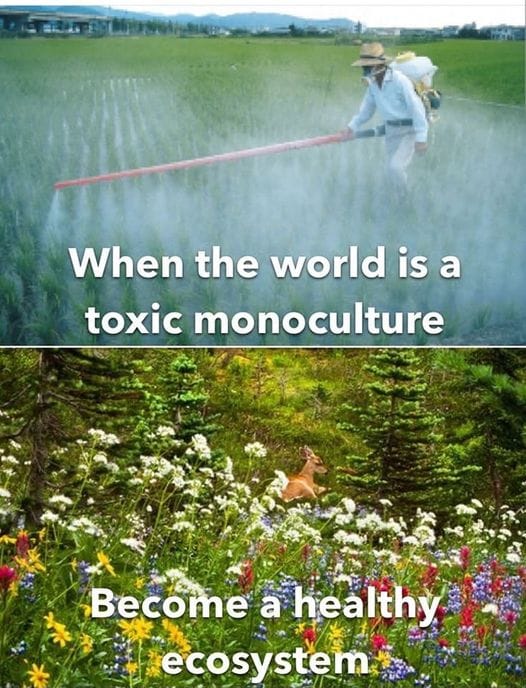
The meme is a play on the concept of permaculture, which is an approach to sustainable living that aims to create harmonious relationships between humans and the natural world. The image shows a person spraying pesticides, with the caption "When the world is a toxic monoculture" implying that our current approach to agriculture is harming the environment. In contrast, the second image shows a person tending to a diverse and thriving ecosystem, with the caption "Become a healthy ecosystem" suggesting that we can create a more sustainable and balanced world by adopting a permaculture approach.
detailed-analysis (gemma3-27b-vision)
Okay, here's an analysis of the image, broken down by the theoretical frameworks you've requested, only applying those that feel relevant.
Visual Description
The image is a diptych (two images paired together).
Top Panel: A wide shot of a perfectly aligned, green field, presumably a crop. A person in protective clothing, equipped with a large spraying device, is visibly applying pesticides/herbicides. There's a visible mist/spray hanging over the field. The scene evokes a sense of artificial control and uniformity.
Bottom Panel: A close-up of a vibrant, diverse wildflower meadow. It’s brimming with various plant species and a small deer is visible. This scene evokes a sense of natural abundance, diversity, and a lack of human intervention.
The text overlaying the top panel reads "When the world is a toxic monoculture," and the bottom panel reads "Become a healthy ecosystem." The juxtaposition of these images and texts clearly presents a critique of modern agricultural practices and suggests a desire for a more natural, balanced way of existing.
---
Foucauldian Genealogical Discourse Analysis
This image lends itself well to Foucault's approach. The top panel represents a discourse of control over nature, specifically rooted in agricultural modernization and the pursuit of high yields.
- Power/Knowledge: The image demonstrates how "knowledge" about agriculture (scientific farming methods, pest control) becomes intertwined with power. The figure in the protective suit embodies this power – the power to manipulate the environment through technology and chemicals. The very act of spraying signifies a desire to normalize a specific, controlled state of the field.
- Genealogy: A genealogical approach would investigate the historical development of this practice. Tracing the origins of large-scale monoculture agriculture, the rise of pesticide use, and the associated “scientific” justifications. We can see how these practices emerged as a way of maximizing production, tied to economic and political agendas, rather than being inherently "natural."
- Discipline/Biopower: The spraying represents a form of biopower – a mode of power that focuses on regulating life itself. It's about controlling what grows, what doesn't, and ultimately, shaping the biological landscape. The protective suit, whilst seemingly for the sprayer's benefit, emphasizes the toxicity of the process, hinting at the vulnerability of other living things.
The bottom image can be read as a contrasting "counter-discourse" - a rejection of that controlled and toxic regime, advocating for a different way of relating to the land.
---
Critical Theory
The image critiques the rationality of modern agricultural practices, echoing themes in Critical Theory. Specifically, it raises questions about:
- Instrumental Reason: The top panel exemplifies the dominance of instrumental reason – the idea that everything, including nature, is merely a tool to achieve human ends (in this case, food production). The focus is solely on efficiency and output, neglecting ecological consequences and intrinsic value.
- Domination of Nature: The image illustrates a pattern of domination over nature, where the environment is treated as something to be controlled and exploited. This is linked to broader patterns of social domination – the same logic that justifies controlling nature can also be applied to controlling people.
- Alienation: The monoculture field, despite its intended purpose of feeding people, creates a disconnect between humans and the natural world. It lacks the complexity and interconnectedness of a healthy ecosystem, and this can contribute to a broader sense of alienation.
The bottom panel, with its biodiversity and apparent "naturalness," represents an attempt to overcome this alienation and reconnect with the environment in a more holistic way.
---
Marxist Conflict Theory
The image can be analyzed through a Marxist lens, highlighting the inherent contradictions of capitalist agricultural systems.
- Means of Production: The spraying equipment, the pesticides/herbicides, and the field itself all represent means of production controlled by a relatively small number of powerful actors (agribusiness, landowners).
- Class Conflict: The image implicitly suggests a conflict between those who profit from this form of agriculture and those who bear the consequences – the environment, local communities, and even future generations. The "toxicity" of the monoculture field has a disproportionate impact on vulnerable populations.
- Commodification of Nature: The image shows how nature is treated as a commodity – something to be bought, sold, and exploited for profit. This commodification obscures the intrinsic value of the environment and leads to unsustainable practices.
The bottom panel can be seen as a call for an alternative, more equitable and sustainable agricultural system – one that prioritizes ecological health and social justice.
---
Note: I’ve consciously omitted Postmodernism and Queer Feminist Intersectional Analysis because, while potentially applicable, they don’t feel strongly supported by the visual content and themes of this image. You could argue for certain connections, but they’d be more stretched than the analyses above.
Let me know if you’d like me to elaborate on any of these points, or if you’d like me to explore the image from a different theoretical perspective!
tesseract-ocr
mar wo q aa 2 oY se E oe we bbs ; J 4 : Sd Rieti R . ag ey When the world is a — toxic monoculture - Serre. hatigine Mees ye? eee om phe! 5 Roe eer oe een ee fet oie Bs a Papen Mia asta ee Y era gS x bea hays ie ee ATE Jas. tag ree tr 5 COD) 4-7 C=) 5 re
simple-description (llama3.2-vision)
This meme is a humorous commentary on the idea that the world is not a perfect, harmonious place. The image shows a person spraying a weed killer in a field, with the caption "When the world is a toxic monoculture" and the contrast "Become a healthy ecosystem". The meme is poking fun at the idea that even in a supposedly natural and peaceful environment, there can be underlying issues that need to be addressed.