First Seen
2023-11-16T21:57:01+00:00
simple-description (llama3.2-vision_11b)
The meme is a play on the idea of permaculture, which is a holistic approach to sustainable living that involves designing ecosystems to be self-sustaining and environmentally friendly. The image is a joke about how permaculture can be a complex and nuanced topic, with the caption "I can explain permaculture to my kids, but I can't explain it to my wife" implying that even experts in the field can struggle to communicate its complexities. The image is a photo of a plant, with the text "I can explain permaculture to my kids, but I can't explain it to my wife" overlaid on top.
detailed-analysis (gemma3-27b-vision)
Okay, let's break down this image and the accompanying dialogue using various theoretical lenses. It's a surprising amount of material to unpack from what seems like a simple plant interaction!
Visual Description
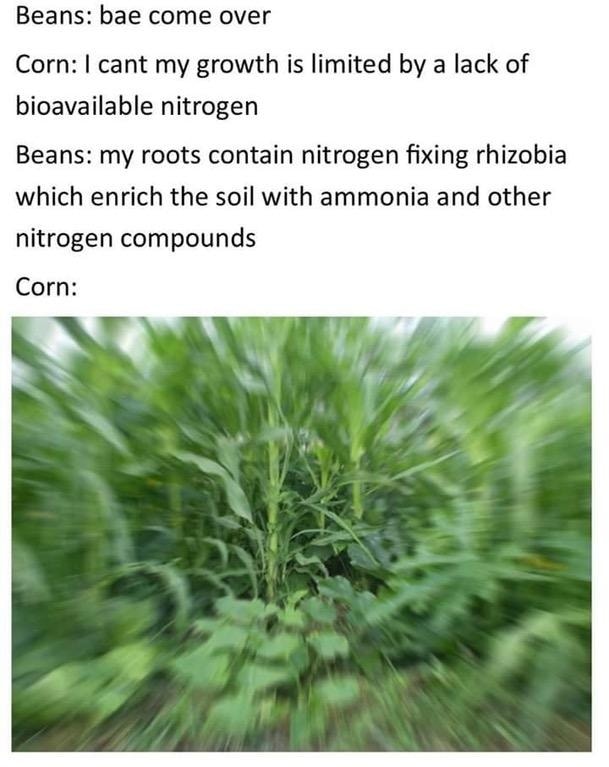
The image is a close-up, vibrant shot of lush, green corn stalks. The stalks are densely packed, creating a pattern of vertical lines and radiating leaves. The perspective is from below, looking upwards into the canopy of the corn. The lighting appears natural, contributing to the vibrant color and suggesting growth and vitality. The image evokes a sense of abundance and organic density. There's a slight motion blur which suggests the presence of wind or a dynamic environment.
---
Foucauldian Genealogical Discourse Analysis
This dialogue and image are ripe for a Foucauldian analysis. The discourse at play revolves around power and knowledge within the agricultural ecosystem.
- Power/Knowledge: The corn's declaration of a lack of "bioavailable nitrogen" isn’t merely a statement of biological fact; it's a performance of vulnerability that implicitly places it in a position of dependence. It requires a specific condition (nitrogen) to exist and requests assistance. The beans, then, possess the knowledge (and the biological capacity – rhizobia) to address this deficiency, immediately establishing a power dynamic. The beans hold the key to the corn’s flourishing.
- Genealogy of "Nitrogen": Tracing the concept of "nitrogen" itself through history reveals how it has been constructed as a limiting factor in agricultural production. This construction has led to specific interventions – the Haber-Bosch process (artificial nitrogen fixation) – which have had profound socio-political and environmental consequences. The beans' natural nitrogen fixation contrasts with this industrial, engineered solution, presenting a different genealogy of agricultural practice.
- Disciplinary Power: The entire "Three Sisters" planting method (corn, beans, squash) can be seen as a form of disciplinary power over the landscape. It's a system for organizing growth and resource allocation, shaping the environment to suit human needs.
---
Critical Theory
The interaction between the corn and the beans offers a useful entry point for a Critical Theory-based examination of the concept of interdependence.
- The Illusion of Self-Sufficiency: Contemporary capitalist society often promotes the idea of individualism and self-reliance. However, this dialogue (and the "Three Sisters" method) demonstrates that even seemingly independent entities (plants) are deeply interdependent for survival. The corn’s admission of its need reveals the falsity of the notion that any being can truly exist in isolation.
- Rejection of Essentialism: The dialogue resists the essentialist idea of plants having fixed needs and roles. The beans, through their rhizobia, are not defined by their nitrogen-fixing ability, but exercise it as a response to the corn’s stated needs. It’s a dynamic, relational process rather than a static, inherent property.
---
Marxist Conflict Theory
While a bit of a stretch, Marxist lenses can be applied:
- Resource Control: The “nitrogen” can be seen as a scarce resource, and the beans have access to it via rhizobia. This creates a form of control. The corn is dependent on the beans for its growth, representing a form of economic dependence (although a biological one here).
- Exploitation (Potential): A cynical Marxist might see this as a veiled form of "exploitation." The beans are providing a vital resource to the corn, allowing it to grow, but receiving what in return? Is this a symbiotic relationship or a subtle imbalance of power? (This is a weak application, admittedly.)
---
Postmodernism
Postmodernism finds interesting avenues to explore within this context:
- Deconstruction of the "Natural": The entire concept of "natural" agriculture is deconstructed. The "Three Sisters" method is a human intervention, a deliberate construction of a certain ecological order. There's no "pure" nature here, only constructed relationships.
- Rejection of Grand Narratives: The dialogue rejects the “grand narrative” of industrial agriculture – the idea that maximizing yield requires external inputs (like synthetic nitrogen fertilizers). It suggests a more localized, relational, and sustainable approach.
- Relational Identity: Both plants define themselves not in terms of inherent qualities but through their relationships with each other. The corn is defined by its need, the beans by their capacity to fulfill that need. This emphasizes relationality over fixed identity.
---
Queer Feminist Intersectional Analysis
This is where things get really interesting and surprisingly rich:
- Mutual Aid & Care: The interaction embodies the principles of mutual aid and care. The beans are providing a life-sustaining resource to the corn, and this isn't framed as charity, but as a reciprocal relationship. This directly challenges traditional notions of competition and individualism.
- Challenging Patriarchal Structures (Potentially): This is a bit interpretive, but one could see the corn's initial "dependence" as a historically constructed vulnerability, mirroring societal expectations imposed on marginalized groups. The beans, then, offer a form of empowerment by providing the means for self-sufficiency.
- Interdependence as Resistance: The "Three Sisters" method can be seen as a form of resistance against dominant agricultural paradigms. It's a localized, ecologically sound system that prioritizes collaboration over competition.
- Non-Linear Relationships: The relationship is not hierarchical, but a fluid exchange. The beans aren't "above" the corn; they are operating in a relational network. This rejects linear, power-based models of interaction.
Let me know if you'd like any of these analyses expanded upon, or if you'd like me to explore another theoretical framework.
simple-description (llama3.2-vision)
This meme is a humorous comparison between a person's romantic relationship and a plant's growth. The text on the image reads: "I've been in a relationship for 3 years and my girlfriend still doesn't know I love her. Meanwhile, I've been watering my plants for 3 years and they still don't know I love them either." The meme is likely a relatable joke about the struggles of relationships and the care we put into our plants.
tesseract-ocr
Beans: bae come over Corn: | cant my growth is limited by a lack of bioavailable nitrogen Beans: my roots contain nitrogen fixing rhizobia which enrich the soil with ammonia and other nitrogen compounds Corn: