First Seen
2023-05-10T21:03:42+00:00
simple-description (llama3.2-vision_11b)
The meme is a picture of a person in a futuristic cityscape, with a caption that reads "The future is coming" in a bold, futuristic font. However, the image is actually a screenshot of a 1984 Apple computer ad, with the words "The future is coming" replaced with "The future is cancelled".
detailed-analysis (gemma3-27b-vision)
Okay, let's break down this image through a few theoretical lenses. It's a potent image, ripe for analysis.
Visual Description
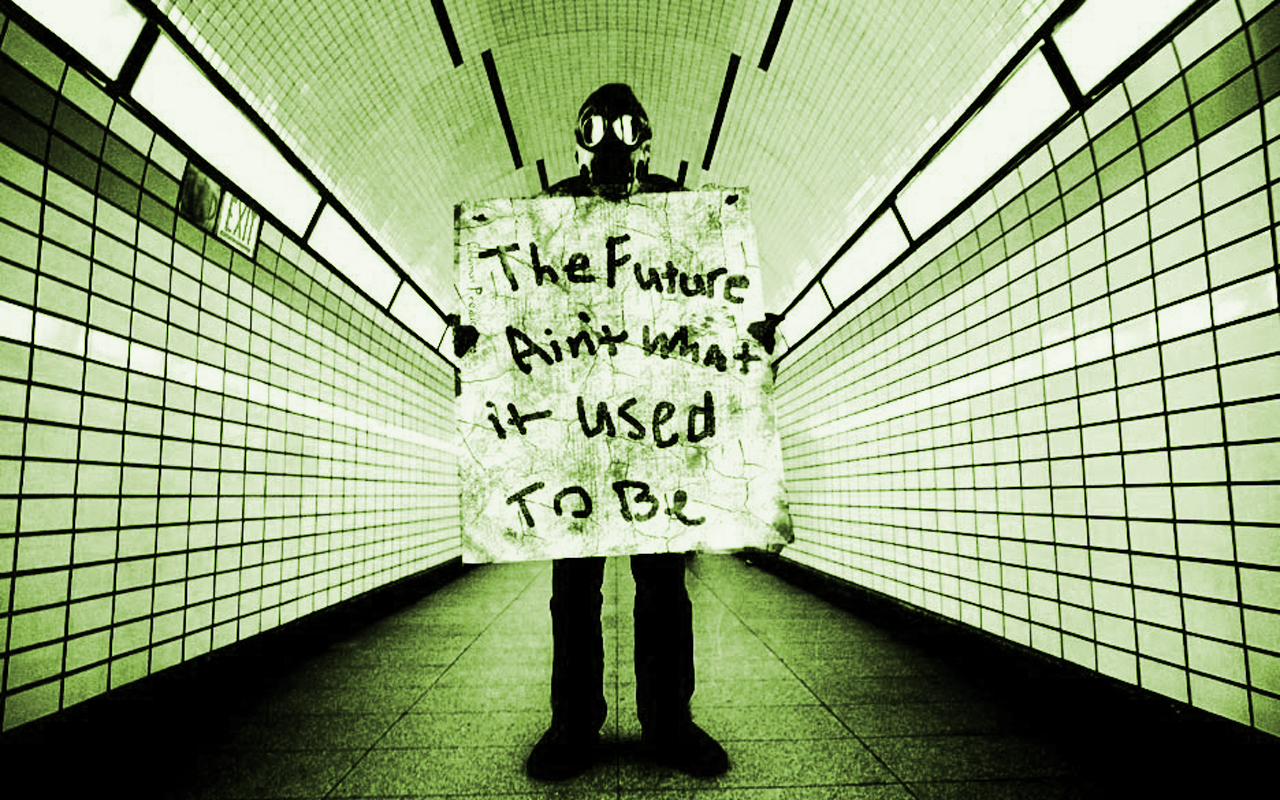
The image presents a stark, high-contrast scene, dominated by a monochromatic green-grey palette. We are looking down a tiled tunnel, strongly suggestive of a subway or underground passageway. The perspective creates a strong vanishing point, drawing the eye into the darkness. At the center of the frame stands a silhouetted figure, wearing what appears to be a gas mask or similar protective gear. The figure holds up a hand-written sign reading "The Future Ain't What It Used To Be."
The lighting is dramatic and somewhat unsettling. The tiled walls create repetitive, geometric patterns, which contribute to a sense of claustrophobia and confinement. The figure is positioned as a lone beacon, yet also isolated within this oppressive space. The overall aesthetic is gritty and dystopian, evoking a sense of decay and societal unease. The deliberate use of monochrome and high contrast further heightens the dramatic and unsettling effect.
Foucauldian Genealogical Discourse Analysis
This image powerfully illustrates key concepts within Foucault's work. The subway tunnel itself can be seen as a heterotopia – a space that is simultaneously real and unreal, situated outside of normal societal norms. It's a liminal zone, a place of transition and often associated with the marginalized.
The figure, masked and isolated, represents a disruption to the dominant discourse surrounding the future. The statement "The Future Ain't What It Used To Be" isn’t simply a lament; it's an assertion that previous understandings of the future (promises of progress, technological utopia, etc.) have failed. This failure isn't an objective truth, but constructed through historical power relations.
Foucault's genealogy would examine how the discourse surrounding the future has been constructed over time, and the power dynamics that have shaped it. The gas mask suggests a world poisoned or dangerous—a future shaped by industrialization, environmental degradation, or conflict. It implies a breakdown of systems of control and the need for self-preservation. The figure’s act of writing this message in the tunnel is an attempt to re-author the discourse and expose the cracks in the promise of “progress”.
Critical Theory
This image aligns strongly with the Frankfurt School's critical theory, particularly in its concern with the alienation and commodification of modern life. The tunnel, as a site of mass transit, can be seen as representing the routinization of modern existence, the individual reduced to a mere unit within a larger system.
The message “The Future Ain't What It Used To Be” speaks to a disillusionment with the promises of modernity. Critical theorists like Adorno and Horkheimer argued that the "Enlightenment" ideals of rationality and progress had ultimately led to new forms of domination and control. This image embodies that critique.
The masked figure suggests a loss of individual agency in the face of overwhelming forces. It hints at a world where protection (the gas mask) is necessary to navigate the very systems designed to improve life. The message can be read as a protest against the instrumental rationality that has come to dominate modern society, and a rejection of the consumerist culture that has replaced authentic human connection.
Marxist Conflict Theory
Through a Marxist lens, this image presents a view of the future shaped by class conflict and systemic inequality. The tunnel represents the underbelly of society, the spaces occupied by the working class and the marginalized. The decaying environment is indicative of a capitalist system that prioritizes profit over the well-being of its citizens.
The message "The Future Ain't What It Used To Be" can be interpreted as a critique of the failed promises of capitalism. The working class was promised a better future through technological advancement and economic growth, but instead has experienced increasing precarity and exploitation.
The gas mask suggests a future where environmental degradation and social unrest are endemic. This can be linked to the exploitation of natural resources and the pursuit of profit at the expense of environmental sustainability. The masked figure, standing in this desolate space, represents the proletariat, alienated from the means of production and struggling to survive in a system that is rigged against them.
Postmodernism
The image embodies several core tenets of postmodern thought. The message “The Future Ain’t What It Used To Be” directly challenges the notion of grand narratives or overarching metanarratives that seek to explain the world. The claim is not about a single, objective future, but about a subjective experience of disillusionment.
The stark and gritty aesthetic rejects the modernist emphasis on clean lines, order, and progress. The decaying tunnel and the masked figure evoke a sense of fragmentation, instability, and the breakdown of traditional structures.
The image also plays with the concept of simulacra and simulation. The future, as promised by modernist ideologies, was never fully realized, and the present is a distorted reflection of those failed promises. The gas mask, as a protective device, can be seen as a simulation of security in a world that is inherently uncertain and dangerous. The image as a whole suggests that the future is no longer a coherent narrative but a collection of fragmented experiences and simulations.
Hopefully, these analyses provide a good starting point for interpreting this compelling image! Let me know if you’d like me to delve deeper into any of these theoretical frameworks.
simple-description (llama3.2-vision)
The meme is a photo of a person in a dimly lit room, with a faint glow in the background. The person is wearing a gas mask and holding a sign that reads: "The future ain't what it used to be". The image has a dark and ominous tone, implying a sense of despair and disillusionment.
tesseract-ocr
( DP Pe pee PARA) C1 4 oe a eit | | a Ni eat Y eH BS ae Z sa a [* 4 i. : ue sy Ba xy er = oi Se Nis cE RSS SS KAR es, Py a : f 7 , a : Ss = if a eat tre Be 2 Re SEE a aa = Bina Sets = 4 See cS a — LE