First Seen
2015-12-18T09:30:09+00:00
simple-description (llama3.2-vision_11b)
The meme is a humorous image of a 17th-century world map, but with the countries of the world rearranged to resemble a giant pug. The text "Papes" is written in a playful, cursive font above the map, implying that the world has been transformed into a giant dog.
detailed-analysis (gemma3-27b-vision)
Okay, let's analyze this incredibly rich historical map through the lenses you've requested. Be prepared for a lengthy response, as each theoretical lens requires substantial unpacking!
Visual Description
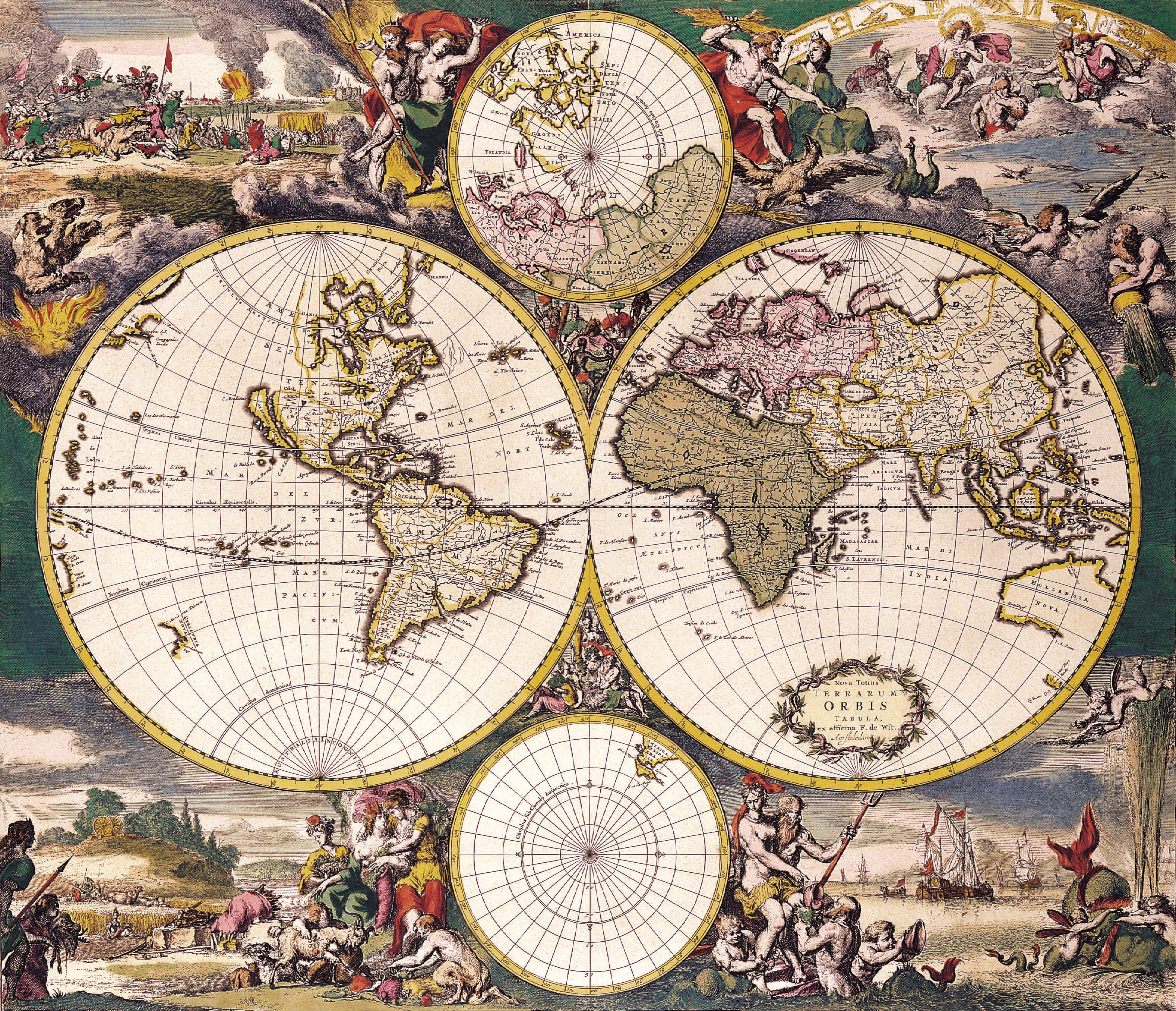
The image is a highly ornate, hand-colored world map from the late 17th/early 18th century, executed in the style of Dutch cartography of the period. It's structured as a series of four main circular maps arranged within a larger rectangular frame, with a smaller circular map near the bottom.
- Central Maps: The four larger circular maps project the world in a stereographic projection, with the North Pole at the center of the upper map. Each map focuses on a distinct hemisphere: the Americas, Europe and Africa, Asia, and the polar regions. These are beautifully detailed, showing coastlines, major cities, rivers, and mountain ranges (though the accuracy compared to modern maps varies significantly). The maps are not uniformly detailed, as exploration and knowledge were more concentrated in certain areas at the time.
- Ornate Border: The frame surrounding the maps is filled with allegorical figures, depicting scenes of warfare, navigation, agriculture, and mythological narratives. These vignettes are rendered in a Baroque style, with dynamic compositions and dramatic lighting. There's an abundance of classical motifs, like nude figures and Roman architectural elements.
- Color Palette: The map employs a color palette dominated by yellows, greens, and blues for land and sea respectively. Areas are marked and labeled in a Gothic, ornate font, indicating cities, regions, and political boundaries. The colors are applied through hand-coloring, giving the map a distinctive texture and visual appeal.
- Overall Style: The map is a synthesis of cartographic knowledge and artistic flourish. It’s not merely a practical tool for navigation but also a symbolic representation of power, knowledge, and the European worldview of the time.
Foucauldian Genealogical Discourse Analysis
Michel Foucault’s genealogical method analyzes how concepts and categories (like “world,” “civilization,” “exploration,” “territory”) are constructed through power/knowledge relations. This map isn't a neutral representation of the world; it's an archive of particular discourses.
- Episteme & Power: The map embodies the episteme – the underlying set of assumptions, beliefs, and practices – of the European Enlightenment. It reflects a belief in the possibility of totalizing knowledge, the ordering of the world through mapping and categorization, and the inherent superiority of European exploration and civilization.
- Discursive Formation: The very act of mapping is a discursive formation. It creates a discourse of ownership, control, and justification for colonial expansion. The map doesn’t simply show the world; it performs the act of claiming it.
- Visibility & Exclusion: What is included in the map (detailed coastlines, European cities) and what is excluded or marginalize (Indigenous territories, complex local geographies) reveals the power relations at play. The map's emphasis on European knowledge and territorial claims renders other ways of knowing and inhabiting the world invisible. The areas left blank or sparsely populated signify a lack of European understanding and a justification for future exploration and exploitation.
- The Panopticon Analogy: Consider the map as a kind of “panoptic” device. The European cartographer, like the panoptic guard, gains a comprehensive view of the world, enabling surveillance, control, and ultimately, domination.
Critical Theory (Frankfurt School)
Drawing on Critical Theory, we can examine this map through the lens of ideology and the “dialectic of Enlightenment.” The map is not just a representation, but a vehicle for ideological reproduction.
- Instrumental Reason: The map exemplifies the instrumental reason of the Enlightenment – the application of rational thought to achieve specific goals (in this case, territorial control, economic gain, and imperial dominance). Mapping is seen as a purely technical exercise, divorced from ethical considerations or the impact on colonized peoples.
- Myth & Domination: The allegorical figures surrounding the maps reinforce prevailing myths about European superiority and the “civilizing mission.” These figures legitimize imperial expansion and mask the violence and exploitation inherent in colonization. The map becomes a tool for constructing a narrative of progress and national greatness.
- Reification: The map reifies – turns into a thing – complex social and political relations. It presents a static, ordered view of the world, obscuring the dynamic, contested nature of power and the lived experiences of those being mapped.
- False Consciousness: The map may contribute to the creation of false consciousness – a distorted understanding of reality that serves the interests of the dominant class. By presenting a Eurocentric view of the world, it can mask the inequalities and injustices of colonialism.
Marxist Conflict Theory
From a Marxist perspective, the map is a visual manifestation of the inherent conflicts between classes and nations, and a tool for furthering capitalist expansion.
- Modes of Production & Imperialism: The map illustrates the expansion of European modes of production (capitalism, mercantilism) into new territories. The discovery and mapping of resources (gold, silver, agricultural land) facilitated the exploitation of labor and the accumulation of capital.
- Class Conflict: While the map doesn't explicitly depict class struggle, it implicitly represents the power relations between European colonizers and the Indigenous populations they subjugated. The map serves to justify the extraction of resources and the imposition of European economic systems.
- Territoriality & Control of Means of Production: The map is fundamentally about defining territories and establishing control over the means of production. The mapping of land, waterways, and resources enabled European powers to monopolize trade and extract wealth from colonized regions.
- Ideological Hegemony: The map contributes to the establishment of ideological hegemony – the dominance of a particular set of beliefs and values. By presenting a Eurocentric worldview, the map reinforces the idea that European civilization is superior and that colonial expansion is justified.
Postmodernism
A postmodern reading challenges the map’s claim to objective truth and totalizing knowledge.
- Deconstruction of Grand Narratives: The map represents a “grand narrative” of European exploration and conquest. Postmodernism would deconstruct this narrative, exposing its inherent biases, contradictions, and silences. The map doesn't offer a single, unified truth about the world, but rather a particular, constructed perspective.
- Simulacra & Hyperreality: The map itself can be seen as a simulacrum – a copy without an original. It's a representation of a representation, further removed from the “real” world. In some ways, the map may come to precede and shape our understanding of the territories it depicts, creating a hyperreality.
- Subjectivity & Perspective: Postmodernism emphasizes the role of subjectivity and perspective. The map is not a neutral representation, but a product of a particular worldview. The map reflects the biases, assumptions, and interests of its creators.
- Fragmentation & Difference: A postmodern reading would highlight the fragmentation and difference inherent in the world. The map attempts to impose order and coherence, but it ultimately fails to capture the complexity and diversity of cultures, landscapes, and experiences.
Queer Feminist Intersectional Analysis
This analysis would examine how the map reinforces heteronormative and patriarchal power structures, and how these intersect with colonial and racial hierarchies.
- Erasure of Indigenous Gender/Sexual Diversity: Colonial maps often erase or misrepresent Indigenous gender and sexual diversity, imposing European norms onto other cultures. Indigenous concepts of gender and sexuality may be radically different from European ones, and these differences are often ignored or suppressed.
- Patriarchal Framing: The allegorical figures surrounding the maps are overwhelmingly male, reinforcing a patriarchal worldview. These figures represent masculine ideals of exploration, conquest, and power.
- Colonial Violence & Gendered/Racial Exploitation: Colonialism was often accompanied by sexual violence and the exploitation of Indigenous women. The map does not acknowledge this violence, but it implicitly reinforces the power relations that enabled it. Colonial expansion also involved the construction of racial hierarchies that justified the subjugation of non-European peoples.
- Intersectionality: This analysis would examine how gender, sexuality, race, and colonialism intersect to create unique forms of oppression and marginalization. The map represents a complex web of power relations that are shaped by these intersecting factors. The map’s construction itself is an act performed by individuals whose positionality affects how they perceive and represent the world.
I hope this detailed breakdown offers a comprehensive analysis of the map through the lenses you requested. It's a remarkable artifact, rich with historical, political, and ideological significance. Let me know if you'd like me to elaborate on any specific point!
simple-description (llama3.2-vision)
This meme is a humorous image of a vintage-style world map with a large, red "X" marked through the middle of the United States. The text "I can see for miles and miles and miles and miles" is written in a playful, cursive font above the "X", referencing the classic song "I Can See for Miles" by The Who. The image is likely used to poke fun at someone's ability to see a long way, implying they are trying to be impressive but are actually just average.
tesseract-ocr
eee ‘eo. a ae eS Pe en re 3 PZ Fg PR |e gh OD eA SE el AN LS eR aS Ae oe pane ee |. | Se ae) ie A, LF /; SO SSN LT SO Heda —— we ag pd Te ma eo OP wae |? = a MAF pes aay Se) cP WSs a ee 6 ye Se NaS oO Seh oe oer Gi seothe S aicdae A Boe yy NCR oN \aae Ps eS oP \ edt eee Ue eae on ‘bh a SCRA TX oo. Vs Se Se Sy ee an Be ee ed) SURE 2 SPN Ma y AX | XN 4 fo) Vee & r) Za. = 2 ge . .- co eee ae eee SS Se ee N S 5d Bx \ iG Se cael, ‘ii = ee Sy ee Se SSS ie =e | oo. Ga ee <é/ A [Ae TA |] [are IE Die = Se ee ee eee man. ee NOR a ee — f S| 4 > Pm Fae SS SSS er Was PEARY Ie Gi ° NR | ee ee Re Ge eS RU RS ———— = Fs aS ee ee ee ae abe 2s. 2 Wa, ED RES: at ay Sh WS ees Oo Cae A yaa | TE ee, Se Rae OS BS f° Se OM OO oe Le a Nal Kk poy A eee ; Ow eS f in a 6 SS Le = MGA ie Q XG. \\G ee’ » AER PO i we. SE xy re De hwo eb a V7 hal” /” BEPI E nate ORES og) A ASE Ores Na /. SES eae eT a a / ON Se Vr ee S ay a SASS) ee Dae Se) 4 a8 = yy. : fe [ae cect BE (WY we ay es ee SC elie ale FN aa cS Ye See ef 3 ie | at FaMcien WE iy S Sey se Ease Spx SBb Peer “yak Lee eet Vg EAN x \ eae By ee Ne ee Wey bf | a | RR fad) f'n . Neon Sarg eee eed . 3 bf : : : has rib Tied ienate [A ies oe, Suter Pie so! SS Soe) Po treg Re Sey ae ‘ oat Dae | 37 ee a Se ee i cist? eee, ae Ba ir ‘a Beaks fe aoe. ; wlio 2 * = 4 i SS 2 ep a a AES ee \ 1 ff ea oe |. TTY Te eae ) eer a al 1 san gh 08m 92 a eS ye ae ia uv pe a aafnces ee (a Ses Ea i al ‘ : le 7 Nae eee xa VS ! | ea ae 25 =e ae BGR } a e ee 4 ‘ gfe i us Soeeaten Boe! Seo ois 8 a Re EE PSB ect ee i eee = h ae a Be ae areca rete | 2 ani RSP iy ogg S Poe ae ge I | ee ie ee es ene aa eee, bes, ad eit Mi Sg et i ee oti = = = i SI AY \ a). eae ores BS # See : : a Ss eee eee eee .\ Yl Pa ae f ay . ( ete tt | a | » : oe a2 or [7 f [es \ signe Lede} hae. a eee | A fet A \, Eb Cab cles ES A —. eens RAK 7 BO he = STA | Wie ns va AGT Oo - W UNE | S , \V< 2 oS TO as |) ey ae \J GS a | |) SS ee ee Wipe Se A oe Bestfies Rots 2S ey RG AMS 7 ee ik Spee eh a Neh [et 3 ( al wea Oe’ : =e N= es Se 4 pS DS ic Oe RN KS Se 7 a, \ ot we hee Lp eee Ae ea RT Se a eee enaer ha a ihe poe ae la ee Fh TERESA Ma yore oe Wee a es io ee Ny io ee a Or a Ais ple th eee GE EN ee Se bet Pa AO