First Seen
2023-05-10T21:03:38+00:00
simple-description (llama3.2-vision_11b)
This meme is an image from the TV show "Star Trek: Discovery" featuring a character, Ash Tyler, played by Shazad Latif, who has a condition that makes him experience emotions in a more intense and literal way. In the image, Ash is reacting to a situation with a shocked expression, as if he's experiencing a strong emotion. The text above the image reads "I'm not crying, you're crying!" which is a humorous way to express that someone is overwhelmed with emotion.
detailed-analysis (gemma3-27b-vision)
Okay, here's an analysis of the image and its caption through several theoretical lenses. Note that some lenses will be more applicable than others, and interpretations are, naturally, subjective.
Visual Description
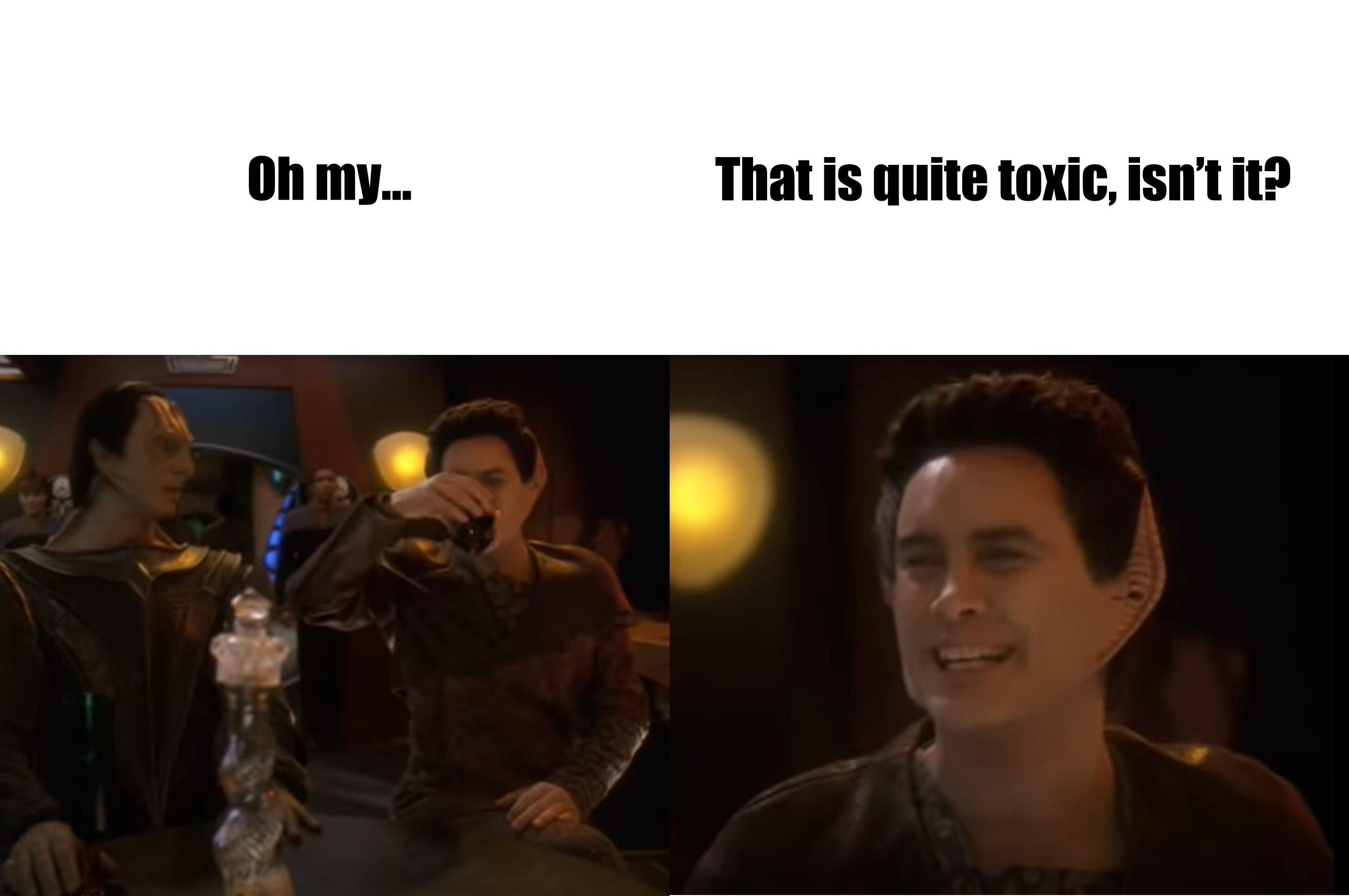
The image is a two-panel meme featuring a screencap from Star Trek: Voyager.
* Panel 1: Shows Commander Chakotay (Robert Beltran) and Seven of Nine (Jeri Ryan) sharing what appears to be a drink. Chakotay is handing Seven the drink in a way that suggests intimacy. The lighting is warm, but dim, with the scene bathed in reddish and blue hues. The characters are dressed in their Starfleet uniforms.
* Panel 2: Features a close-up of Commander Chakotay, looking directly at the viewer with a slightly unsettling, knowing smirk. The lighting is stark, highlighting his face and creating strong shadows. His expression implies a knowing complicity or cynical observation.
* Caption: The image is captioned "Oh my..." followed by "That is quite toxic, isn't it?" This juxtaposes the potentially romantic or intimate moment with a critical framing of its inherent problematic aspects.
Foucauldian Genealogical Discourse Analysis
The meme's power comes from its deployment of “toxicity” as a discourse. Foucault's genealogical method would ask how this discourse around toxicity has evolved historically.
Power/Knowledge: The caption suggests a power dynamic at play. The character, Chakotay, understands that the depicted interaction is problematic, implying a superior position of knowledge*. The 'toxicity' isn’t inherent in the act itself, but constructed through discourse.
* Disciplinary Power: The "toxicity" label can be seen as a form of social control – defining certain behaviors as unacceptable. It creates a disciplinary framework within which we interpret the scene. The meme draws upon contemporary discussions of boundaries, consent, and power imbalances to retroactively frame a scene from a 1990s TV show.
* Historical Context: The meme acknowledges and responds to a contemporary re-evaluation of relationships depicted in older media. There's a shift in how we view power dynamics, and the meme capitalizes on that.
Critical Theory
The meme engages with aspects of Critical Theory, particularly regarding the reproduction of social norms and power structures.
Ideology: The scene, taken at face value, might initially appear as a moment of connection. The meme interrupts* this initial interpretation, revealing the potential for subtle coercion or imbalance of power. This disrupts the naturalization of certain relationship dynamics.
* Domination and Resistance: The meme itself can be seen as an act of resistance against the way certain relationships have been traditionally portrayed in media. It challenges the romanticization of potentially problematic interactions.
* Reflexive Modernity: The meme is inherently self-aware, reflecting on the conditions of its own production and the social context in which it circulates. It acknowledges the problematic aspects of the scene with the benefit of contemporary understanding.
Queer Feminist Intersectional Analysis
The meme can be interpreted through a Queer Feminist Intersectional lens, especially when considering the character of Seven of Nine.
* Power Dynamics and Gender: Seven of Nine's backstory as a former Borg drone involves a loss of agency and bodily autonomy. Any romantic or intimate relationship she enters must be examined through this lens. The meme implicitly suggests that even a seemingly consensual interaction might be tainted by past trauma and power imbalances.
* Toxic Masculinity: Chakotay’s smirk can be interpreted as embodying a subtle form of toxic masculinity – a knowing acknowledgment of his own power and the potential for exploitation.
* Intersectionality: While not explicitly present, the lens highlights how power imbalances can be compounded by multiple factors (gender, trauma, etc.). The meme demands a critical consideration of the intersection of these dynamics.
In conclusion:
The meme is surprisingly layered and taps into contemporary anxieties about power, consent, and the re-evaluation of past media representations. It leverages a visual contrast and a pointed caption to disrupt a potentially romantic scene, forcing a critical reassessment of its underlying dynamics. Its effectiveness stems from its ability to use irony and contemporary discourse to provoke thought and challenge established norms.
simple-description (llama3.2-vision)
This meme features a screenshot from the TV show "Star Trek: The Next Generation" where the character Data, an android, is reacting to a drink being served to him. The text above the image reads "Oh my..." and the text below reads "That is quite toxic, isn't it?" The image is a humorous take on Data's innocence and lack of understanding of human emotions and experiences.
tesseract-ocr
Oh my... That is quite toxic, isn't it?