First Seen
2024-07-09T04:08:05.096697+00:00
simple-description (llama3.2-vision_11b)
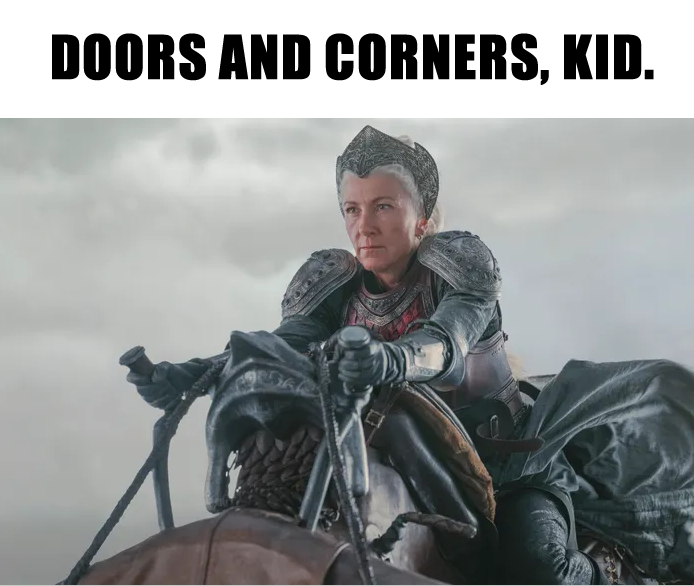
This meme is a play on the phrase "on the one hand" and the movie "Lord of the Rings" character "Gandalf's" phrase "you shall not pass" is replaced with "on the one hand" and the image is of Gandalf's horse but it is now a "giant" horse.
detailed-analysis (gemma3-27b-vision)
Here’s an analysis of the image, broken down into the requested sections, noting that not all theoretical lenses are equally applicable.
Visual Description
The image features a middle-aged woman, dressed in highly stylized, ornate armor reminiscent of medieval or fantasy battle attire. She is seated upon a dark-colored horse, or what appears to be a mechanical version of one, judging by the visible metal framework. Her armor is a mix of dark metal plates and red fabric, with a high, pointed collar framing her face. Her expression is stern and unwavering, conveying authority and possibly menace. The background is blurred and indistinct, appearing overcast or foggy, creating a sense of distance and imposing presence. A text overlay at the top of the image states “Doors and Corners, Kid.” This phrase is enigmatic and contributes to a sense of foreboding or challenge.
Foucauldian Genealogical Discourse Analysis
The image lends itself to a Foucauldian reading because of the highly constructed display of power. The armor isn’t merely protective gear; it is the performance of power. Michel Foucault argued that power operates not just through repression, but through the production of discourse and the construction of subjects.
* Discipline & Biopower: The armor represents a disciplinary practice, imposing a strict order and aesthetic on the body. The visual imposition of the armor and the horse represent biopower – the ways power operates over life itself, controlling and shaping it.
* Genealogy of Power: We could trace the genealogy of this display of power through historical representations of knights, monarchs, and military leaders. The image draws upon this history, but it is not a simple reproduction. It’s a modern re-imagining, suggesting that power is always reconfigured and re-presented.
The Gaze: The woman's unwavering gaze is crucial. It’s not simply looking; it’s exercising* power through the gaze, controlling the visual field and demanding recognition. The phrase “Doors and Corners, Kid” could be interpreted as a challenge, a threat, or a demand for submission. It highlights the power dynamics at play.
Critical Theory
The image can be approached through a lens of critical theory, focusing on the ways it reinforces or challenges dominant ideologies.
* The Ideal of the Warrior: The image upholds a traditional ideal of the warrior, dressed in armour, mounted on a horse. This ideal is often tied to notions of heroism, strength, and conquest.
* Critique of Authority: However, there is also a potential subversion. This is not a simple romanticization of war. The woman’s stern expression and the ominous text suggest a darker, more complex relationship to power. The image could be critiquing the arbitrary and often violent exercise of authority.
* Media Representation: The image itself is a constructed representation. It raises questions about how power is portrayed in media and how these portrayals shape our understanding of it.
Marxist Conflict Theory
While not the most immediately apparent lens, a Marxist reading can be applied by focusing on the symbols of power and control.
* Control of Means of Production: The armor, the horse (or its mechanical equivalent), and the woman herself represent control of the means of production – not necessarily industrial, but of violence, force, and, ultimately, of the narrative.
* Class & Hierarchy: The image visually reinforces a clear hierarchical structure. The woman is positioned as the one who wields power, while the unseen “kid” is presumably subject to it. This reinforces existing class structures and power imbalances.
* Ideological Control: The image is itself a tool for ideological control. It presents a specific vision of power and authority, which serves to legitimize it and maintain the status quo.
Postmodernism
The image displays several elements aligning with postmodern thought:
* Pastiche & Irony: The combination of medieval-style armor with potentially modern technology (the mechanical horse) creates a pastiche – a blending of different styles and eras. This blurring of boundaries is characteristic of postmodernism.
* Deconstruction of Grand Narratives: The image disrupts the traditional “heroic warrior” narrative. The stern expression and the foreboding text suggest a more ambiguous and cynical view of power.
* Simulation & Hyperreality: The image can be viewed as a simulation of power, a constructed representation that is divorced from any “authentic” reality.
Queer Feminist Intersectional Analysis
While the image doesn't directly suggest queerness, an intersectional feminist reading can focus on how the image challenges traditional gender roles.
* Breaking Gender Norms: The image subverts traditional depictions of women. This woman is not portrayed as delicate or submissive, but as a powerful and formidable figure. It challenges the expectation that women should be passive or nurturing.
* The Performance of Power: It can be analyzed through a feminist lens that critiques the performative aspects of power. The woman's armor and position symbolize a constructed and deliberate performance of power, potentially challenging the naturalization of patriarchal structures.
* Intersection with Class/Status: This woman's power isn't just gendered, it’s likely tied to class, status, or some other form of social privilege. This makes for a more complex intersectional understanding.
Please Note: These analyses are interpretations and could be approached differently depending on the specific theoretical focus and the interpreter's perspective. The image is ambiguous enough to support multiple readings.
simple-description (llama3.2-vision)
This meme is a photo of a character from the Game of Thrones series, specifically a younger version of the character Melisandre, played by actress Carice van Houten. The text above the image reads "Doors and corners, kid." This is a play on the character's famous phrase "Drinks and kisses, kid," which is a humorous and ironic twist on the original quote.