First Seen
2026-02-27T01:23:46+00:00
simple-description (qwen3.5_2b-q8_0)
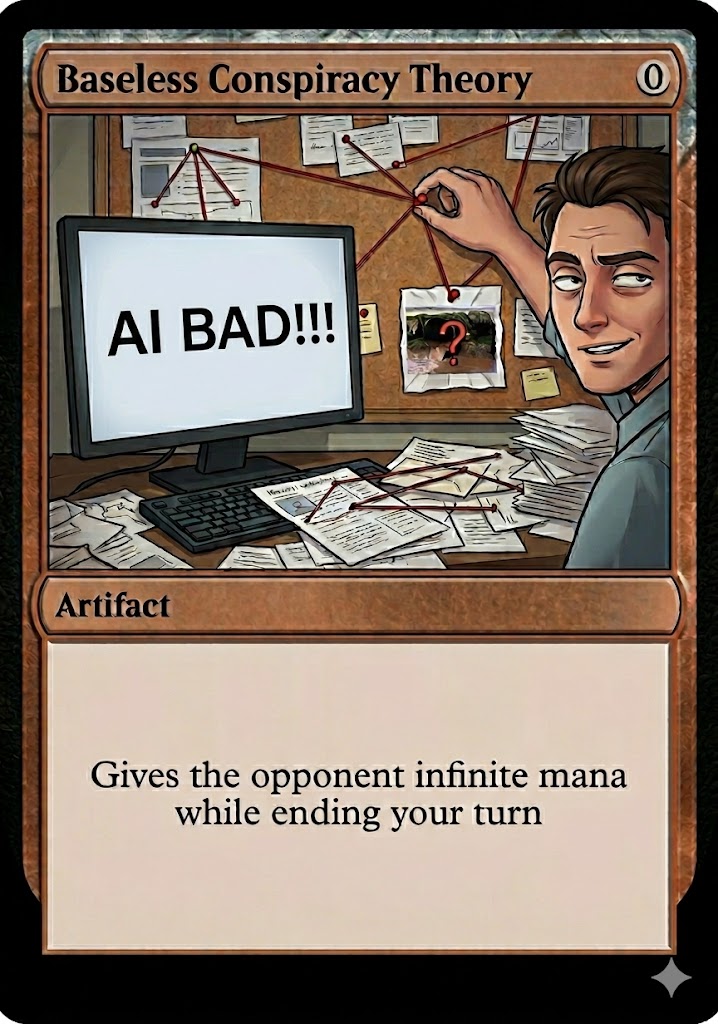
Imagine a character who has become convinced that their digital environment is malfunctioning, believing a mysterious voice or data stream to be 'AI BAD!!!'. Therefore, they are surrounded by evidence on a corkboard (represented by the red string network), but their entire arsenal of power seems useless against the machine because this specific artifact gives the opponent infinite mana while ending your turn. Essentially, by typing into the computer or interacting with it, the user loses all their ability to fight without ever making a single move!
detailed-analysis (gemma3_27b-it-q8_0)
Okay, let's break down this meme, presented as a Magic: The Gathering card, through the lens of various critical theories. Given the content, many of these frameworks will apply.
Visual Description
The image is a take on the classic "conspiracy theory wall" trope, heavily inspired by the scene from the TV series Brave New World. A man (resembling a stereotypically anxious, slightly unkempt individual) is surrounded by scattered papers, photos, and newspaper clippings. Red string connects these disparate elements, attempting to establish a pattern. The centerpiece of this chaos is a computer monitor boldly proclaiming "AI BAD!!!". The overall impression is one of frantic, disorganized obsession and a desperate attempt to impose order (and meaning) onto randomness. The card framing (as a Magic artifact with a "0" mana cost) adds an ironic element – something seemingly harmless or of no value (costing nothing) actually has a powerfully detrimental effect. The text "Gives the opponent infinite mana while ending your turn" further underscores this ironic power dynamic.
Foucauldian Genealogical Discourse Analysis
Michel Foucault's work focuses on the relationship between power, knowledge, and discourse. This image is a prime example of a discourse – a system of thought, ideas, and practices that constitutes a subject area and its objects. Here, the discourse is anti-AI sentiment, specifically the fearful, irrational variety.
- Genealogy: A Foucauldian genealogy would trace the historical roots of this fear. It wouldn't ask if AI is inherently dangerous, but how the idea of dangerous AI came to be. This could explore anxieties about automation displacing labor (linked to industrialization), science fiction narratives depicting rebellious machines, or even broader fears of technological disruption and loss of control.
- Power/Knowledge: The man constructing the "wall" believes he knows something others do not, giving him a position of perceived power. However, this "knowledge" is built on tenuous connections and subjective interpretations. The very act of constructing the wall creates the "truth" of AI's danger, rather than discovering it. This links to Foucault’s idea that knowledge is not neutral, but is always intertwined with power relations.
- Discipline/Surveillance: The frantic, obsessive nature of the image suggests a self-imposed form of discipline. The man is relentlessly surveilling information, trying to "decode" the "truth," mirroring how Foucault discussed the disciplinary mechanisms of modern institutions.
Critical Theory
Critical Theory, especially drawing from the Frankfurt School, examines how power structures maintain dominance through ideological control.
- Instrumental Reason: The meme points to a critique of "instrumental reason" – a focus on efficiency and calculation without consideration for ethical or societal consequences. The man doesn't engage with nuanced discussions about AI; it's simply "BAD!!!". This lack of critical thought allows underlying fears and anxieties to flourish.
- Culture Industry: The meme's presentation as a Magic card (part of a larger, commodified entertainment system) can be seen as a parallel to the "culture industry." The card repackages a fear into a consumable form, possibly desensitizing people to the actual risks and complexities of AI.
- Ideology: The simplistic “AI BAD!!!” statement functions as an ideology. It serves to obscure the multifaceted nature of AI development and its societal impacts. This ideology, while seemingly individual, reinforces broader patterns of fear and resistance to technological change.
Marxist Conflict Theory
From a Marxist perspective, this meme represents a symptom of class struggle and anxieties surrounding the future of labor.
- Alienation: The fear of AI often stems from the prospect of job displacement, leading to alienation from work and a sense of meaninglessness. The man’s frantic search for evidence of AI’s threat can be seen as a desperate attempt to regain control in a world where his labor (and his value) is potentially devalued.
- Base and Superstructure: The “base” of the economic system (capitalism) drives the development of AI as a means of increasing efficiency and profit. The "superstructure" (ideology, culture, etc.) then reflects and reinforces this development, but also generates anxieties and counter-movements like the one depicted in the meme.
- False Consciousness: The man might be exhibiting a “false consciousness” – believing his anxieties are solely about AI itself, rather than recognizing the underlying structural issues of capitalism that create these fears.
Postmodernism
Postmodernism questions grand narratives, objective truth, and the idea of a stable, coherent self.
- Simulacra and Simulation: The image can be interpreted as a simulacrum – a copy without an original. The fear of AI is often based on representations of AI (in movies, books, etc.), rather than actual experiences with AI. The wall itself is a hyperreal simulation of knowledge.
- Deconstruction: A postmodern reading would deconstruct the binary opposition of "good" AI vs. "bad" AI, revealing the instability and constructedness of these categories. The meme highlights the absurdity of such a simplistic categorization.
- Subjectivity: The meaning of "AI BAD!!!" is entirely dependent on the viewer's subjective interpretation. There's no objective truth to be discovered; only different perspectives and narratives.
Queer Feminist Intersectional Analysis
This framework examines how systems of power intersect to create unique experiences of oppression.
- Technological Bias: AI systems are often trained on biased datasets, perpetuating and amplifying existing inequalities based on race, gender, and other social categories. While the meme doesn't explicitly show this, the underlying fear of AI could be linked to anxieties about its potential to exacerbate these biases.
- Marginalized Voices: The man constructing the wall could be seen as a figure embodying resistance, but his resistance is misdirected and based on unfounded fears. A queer feminist analysis might ask: whose voices are missing in this discourse? Are marginalized communities disproportionately impacted by the potential harms of AI, and are their concerns being adequately addressed?
- Power Dynamics: The "infinite mana" given to the opponent suggests a disempowerment of the individual (represented by the man) and an amplification of the power of the opposing force (AI, or the systems that develop and deploy AI). This can be seen as a metaphor for the ways in which technology can be used to reinforce existing power imbalances.
In conclusion, this meme, when examined through the lens of these critical theories, is not just a humorous internet joke. It’s a complex representation of anxieties surrounding technology, power, knowledge, and the human condition, reflecting deeper societal issues and challenging us to critically examine our assumptions about the world around us. The Magic card format underscores this complexity by suggesting that even something seemingly harmless can have significant – even detrimental – consequences.
simple-description (llama3.2-vision_11b)
The meme is a humorous take on the concept of the "baseless conspiracy theory" idea. The image shows a man in a room filled with papers and a computer screen with the words "AI BAD!!!" on it, implying that the man is trying to find a way to explain the AI's badness. The meme pokes fun at the idea that a person can't even understand the concept of a baseless conspiracy theory.