First Seen
2023-05-10T21:03:38+00:00
simple-description (llama3.2-vision_11b)
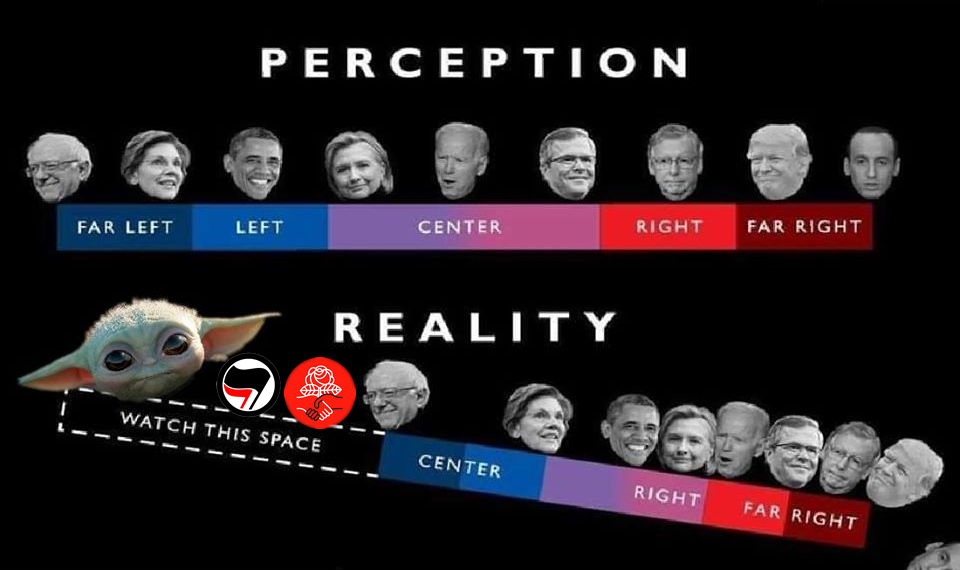
The meme is a play on the concept of "left" and "right" ideologies, with a humorous twist. The image shows a split-screen of two politicians, one from the left and one from the right, with a caption "Left/Right" and a red and blue color scheme. The meme is captioned "The only time left and right agree is on the importance of" and lists various topics, such as "tax cuts", "gun control", and "climate change", with a tongue-in-cheek tone.
detailed-analysis (gemma3-27b-vision)
Okay, here's a breakdown of the image, analyzed through the lenses you requested, broken down into sections with headings. I'll indicate when a section doesn't apply. It's a complex image, ripe for interpretation.
Visual Description
The image is a digitally created composition divided into two horizontal sections, labeled "PERCEPTION" and "REALITY." Both sections feature a row of digitally pasted headshots of prominent political figures spanning the political spectrum from "Far Left" to "Far Right." The individuals in the order are:
* Far Left: Bernie Sanders
* Left: Hillary Clinton
* Center: Barack Obama, Joe Biden
* Right: Donald Trump, George W. Bush
* Far Right: Vladimir Putin, and another face.
Beneath “Reality”, a digitally inserted image of "Baby Yoda" (Grogu) is present, along with two logos, an image of a hammer and sickle, and a symbol of the Red Guard.
The “Reality” row is overlaid with a dotted line rectangle drawing attention to the area.
The color scheme changes from blue (Far Left) to purple/red (Center) to red (Far Right) as you move across the spectrum, visually representing the ideological alignment. The image is stark, dark, and appears designed to evoke a sense of contrast and potential manipulation.
Foucauldian Genealogical Discourse Analysis
This image lends itself strongly to a Foucauldian analysis. The "PERCEPTION" and "REALITY" labels immediately establish a dichotomy – a division between how we understand the world and the world as it is. Foucault would be less concerned with whether the image depicts "true" reality and more interested in the power dynamics embedded within the very construction of those categories.
Discourse & Power: The act of arranging these political figures along a linear spectrum is a discursive practice. It creates a discourse of political alignment, but it is not neutral. It suggests a specific logic – that political positions are neatly categorized and easily defined. The image implicitly claims authority* in defining that categorization.
* Genealogy: A genealogical investigation might trace the historical development of this "political spectrum" itself. When and how did this model emerge? What power relations did it serve to reinforce? How has it been used to include and exclude certain ideologies?
* Knowledge/Power: The image demonstrates that knowledge isn't objective, but is inextricably linked to power. The arrangement of figures isn’t about objective truth, but a construction designed to categorize, control, and perhaps, delegitimize certain positions.
Critical Theory
This image is a clear invocation of core tenets within Critical Theory. It’s a visual argument about the manipulation of perception and the construction of reality.
* Ideology: The alignment of figures clearly communicates a specific ideology. The image suggests that those in the “center” are somehow more reasonable or objective, while those on the “extremes” are problematic. This is a classic example of how ideology can be presented as common sense.
* Hegemony: The image arguably participates in maintaining a hegemonic structure. It presents a limited, simplified view of the political landscape, potentially obscuring the complex factors that shape political beliefs and actions.
* False Consciousness: The image implies that people are often unaware of the forces that shape their perceptions. The "PERCEPTION" vs. "REALITY" labels suggest that many are operating under false pretenses.
* Critique of Enlightenment Reason: Critical Theorists like Adorno and Horkheimer would likely see the image as a symptom of the “instrumental reason” that dominates modern society. The attempt to categorize and control the political landscape is a form of domination.
Marxist Conflict Theory
The image is rich with implications for a Marxist analysis.
Class Struggle (Symbolic): While not directly depicting economic classes, the image represents* a conflict – a struggle for ideological dominance. Each figure symbolizes a particular interest group or worldview.
* Base & Superstructure: The political figures (superstructure) are presented in a way that suggests they are influenced by underlying power dynamics (the base). The alignment implies that these figures are not simply acting on their own, but are products of larger societal forces.
* Ideology & False Consciousness (Again): The image reinforces the Marxist idea that dominant ideologies serve to maintain the status quo. By presenting a specific view of the political landscape, the image potentially obscures the true sources of power and inequality.
* Symbolism of the Hammer and Sickle: The inclusion of the hammer and sickle symbol speaks directly to communist ideology. The symbolic gesture can be interpreted as a critique of capitalism, or even a claim of agency.
Postmodernism
The image's treatment of "Reality" and “Perception” is ripe for a postmodern deconstruction.
* The Death of Grand Narratives: The image challenges the notion of a single, objective "Reality." By juxtaposing "Perception" and "Reality," it suggests that there are multiple, equally valid ways of understanding the world.
Simulacra & Simulation: The digitally manipulated nature of the image itself reflects the postmodern concept of simulacra. The image is a copy of a copy, removed from any "real" referent. The figures are representations of* representations.
* Deconstruction: A deconstructive reading would focus on the inherent contradictions and ambiguities within the image. What is the "Reality" being presented? Who is defining it? What is excluded?
* Baby Yoda’s Inclusion: The inclusion of Grogu from The Mandalorian raises questions about our media consumption, the construction of cute characters, and the creation of a false “reality”.
Queer Feminist Intersectional Analysis
This lens is less directly applicable, but still offers some avenues for interpretation.
* Power Dynamics & Representation: The image is overwhelmingly dominated by white, male figures. This reinforces the historical exclusion of women and people of color from positions of power.
* Intersectional Exclusion: This image is an example of the silencing of intersecting identities by focusing on political ideologies rather than identity markers.
* Challenging the Norm: By presenting the image as a reality, it’s tacitly creating a framework of a reality that excludes queer and feminist voices.
Overall:
The image is a complex, provocative work that invites a variety of interpretations. It is clearly designed to provoke thought and challenge assumptions about the nature of political reality. It’s a strong example of how visual media can be used to express ideology, critique power structures, and raise questions about the nature of truth itself.
simple-description (llama3.2-vision)
The meme is a visual comparison between the left and right sides of a political spectrum. The top section, labeled "Left," features a series of politicians, including Bernie Sanders, Hillary Clinton, and Elizabeth Warren, with a label indicating they are "Far Left." In contrast, the bottom section, labeled "Right," features a series of politicians, including Donald Trump, Ted Cruz, and Mike Pence, with a label indicating they are "Far Right."
tesseract-ocr
PERCEPTION Fury LI a | me Ea -