First Seen
2023-11-07T20:20:32+00:00
simple-description (llama3.2-vision_11b)
This meme is an image of a scene from the TV show "Stranger Things" with a caption that reads: "I'm the boss. You're fired. You're going to go back to Hawkins and you're going to find that girl and you're going to bring her back here. And if you are ever caught you will be brought straight back here to the Hawkins lab for questioning. So you do what Mike says and you tell us what happened."
detailed-analysis (gemma3-27b-vision)
Okay, here's an analysis of the image presented, broken down into relevant sections based on the requested theoretical lenses. I’ll only include sections that are applicable, as not every theory will perfectly map onto this image.
Visual Description
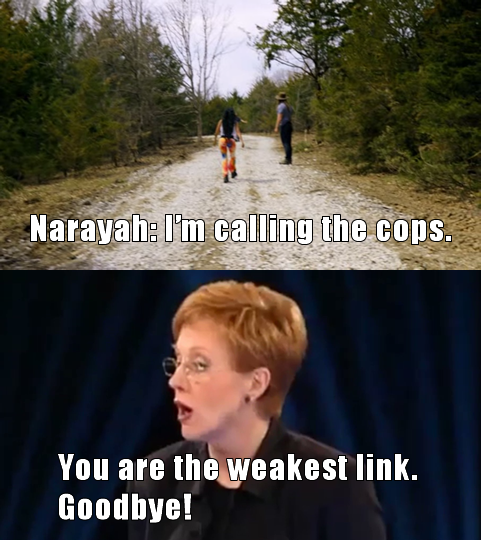
The image is a diptych, meaning it's a two-panel composition.
* Top Panel: Depicts a dirt path winding through a wooded area. Three figures are visible walking away from the viewer, seemingly receding into the trees. The lighting suggests it's a cloudy day or early evening. The composition suggests a sense of isolation or pursuit.
* Bottom Panel: Shows Anne Robinson, host of the British game show "The Weakest Link," in a dramatic pose, seemingly yelling into the camera. The background is a stark black, focusing all attention on her face and expression. Text overlays the image saying "You are the weakest link. Goodbye!"
The overall effect is to juxtapose a scene suggesting vulnerability and possibly threat (the figures in the woods) with a confrontational and dismissive declaration of failure.
---
Foucauldian Genealogical Discourse Analysis
This image lends itself well to a Foucauldian reading. The phrase “You are the weakest link” is not merely a statement of fact about a game show participant; it's a mechanism of power/knowledge.
Discourse: "The Weakest Link" creates a specific discourse around competence, failure, and evaluation. It establishes a framework where individuals are categorized* as “weak” or “strong,” thereby defining what those terms mean within the game’s context.
Power/Knowledge: Robinson's pronouncement isn't simply judging someone's performance; it constitutes their identity as the “weakest link.” The power to name, categorize, and ultimately dismiss someone is a form of power, and that power is linked to the "knowledge" produced by the game show’s rules and format. The statement isn’t just about weakness; it creates* weakness as a social category.
* Genealogy: The show participates in a genealogy of practices of evaluation and dismissal that have historical roots in broader societal structures. This extends beyond the game show, mirroring ways individuals are evaluated and marginalized based on perceived weaknesses in various social contexts (workplace, school, etc.).
* The call to the police creates a panoptic control situation, invoking a higher power and further solidifying the categorization.
---
Critical Theory
The image exemplifies the concerns of Critical Theory, particularly regarding domination and control.
* Ideology: The game show can be seen as a microcosm of capitalist ideology, where individuals are pitted against each other in a competitive struggle for “success” (in this case, staying in the game and winning money). The emphasis on eliminating the “weakest link” reinforces the idea that only the strong survive, justifying social hierarchies.
* Power Dynamics: Robinson embodies the authority figure, wielding the power to judge, dismiss, and ultimately eliminate participants. This reflects broader power dynamics in society, where certain individuals or institutions hold the power to define success and failure, and to control the fates of others.
* Alienation: The competitive environment of the game show could be seen as contributing to alienation, as participants are reduced to their perceived "strength" or "weakness," and their individuality is suppressed.
---
Marxist Conflict Theory
While not a direct application, Marxist Conflict Theory can provide some insight.
* Competition & Hierarchy: The game show inherently structures a competitive environment. Participants are in direct conflict with each other, vying for a limited prize. This mirrors the class struggle central to Marxist theory, where groups compete for scarce resources.
* The Value of Labor: One could argue that the participants are 'selling' their knowledge and abilities (their 'labor') within the game show format. The 'weakest link' is deemed 'worthless' in this exchange, reflecting a capitalist valuation of individuals based on their productivity or contribution. However, this reading is less robust than the other analyses.
---
Postmodernism
The image exhibits characteristics that align with some postmodern ideas:
Simulacra and Simulation: The game show itself is a simulation of competition and success. The 'weakest link' is defined within* this simulation, not necessarily based on any objective reality. The pronouncement becomes a performative act, creating meaning (weakness) rather than reflecting it.
* Deconstruction of Meaning: The stark juxtaposition of the two images challenges any simple interpretation. The connection between the vulnerable figures in the woods and the harsh dismissal by Robinson is deliberately ambiguous, questioning the idea of a coherent narrative or meaning.
I hope this analysis is helpful! Let me know if you'd like me to elaborate on any of these points.
simple-description (llama3.2-vision)
This meme features a split-screen image with a picture of a woman (likely a comedian or actress) on the top, and a screenshot of a video game or online chat on the bottom. The top image shows a woman with a shocked expression, while the bottom image shows a text chat window with a user named "Narayah" saying "I'm going to go get the cops". The text at the bottom of the meme reads "You are the weakest link. Goodbye!"
tesseract-ocr
i x ie ae * a" — ‘ a rrririe Poe he HO | aN TET Ls link. OC