First Seen
2023-05-10T21:03:38+00:00
simple-description (llama3.2-vision_11b)
The meme is a humorous image of a character from the animated movie "The Lego Movie" (Wyldstyle) as a teacher, with a caption that pokes fun at the idea of Bernie Sanders being a "radical" or "extreme" left-wing politician, implying that he is actually a moderate or centrist in comparison to others in the Democratic Party. The text "I'm not a radical, I'm just a moderate" is a play on words, referencing Bernie Sanders' 2020 presidential campaign slogan "Not Me. Us."
detailed-analysis (gemma3-27b-vision)
Okay, let's break down this image and accompanying text through a lens of several theoretical frameworks. Please note that this analysis will be nuanced and interpretive, as with any application of theory to a visual and textual artifact.
## Visual Description
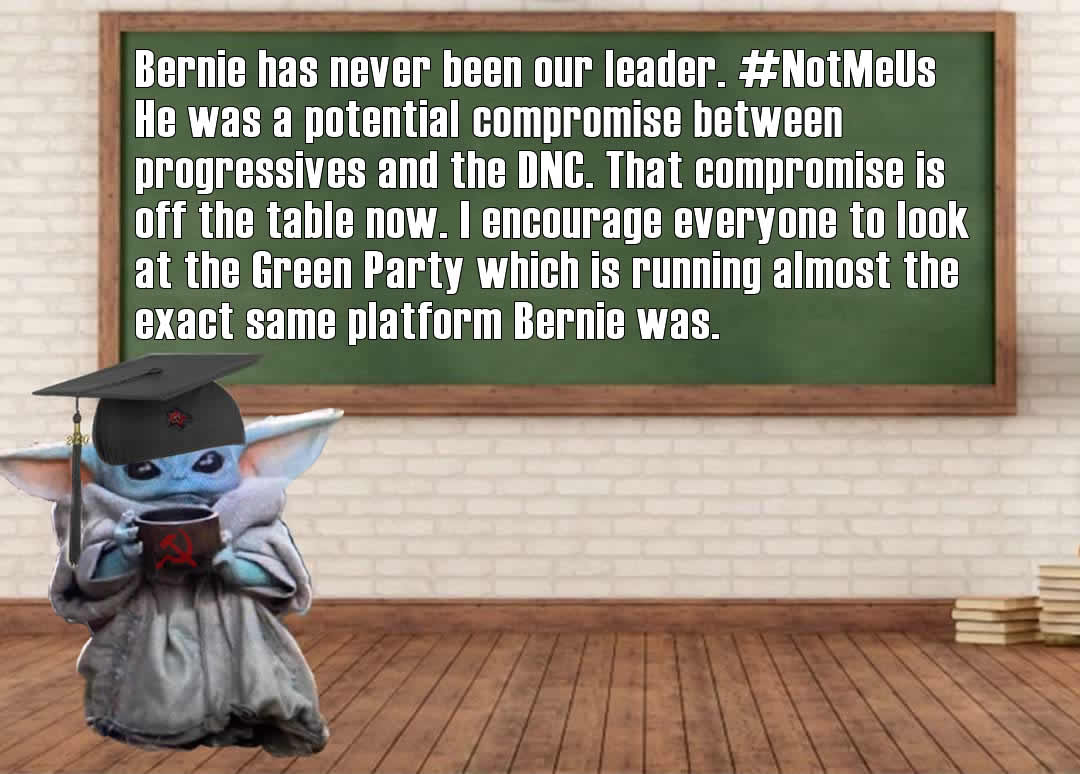
The image depicts a digitally rendered "Baby Yoda" (Grogu) figure wearing a mortarboard graduation cap. The character is standing in front of a chalkboard displaying the text "Bernie has never been our leader. #NotMeUs He was a potential compromise between progressives and the DNC. That compromise is off the table now. I encourage everyone to look at the Green Party which is running almost the same platform Bernie was." Beneath Grogu is a stack of books. The setting appears to be a classroom or lecture hall. The overall aesthetic is a blend of internet meme culture, political commentary, and classroom imagery. The figure's inclusion and attire may indicate the subject is engaging with political and social commentary.
## Foucauldian Genealogical Discourse Analysis
This image and its text can be examined through a Foucauldian lens by focusing on the discourse surrounding political leadership, compromise, and the shifting power dynamics within the American political system.
Power/Knowledge: The text asserts a shift in power - a rejection of Bernie Sanders as a central figure and a redirection towards the Green Party. This assertion isn’t simply about preference; it’s a claim of producing* knowledge – defining who is and isn't a legitimate leader, and shaping the narrative around viable political alternatives.
Genealogy of ‘Compromise’: The text frames Bernie Sanders as a “compromise.” A Foucauldian approach would ask: how has the concept of “compromise” been historically constructed within American political discourse? What power relations are embedded within the expectation of compromise, and who benefits from it? The text signals a rejection* of this genealogy, suggesting a desire to move beyond what is perceived as a system of settling for less than a genuinely progressive agenda.
Disciplinary Power: The presence of Baby Yoda in a classroom-like setting can be interpreted as a metaphor for the "disciplinary power" Foucault describes. Baby Yoda, a popular and endearing figure, is used to teach* a particular political stance – rejecting compromise and embracing the Green Party. It's a subtle form of persuasion, leveraging cultural capital to shape political beliefs.
## Critical Theory
This image aligns with core tenets of Critical Theory, specifically regarding ideology and the critique of established systems.
* Ideology Critique: The text critiques the established Democratic Party (DNC) as incapable of truly representing progressive values. It frames Sanders as a "compromise" candidate – meaning his platform was diluted to appease the center – and rejects that entire framework. The call to look to the Green Party is a rejection of the dominant ideological framework and an embrace of an alternative.
* Emancipatory Potential: While the image leverages a popular culture icon, the message implies a desire for social and political transformation. By rejecting compromise and advocating for a Green Party platform, the text hints at a desire to move beyond the limitations of the existing system.
* Cultural Hegemony: The inclusion of a popular character like Baby Yoda speaks to the influence of culture in shaping political attitudes. This imagery allows for a broader dissemination of the message beyond traditional political circles.
## Marxist Conflict Theory
From a Marxist perspective, the image and text speak to the inherent class conflict and the struggle for political power.
* Class Struggle: While not explicitly stated, the rejection of compromise and the call for a Green Party platform can be seen as a response to the perceived failure of the Democratic Party to address the needs of the working class and marginalized communities. It suggests a breakdown in the alliance between the progressive left and the Democratic establishment.
* Base and Superstructure: The text implies that the "superstructure" (political institutions and ideology) are not adequately serving the "base" (the material interests of the people). The call to the Green Party suggests a desire to construct a different political structure that is more aligned with progressive values.
* Revolutionary Potential: While not directly advocating for revolution, the rejection of compromise and the call for a new political platform can be seen as a step towards challenging the existing power structure.
## Postmodernism
Postmodern elements are present in the image and text, particularly regarding the subversion of traditional authority and the playful use of cultural references.
* Deconstruction of Authority: The rejection of Bernie Sanders as a leader challenges the notion of centralized authority and advocates for a more decentralized, grassroots approach to political change.
* Intertextuality & Pastiche: The image relies heavily on intertextuality, blending political commentary with popular culture references. The use of Baby Yoda is a pastiche, a playful imitation that adds a layer of irony and humor.
* Simulacra and Simulation: The image can be interpreted as a simulation of political discourse, blending reality and representation. The use of a digital image and a popular culture icon creates a distance from traditional forms of political communication.
Note: These analyses are not mutually exclusive. The image and text are rich with meaning, and can be interpreted through multiple theoretical lenses. The most insightful interpretations often draw upon a combination of these frameworks.
simple-description (llama3.2-vision)
This meme is a photo of a cartoon character, Baby Yoda, wearing a mortarboard and holding a cup, standing in front of a chalkboard. The text on the chalkboard reads: "Bernie has never been our leader. #NotMyLeader" and "I'm a communist and I support Bernie but..."
tesseract-ocr
Bernie has never been our leader. ##NotMel/s He was a potential compromise between progressives and the DNC. That compromise is CME TC TS ACC eT CaN Lik CTS COMETH G EDM TM TACT MD MUUCH ES TUT eC exact same platform Bernie was. eo ¥ — = : eS ray == aN