First Seen
2026-04-02T05:34:03+00:00
simple-description (qwen3.5_2b-q8_0)
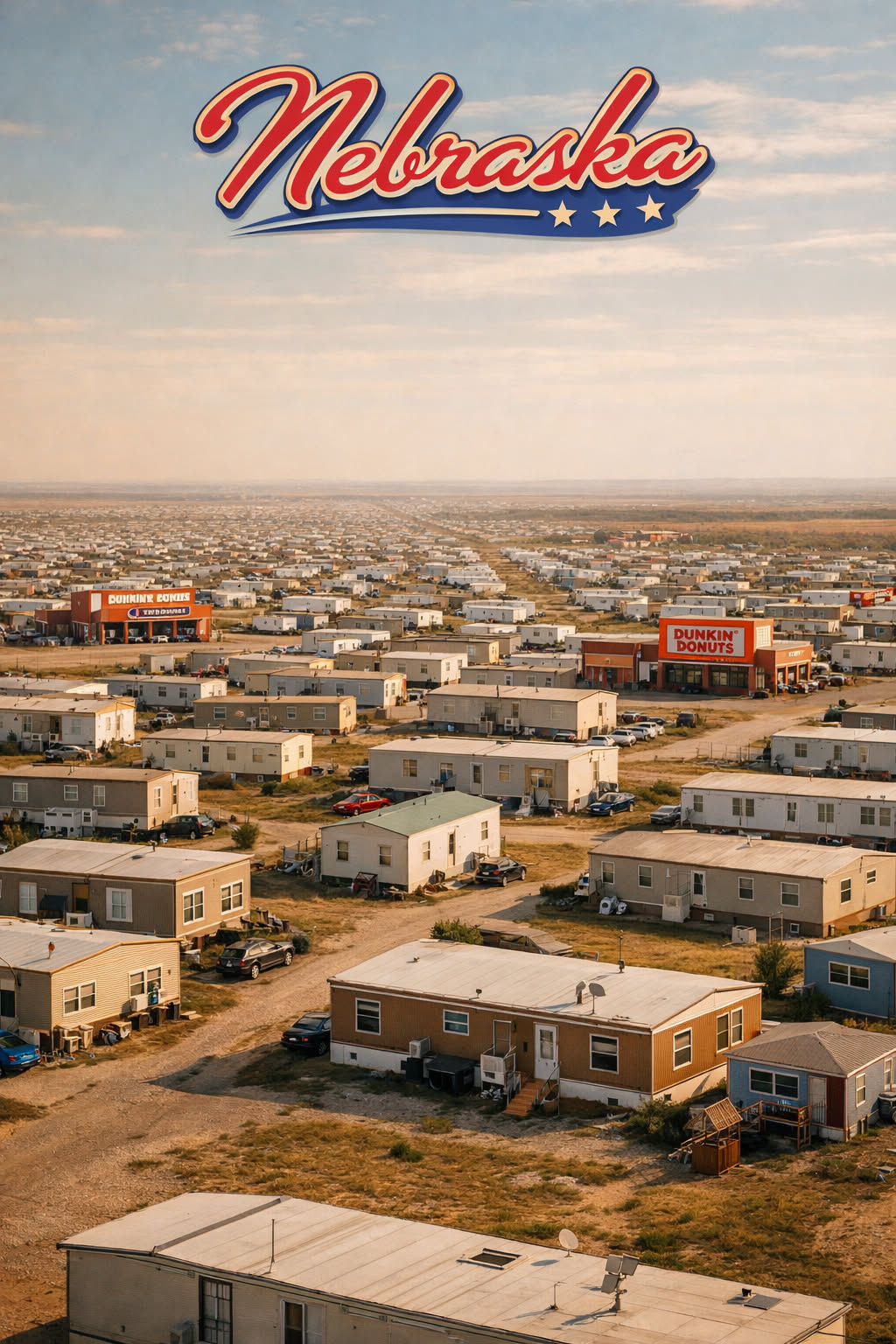
This image displays a vast landscape filled with rows of mobile homes and retail stores, including visible Dunkin' Donuts franchises. A large red banner labeled "Nebraska" has been superimposed on top of the photo, creating the effect of an official state poster. This meme is frequently shared for humorous content about people pretending to live in South Dakota while claiming they are from Nebraska.
detailed-analysis (gemma3_27b-it-q8_0)
Okay, let's break down this image as an "Original Content" (OC) meme, applying relevant theoretical frameworks where applicable. Given the nature of the image, and the "Nebraska" branding, there's a lot to unpack. I'll go through the sections you requested, omitting those that simply don't fit the analysis.
Understanding the OC Meme Context:
Before diving in, remember "OC" on platforms like Reddit often revolves around intentionally jarring, slightly off-kilter, or ironic imagery. The humor frequently arises from juxtaposition – taking something ordinary and framing it in an unexpected way. The "Nebraska" logo is key – it's an assertion of place, a deliberate branding that likely plays with stereotypical perceptions of the state. The photo itself is not what one immediately associates with travel ads or state promotion.
---
Visual Description
The image presents an aerial view of a large, sprawling mobile home/manufactured housing community. The color palette is dominated by beige, tan, and muted earth tones, reflecting the dry, flat landscape. Houses are densely packed, largely uniform in shape and size, with small yards. A few vehicles are visible. The lighting suggests late afternoon or early morning – warm, golden, but with long shadows. Two Dunkin Donuts signs break up the repetitive landscape.
The composition is relatively symmetrical, drawing the eye across the expanse of the community. There's a sense of both order (the grid-like layout) and overwhelming sameness. The "Nebraska" logo is overlaid in a font suggestive of sports team branding or vintage advertising, adding a layer of deliberate design.
---
Foucauldian Genealogical Discourse Analysis
This image resonates strongly with Foucault's ideas about power, knowledge, and discourse. The very act of representing this landscape is a power move. The framing constructs a "truth" about Nebraska, or, more specifically, about a part of Nebraska that is often rendered invisible or marginalized.
- Discourse on "Home": The image challenges the dominant discourse surrounding the "American Dream" and homeownership. The mobile home community stands in contrast to the idealized images of suburban houses and picket fences. It exposes the gap between this ideal and the reality for many.
- Discipline and Normalization: The grid-like arrangement of the homes can be seen as a manifestation of disciplinary power. It represents an attempt to order and control space, and, by extension, the lives of those who inhabit it. The uniformity suggests a normalization process, where individual expression is curtailed in favor of conformity.
- The Power of the Gaze: The aerial perspective positions the viewer as an observer above the community, exercising a kind of power through visual dominance. This further reinforces the "othering" of this space and its inhabitants.
- The Branding: The overlayed logo serves as a discourse marker. It says "Nebraska is this" which is not necessarily accepted discourse. The power lies in the challenge of this branding.
---
Critical Theory
From a Critical Theory perspective (particularly drawing on the Frankfurt School), the image functions as a critique of late-stage capitalism and its impact on social space.
- Commodification of Housing: The prevalence of manufactured homes points to the commodification of housing – where shelter is treated as a marketable good rather than a fundamental human right. This highlights the inequalities inherent in the capitalist system.
- Alienation and Standardization: The sameness of the homes and the lack of individual architectural expression are indicative of alienation. People are reduced to consumers in a standardized system, their individual needs and desires subsumed by the demands of the market.
- The Culture Industry: The "Nebraska" branding can be viewed as an element of the culture industry. It's a deliberate attempt to create a recognizable, marketable "image" that obscures the complexities and contradictions of the state. The juxtaposition with Dunkin Donuts reinforces this – the commercialization of even the most basic aspects of life.
- False Consciousness: The overall effect could be interpreted as a subtle commentary on "false consciousness" – the idea that people are unaware of the true nature of their social and economic exploitation.
---
Marxist Conflict Theory
This image visually embodies many of the central tenets of Marxist Conflict Theory.
- Class Struggle: The scene represents a tangible manifestation of class stratification. Mobile home communities are often inhabited by working-class individuals and families who have limited access to more expensive housing options. The image starkly depicts the spatial segregation of class.
- Means of Production: The homes themselves represent a basic means of shelter, but are controlled by banks, lenders, and manufactured housing companies – the owners of capital. The residents are dependent on these entities.
- Exploitation: The lack of aesthetic appeal and the density of the community can be interpreted as a visual symbol of the exploitation of labor. It suggests a system where profit is prioritized over the well-being of workers.
- Superstructure: The presence of Dunkin Donuts (a symbol of consumerism) and the branding of “Nebraska” can be seen as part of the superstructure – the cultural and ideological institutions that reinforce the dominance of the ruling class.
---
Overall Interpretation (as an OC Meme):
The brilliance of this as an OC meme lies in its deliberate dissonance. It's not a picturesque Nebraska landscape. It's a deliberately unflattering, somewhat bleak portrayal that subverts expectations. The "Nebraska" branding adds a layer of irony – a bold statement that forces the viewer to confront uncomfortable truths about the state (and, by extension, America) and the realities of economic inequality and the often-hidden landscapes of working-class life. The meme’s strength lies in its ability to spark conversation and challenge pre-conceived notions. It is an artistic depiction of realism that makes people reconsider an area that is often overlooked or misrepresented.
Let me know if you'd like me to elaborate on any of these points or explore other theoretical frameworks.
simple-description (llama3.2-vision_11b)
This meme features an image of a large, rundown mobile home park in Nebraska, with a prominent sign reading "Nebraska" at the top. The image is meant to be humorous, as it implies that the state of Nebraska is so bad that it's only fitting that it would have a mobile home park that is also subpar. The meme is likely intended to poke fun at the state's reputation for being rural and not particularly well-to-do.