First Seen
2025-09-20T00:49:38.720335+00:00
simple-description (qwen3.5_2b-q8_0)
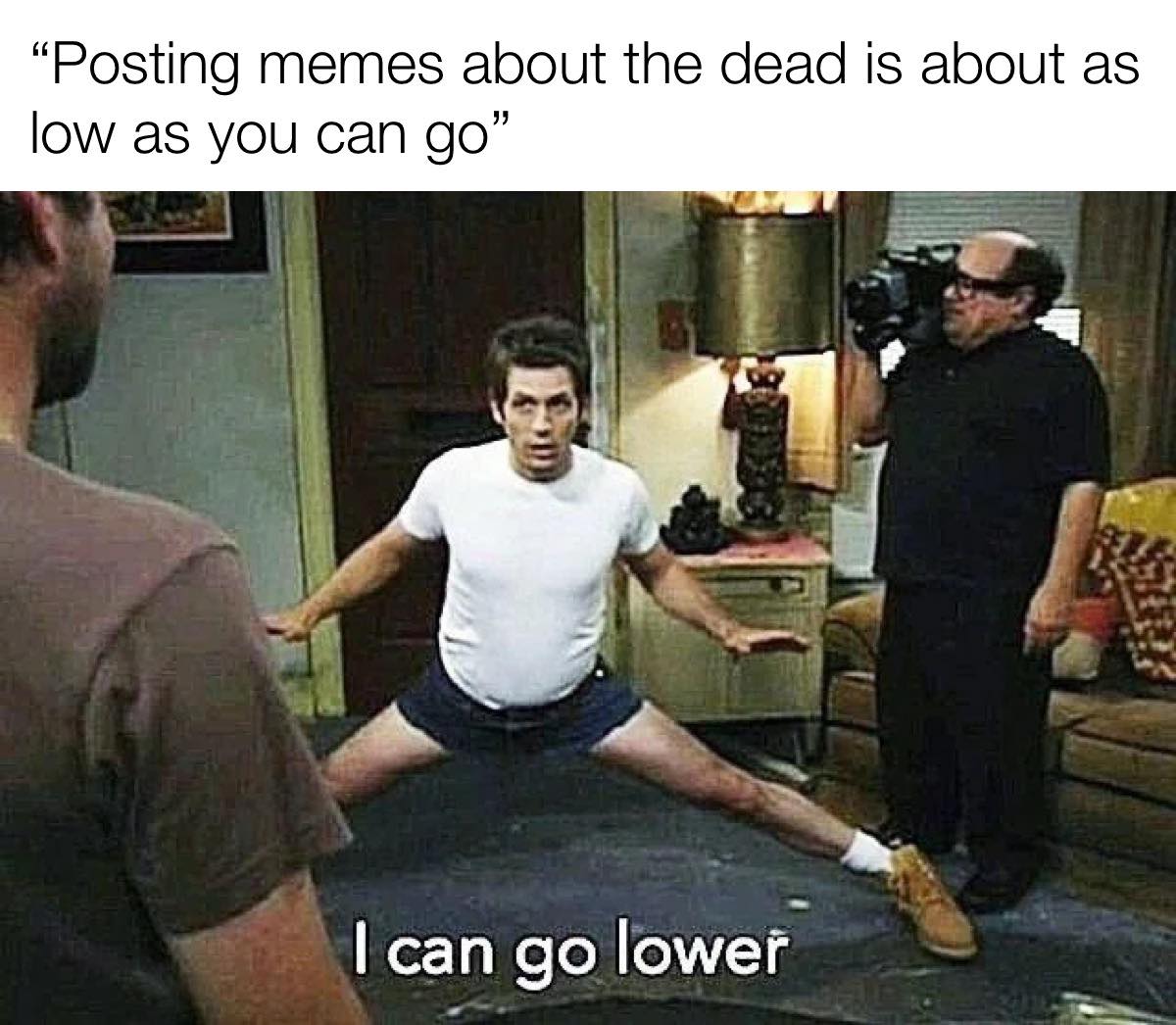
"This meme illustrates nihilism by suggesting that discussing the dead is so meaningless or futile that it feels like an end-all, be-all to all other life. The top text implies that posting about dying people is as trivial and boring as looking at random trash in the park. The bottom line, "I can go lower," humorously admits a cynical acceptance of this void; it suggests that even if one finds talking about death horrifying, they will simply move on to something trivially insignificant rather than being too bothered by the reality."
detailed-analysis (gemma3_27b-it-q8_0)
Here's an analysis of the meme, framed through the lens of Nihilism and applying relevant theoretical frameworks where appropriate.
Meme Analysis: "Posting About the Dead is About as Low as You Can Go" (Nihilistic Perspective)
Visual Description
The image is a still from It's Always Sunny in Philadelphia, featuring Charlie Kelly (played by Charlie Day) attempting a very awkward, low split. He’s straining, his face contorted in effort, and the framing emphasizes the ungainly position. In the background are Frank Reynolds (played by Danny DeVito) observing and Dee Reynolds (played by Kaitlin Olson) lounging. The caption reads “I can go lower” superimposed over the image. The top text reads, “Posting about the dead is about as low as you can go.”
Nihilistic Interpretation
At its core, the meme embodies a nihilistic sentiment. Nihilism, in its various forms, rejects inherent meaning, value, or truth. The statement "posting about the dead is about as low as you can go" taps into a sense of disrespect, and the inherent meaninglessness of posthumous "honoring." It suggests that even attempts to imbue the dead with meaning are ultimately pointless because meaning itself is a human construct without objective foundation.
The image reinforces this. Charlie’s excruciatingly awkward and seemingly pointless attempt to lower himself—to go “lower”— visually represents the futile pursuit of a lower, more degraded state. There's a sense of pushing boundaries simply because there’s no inherent reason not to, or because the concept of "lower" itself is absurd. It's a performance of meaninglessness.
Postmodernism
The meme leans heavily into postmodern ideas.
- Rejection of Grand Narratives: The act of “honoring” the dead is often part of a larger "grand narrative" – cultural beliefs about morality, remembrance, and respect for ancestors. This meme mocks this narrative, challenging the idea that there is a “correct” way to deal with death.
- Simulation and Hyperreality: The entire image is a simulation – a staged scene from a television show used to convey a detached and cynical comment about digital behavior. It highlights how we now experience (and arguably perform) emotion, even grief, through mediated channels like the internet, creating a hyperreality.
- Irony and Parody: The meme relies on irony. The image of Charlie's ridiculous pose is incongruous with the somber topic of the dead, creating a darkly humorous and subversive effect.
Critical Theory
This meme could be viewed through a Critical Theory lens, specifically focusing on the commodification of grief and the spectacle of mourning.
- The Spectacle: In a society obsessed with visibility, even grief can become a spectacle, performed for an audience. Posting about the dead on social media, even with good intentions, can be seen as a performance of sadness designed to elicit validation.
- Commodification of Emotion: The meme hints at the way even deeply personal experiences like loss can be exploited for engagement, likes, and social capital online. Grief can become content.
- Power Dynamics: The "low" is framed as a transgression against social norms. The meme subtly questions who defines "low" and who has the power to enforce those definitions. It's a challenge to the authority of societal expectations around mourning.
In conclusion, this meme encapsulates a nihilistic and postmodern sensibility. It challenges the inherent meaning we ascribe to the dead, critiques the performative nature of online mourning, and revels in the absurdity of a world where even grief can be subjected to a cynical, ironic gaze. The visual of Charlie Kelly’s painful contortion serves as a potent metaphor for the futile pursuit of "lower" emotional states and the ultimate meaninglessness of the spectacle.
simple-description (llama3.2-vision_11b)
This meme is a humorous take on the concept of nihilism, which is the idea that life has no inherent meaning or value. The meme features a character from the TV show "It's Always Sunny in Philadelphia" in a ridiculous pose, with the caption "I can go lower" implying that even in the face of absurdity, one can still find a way to be more absurd. The text "I can go lower" is a sarcastic comment on the idea that even in the most absurd situations, one can always find a way to be more absurd, which is a characteristic of nihilism.