First Seen
2024-05-15T19:47:14.354489+00:00
simple-description (llama3.2-vision_11b)
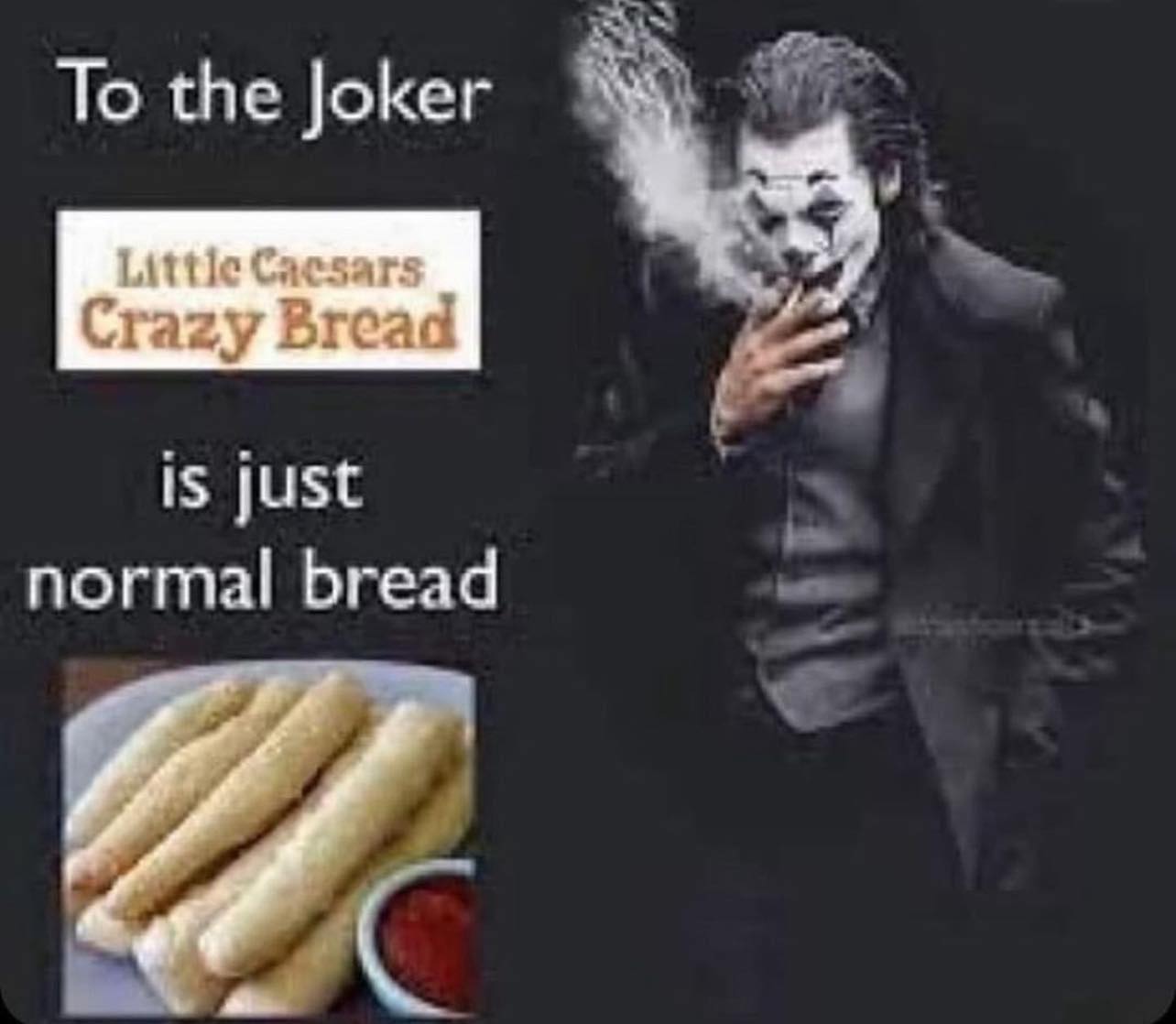
This meme is an example of nihilism, as it presents a bleak and absurd perspective on the world. The image juxtaposes the iconic Joker character with a mundane and ironic statement about the absurdity of everyday life. The text reads: "To the Joker: Little Caesars Crazy Bread is just normal bread."
detailed-analysis (gemma3-27b-vision)
Okay, let's break down this image through the lenses of various theoretical frameworks. Given the content, several of these will be more relevant/applicable than others.
## Visual Description
The image is a digitally created meme. It features a dramatic portrait of Joaquin Phoenix as the Joker (from the 2019 film Joker). The Joker is smoking a cigarette, a wisp of smoke billowing around his face, appearing as though it might be an explosion. Superimposed on the left side is a rectangular logo of "Little Caesars Crazy Bread." Underneath the image it states “is just normal bread”. Beneath that is a photo of several pieces of “Crazy Bread” on a plate with a small container of sauce. The background is black. The overall aesthetic leans into the dramatic, chaotic imagery associated with the Joker and contrasts this with the mundanity of a mass-produced fast-food side dish.
## Foucauldian Genealogical Discourse Analysis
This image is ripe for a Foucauldian analysis. The meme highlights the discourse surrounding "normalcy" and "madness/craziness."
Power/Knowledge: The marketing of "Crazy Bread" by Little Caesars attempts to establish a relationship between breadsticks and a perceived state of "craziness", associating a commercial product with a concept that is often stigmatized and pathologized. The meme subverts* this by arguing that the "craziness" is merely a marketing tactic applied to ordinary breadsticks.
* Genealogy of "Crazy": A genealogical approach would examine how the concept of "crazy" itself has historically been constructed – how it has been used to define boundaries, control populations, and exert power. By labeling a food item “crazy,” Little Caesars appropriates and commodifies this historically loaded term.
Disciplinary Power: The meme implicitly critiques the way marketing and branding attempt to discipline* our perceptions and desires. By pointing out the ordinariness of “Crazy Bread,” it resists the power of marketing to convince us of something that isn’t true.
* Normalization: The meme further shows the absurdity of normalizing marketing claims and demonstrates how even concepts like “craziness” are simply constructions used to sell products.
## Critical Theory
This image can be understood through a lens of Critical Theory, especially considering the concepts of mass culture and ideology.
* Culture Industry: The image directly addresses the function of the "culture industry" (Adorno & Horkheimer). Little Caesars, as part of this industry, creates a product, labels it "crazy", and attempts to generate desire through association. The meme acts as a critical response, exposing the manipulation inherent in this process.
* Commodification: The meme highlights how even abstract concepts like "craziness" are commodified and integrated into capitalist systems.
* False Consciousness: The meme implicitly suggests that those who believe “Crazy Bread” is somehow different or special are operating under "false consciousness" - a lack of awareness about the true nature of the product and the forces shaping their perceptions.
* Ideology Critique: The meme functions as an ideology critique – it questions the underlying assumptions and power structures that shape our understanding of products, marketing, and even the concept of “normal”.
## Marxist Conflict Theory
While the image isn't overtly political, a Marxist reading reveals underlying dynamics.
* Capitalism and Spectacle: Little Caesars, as a capitalist enterprise, creates a spectacle around a simple product to drive sales. The meme directly challenges this spectacle.
* Alienation: The mundane reality of “Crazy Bread” contrasted with the image of the Joker can be seen as a comment on the alienation inherent in capitalist production. The dramatic branding attempts to inject meaning into a fundamentally meaningless product.
* Class and Consumption: The meme implicitly critiques the way advertising targets and manipulates consumer desires, regardless of socioeconomic class.
## Postmodernism
This image is almost a perfect example of postmodern playfulness and deconstruction.
* Pastiche & Irony: The image combines a serious, dramatic image (the Joker) with a mundane, commercial product, creating a juxtaposition that is inherently ironic. It's a pastiche - a mixing of different styles and references.
Deconstruction of Meaning: The meme challenges the assumed meaning of "crazy." It deconstructs* the marketing language and reveals the absurdity of applying such a label to a simple breadstick.
* Hyperreality: The image can be seen as a representation of “hyperreality” (Baudrillard). The branding of "Crazy Bread" creates a symbolic reality that obscures the actual product. The meme draws attention to the gap between the signifier ("crazy") and the signified (ordinary breadsticks).
* Self-Reflexivity: The meme is self-reflexive – it draws attention to its own artificiality and its critique of mass culture.
Note: Some of these lenses apply more strongly than others. I've tried to provide a nuanced interpretation considering the meme's content and potential meanings.
Let me know if you'd like me to elaborate on any of these interpretations.
tesseract-ocr
To the Joker le * Pr s i etic a aw normal bread - va
simple-description (llama3.2-vision)
This meme is a play on the phrase "to the moon" and features an image of the Joker, a character known for his chaotic and unpredictable behavior. The text in the image reads "to the joker: little caesars crazy bread is just normal bread" and is meant to be humorous and ironic, implying that the Joker's expectations for a wild and exciting experience are not met by a simple, everyday food item. The meme is likely to be humorous for its absurdity and the contrast between the Joker's expectations and the mundane reality of the food.