First Seen
2023-05-10T21:03:36+00:00
simple-description (llama3.2-vision_11b)
The meme is a humorous take on the nihilistic idea that life has no inherent meaning or value. It features a screenshot of a conversation between a customer and a cashier at a store, where the customer is unhappy with the service and the cashier responds with a sarcastic and nihilistic comment. The text reads: "I asked the cashier for a discount and he said 'I don't get paid enough to care'". This meme pokes fun at the idea that even in mundane interactions, people can be cynical and unenthusiastic, reflecting a broader nihilistic worldview that life is devoid of inherent meaning or value.
detailed-analysis (gemma3-27b-vision)
Okay, here's an analysis of the Twitter post, broken down into relevant theoretical sections. Not every section applies, as that would be forced, so I've included only those where meaningful analysis can occur.
## Visual Description
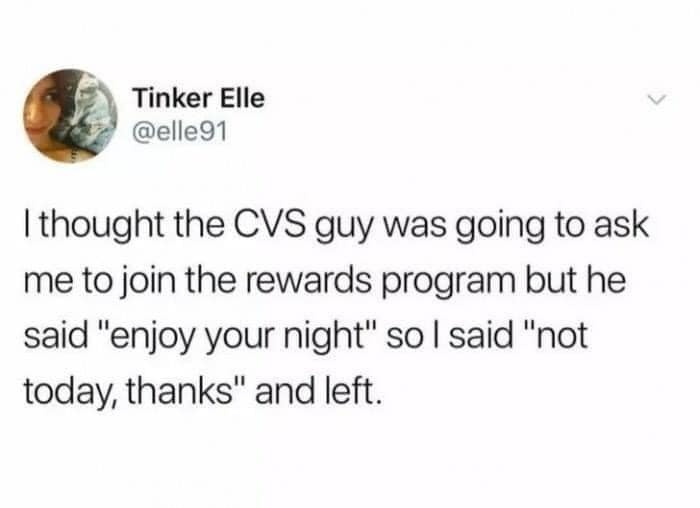
The image is a screenshot of a Twitter post from user @elle91, identified as "Tinker Elle." The profile picture is a close-up of a person’s face in a grayscale photograph. The background appears to be textured, possibly fabric. The text is a short anecdote about an interaction at CVS. The post appears to be a simple text-based update, characteristic of many Twitter posts.
## Foucauldian Genealogical Discourse Analysis
This seemingly simple anecdote can be interestingly examined through a Foucauldian lens. The interaction at CVS is framed around discourse – specifically, the discourse of customer service and consumerism.
Power/Knowledge: The CVS employee represents an institution wielding power through the "rewards program." This program isn’t merely about offering discounts; it’s about gathering data, shaping consumer behavior, and ultimately, exerting control over the customer. The invitation to join the program can be seen as a manifestation of this power, an attempt to know* the customer's spending habits.
* Disciplinary Power: While subtle, the rewards program operates as a form of disciplinary power. It encourages certain behaviors (consistent purchasing) and creates norms (active participation in the program) to categorize and manage the customer.
* Resistance: The customer's response – “not today, thanks” – is a small act of resistance against this disciplinary power. It’s a rejection of being categorized, analyzed, and controlled. It's a refusal to be drawn into the system.
* Genealogy: One could trace the genealogy of this interaction. The development of loyalty programs, data collection, and personalized marketing all contribute to a historical shift in the relationship between consumers and businesses. What once was a simple transaction is now deeply entwined with surveillance and behavioral modification.
## Postmodernism
This interaction exemplifies several hallmarks of postmodern thought:
Rejection of Grand Narratives: The anecdote subverts the "grand narrative" of consumerism, which assumes that everyone desires constant acquisition and engagement with reward systems. The customer actively disrupts* this expectation.
* Irony and Playfulness: There’s a sense of irony in the customer's expectation (being asked to join the rewards program) versus the actual interaction ("enjoy your night"). The customer's response is a playful subversion of expectations.
* Fragmentation of Meaning: The initial expectation of a transactional exchange is fractured by the employee’s seemingly unrelated farewell. This highlights the breakdown of clear, predictable social interactions.
* Hyperreality: The focus on rewards programs, data collection and customization represents the hyperreal – simulations that have replaced authentic experience. The customer rejects participating in this artificial realm.
## Queer Feminist Intersectional Analysis
While not overtly “queer” or "feminist," an intersectional lens can be applied by recognizing the customer’s agency and a potential rejection of normative expectations surrounding consumer behavior.
* Agency: The customer asserts agency in a space often designed to limit it. They aren't simply a passive recipient of marketing; they actively refuse participation.
* Subversion of Expectations: The customer’s response deviates from the expected polite acquiescence in a service encounter. This can be interpreted as a subtle act of resistance against patriarchal and capitalist structures that often dictate social interactions and expectations of women in consumer spaces.
* Intersectional nuance: The anecdote lacks information about the customer's identity, making a detailed intersectional analysis difficult. However, one could speculate that the customer’s refusal might be connected to broader social critiques or experiences of marginalization within the consumer sphere.
In conclusion: This seemingly simple Twitter post is surprisingly rich in potential for theoretical analysis. It offers a snapshot of power dynamics, resistance, and the fractured nature of contemporary consumer culture, opening itself up to analysis through Foucauldian, Postmodern, and intersectional lenses.
simple-description (llama3.2-vision)
This meme is a humorous take on a common experience at a retail store. The text reads: "I thought the CVS guy was going to ask me to join the rewards program but he said 'enjoy your night' so I said 'not tonight, thanks' and left." The meme pokes fun at the idea of a person being overly friendly and enthusiastic, only to be met with a sarcastic response.
tesseract-ocr
@ Tinker Elle @elle91 | thought the CVS guy was going to ask me to join the rewards program but he said "enjoy your night" so | said "not today, thanks" and left.