First Seen
2023-05-10T21:03:36+00:00
simple-description (llama3.2-vision_11b)
The meme is a play on the idea of nihilism, which is a philosophical idea that life has no inherent meaning or value. The image is a simple drawing of a blank, white page, with the text "just found my purpose in life" written on it. The humor comes from the absurdity of finding meaning in a blank page, which is a classic nihilistic theme.
detailed-analysis (gemma3-27b-vision)
Here's an analysis of the image, broken down into relevant theoretical sections as requested. It’s important to note that these are interpretations; applying these theories to a simple image is often an exercise in creative thought rather than a definitive analysis.
Visual Description
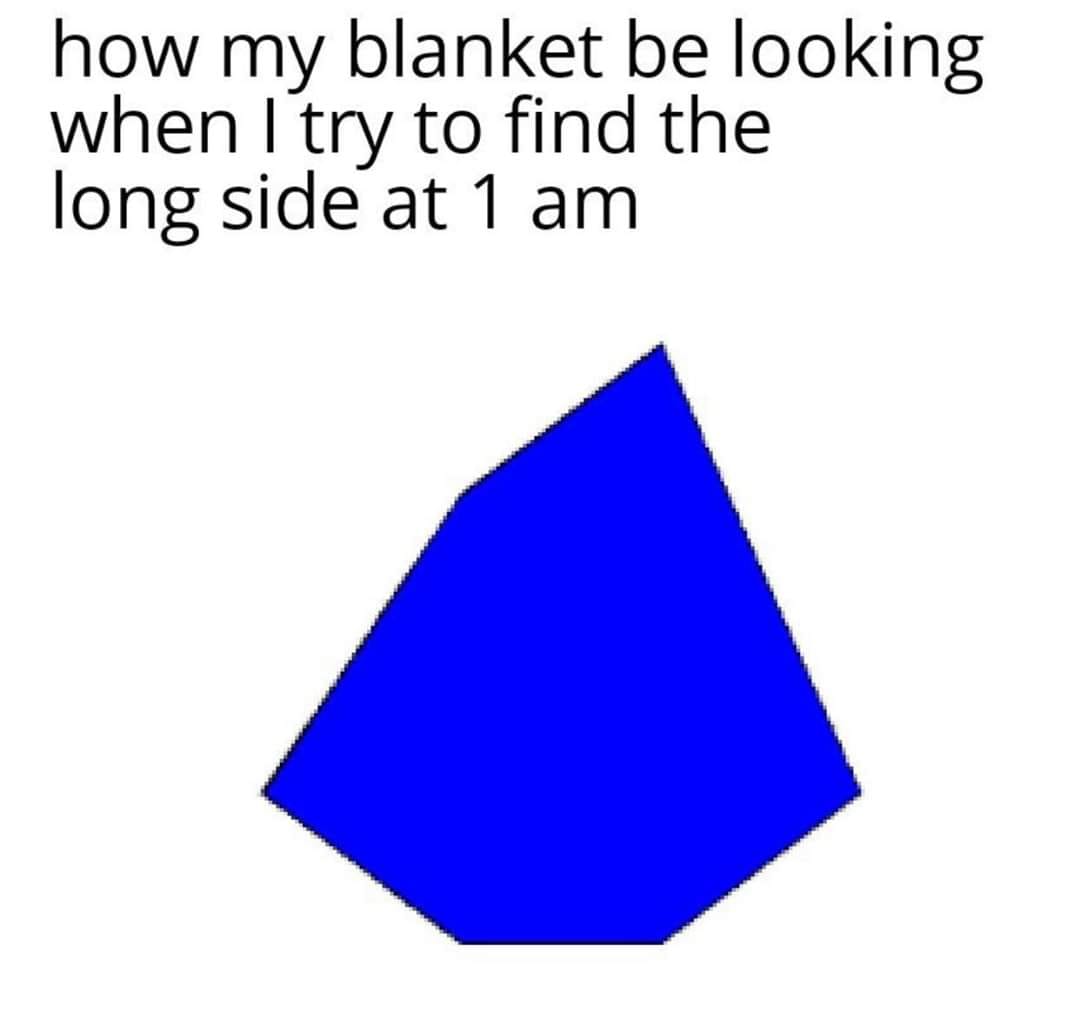
The image features a solid blue polygon with an irregular, almost haphazard shape. It resembles a crumpled or bunched-up blanket. The polygon has approximately 7 sides, and appears to be an awkward, asymmetrical form. It is centered against a pale gray background. Above the polygon is text reading “how my blanket be lookin when I try to find the long side at 1 am”.
Foucauldian Genealogical Discourse Analysis
This image, through its meme format, participates in a discourse surrounding nighttime routines, comfort, and the minor struggles of daily life. A Foucauldian analysis might explore how this shared experience ("trying to find the long side of the blanket at 1 am") is constituted through this discourse. The seemingly trivial act of searching for the long side becomes normalized as a relatable struggle, reproduced and circulated through social media.
The genealogical aspect would explore the historical conditions that created this particular frustration. Was there a time when blankets were always rectangular? How did changes in blanket production, bedroom arrangements, or societal expectations around sleep contribute to the specific problem depicted? The image subtly suggests a power dynamic: the blanket, as an object, resists a simple understanding, embodying a minor form of control over the individual seeking comfort.
Critical Theory
From a critical theory perspective, the image highlights the commodification of comfort. Blankets are not simply functional objects but are tied to emotional states and are often marketed as sources of security and well-being. The image’s humor stems from the failure of the commodified blanket to fully deliver on this promise. It's not providing the simple, linear comfort it's supposed to.
This mismatch between expectation and reality reveals a deeper societal critique: a system that prioritizes consumption without fully addressing the underlying anxieties or feelings of insecurity that drive it. The “struggle” with the blanket becomes symbolic of larger, more pervasive struggles for comfort and control in a complex world.
Postmodernism
The image embodies several postmodern characteristics. First, its very form – a meme – is a quintessential postmodern phenomenon. Memes are inherently intertextual, drawing on shared cultural references and remixing them. The humor lies in the self-aware recognition of a common, mundane experience.
The chaotic, non-geometric shape of the blanket can also be read as a rejection of grand narratives and rigid structures. It's an embrace of ambiguity, imperfection, and the fragmented nature of modern life. The image subverts the expectation of a "perfect" or "ordered" blanket, suggesting that meaning can be found in the messy and unpredictable.
Queer Feminist Intersectional Analysis
While not immediately obvious, the struggle with the blanket can be connected to themes of bodily autonomy and discomfort. The act of struggling with a blanket in the dark, alone, is an intimate, bodily experience. This can be linked to the ways in which individuals are often forced to navigate discomfort and boundaries in their own spaces, particularly when dealing with everyday objects.
Further, the experience can be inflected through an intersectional lens. Different bodies might experience this discomfort differently (e.g., someone with sensory sensitivities or a physical disability). The image's humor, therefore, could be read as a subtle commentary on the ways in which societal norms and expectations around comfort are not universally applicable. The vulnerability of struggling with something so basic, in the dark and alone, speaks to the experiences of marginalization and the need for safe, comfortable spaces.
It's worth emphasizing again that these analyses are interpretations. The strength of this image is its simplicity and the open-endedness of its message. It allows for diverse readings depending on the theoretical framework applied.
simple-description (llama3.2-vision)
This meme is a humorous take on the struggle of finding a comfortable sleeping position in bed. The image depicts a blue, irregularly-shaped pillow with a caption that reads, "how my blanket is looking when I try to find the long side at 1 am". The meme is a relatable and lighthearted commentary on the frustrating experience of trying to get comfortable in bed, especially when you're feeling tired and restless.
tesseract-ocr
how my blanket be looking when | try to find the long side at 1 am