First Seen
2023-05-10T21:03:36+00:00
simple-description (llama3.2-vision_11b)
The meme is a play on the idea of nihilism, which is the philosophical idea that life has no inherent meaning or value. The image is likely a picture of a child playing in a room filled with toys, but the caption "your children will grow up in a world where they will be forced to work to survive, not to pursue their passions" suggests that the child's innocence and joy will be lost as they grow up and face the harsh realities of the world. The image is a commentary on the idea that the world is a cold, unforgiving place, and that the innocence of childhood is a fleeting and ultimately doomed thing.
detailed-analysis (gemma3-27b-vision)
Okay, here's an analysis of the image broken down by the requested theoretical frameworks, only where those frameworks are applicable. I'll try to be thorough but concise, noting where things are a weaker fit.
Visual Description
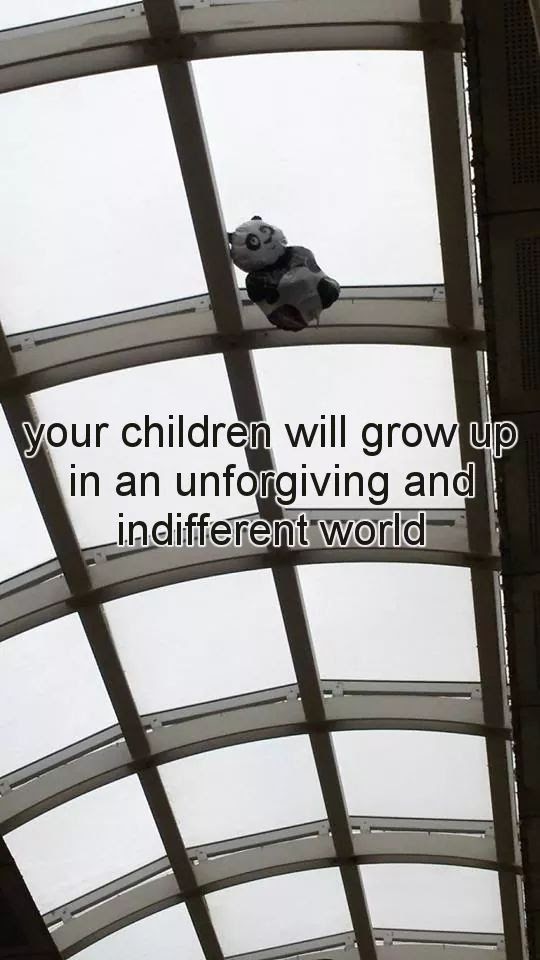
The image features a stark architectural space, likely an interior beneath a glass and metal structure reminiscent of a greenhouse or a large atrium. The composition is dominated by a grid of dark, intersecting metal beams forming a ceiling or skylight, with light filtering through the glass panes. A small, humanoid figure (possibly a doll or a toy) is positioned within this architectural framework, seemingly suspended or perched precariously. The overall tone is somewhat bleak and industrial, contrasting with the possibly innocent nature of the figure. Text overlays the image: “your children will grow up in an unforgiving and indifferent world." The angle of the shot is low, looking upwards, emphasizing the imposing nature of the structure.
---
Foucauldian Genealogical Discourse Analysis
This image lends itself particularly well to a Foucauldian reading. The architectural structure, the grid, represents a system of power and control, akin to the panopticon. The grid isn’t necessarily intended to be oppressive, but it functions to organize space and, by extension, to normalize certain behaviors and ways of being. The small figure within this structure can be seen as a subject positioned within these power dynamics. The text, “your children will grow up in an unforgiving and indifferent world,” reinforces this. It suggests that the environment these children will inhabit is not nurturing but actively disciplining them through its indifference.
The “unforgiving and indifferent world” isn’t a singular, intentional force but a discourse – a system of knowledge and power that shapes how we understand the world and our place within it. Genealogically, one could trace the historical development of this discourse of indifference, examining how it arose within modernity, perhaps tied to neoliberal values of self-reliance and market forces, where empathy and social support are diminished. The image doesn’t show the source of this indifference, but illustrates its effects on potential future generations.
---
Critical Theory
The image resonates with Critical Theory’s focus on the critique of social structures and the alienation of the individual. The grid, as a symbol of a rationalized, modern world, can be seen as an expression of “instrumental reason” (Horkheimer and Adorno), where everything is evaluated in terms of its usefulness or efficiency. This leads to the dehumanization of both the environment and the individuals within it.
The “unforgiving and indifferent world” points to a loss of empathy and a decline in the ability to connect with others. This is a key theme in the Frankfurt School's analysis of mass society, which suggests that the commodification of culture and the emphasis on individual consumption lead to social fragmentation and a sense of powerlessness. The small figure can be interpreted as symbolizing the vulnerability of the next generation in this system. The image evokes a feeling of anxiety and despair, reflecting the Critical Theory’s concern about the potential for social domination.
---
Marxist Conflict Theory
The image doesn’t directly showcase class struggle, but it can be read through a Marxist lens. The imposing architectural structure could be interpreted as a symbol of capitalist control, representing the built environment designed to serve the interests of the ruling class. The “unforgiving and indifferent world” speaks to the exploitative nature of capitalism, where individuals are often treated as mere commodities, lacking in inherent worth. The figure’s isolation within the structure could be seen as a metaphor for the alienation of the working class. However, this reading is weaker than others, as the image doesn’t explicitly depict economic inequality or class dynamics.
---
Postmodernism
The image is somewhat aligned with some Postmodern sensibilities, specifically regarding its depiction of alienation and fragmentation. The starkness of the architecture and the smallness of the figure create a sense of isolation and detachment. The text contributes to this by highlighting the meaninglessness or harshness of the world. The lack of a clear narrative or a positive message is also typical of Postmodern art.
However, the image isn’t necessarily deconstructing any grand narratives or celebrating difference. It's more of a melancholic expression of existential anxiety than a playful subversion of established norms.
---
Queer Feminist Intersectional Analysis
While not explicitly representing gender or sexuality, the image could be interpreted through an intersectional lens by focusing on vulnerability and power dynamics. The small figure could represent marginalized groups who are disproportionately affected by an “unforgiving and indifferent world.” The grid-like structure can be seen as a system that reinforces existing power imbalances and marginalizes those who do not fit within its confines.
The indifference of the world can be read as a form of violence – a denial of care and recognition. This is particularly relevant for feminist analysis, which often focuses on the ways in which patriarchal systems dehumanize and exploit women. However, this reading requires a significant amount of projection, as the image doesn’t explicitly address issues of gender, sexuality, or intersectionality.
Let me know if you would like me to elaborate on any of these points or explore another theoretical framework!
simple-description (llama3.2-vision)
This meme is a photo of a child's toy, a teddy bear, stuck in a ceiling tile. The image is captioned "your children will grow up in an unforgiving and indifferent world". The tone is darkly humorous, implying that the child's toy is a metaphor for the harsh realities of growing up.
tesseract-ocr
| 4 3 > —— i _ * ee | your childre will grow’ vo in an unfoggiving andy indifferemtworlcm i ZA a i | gua |