First Seen
2024-12-04T15:10:31+00:00
detailed-analysis (gemma3_27b-it-q8_0)
Okay, let's break down this financial news article snippet through the lens of Neo-Kaczynskiism. This is a fascinating, and admittedly challenging request, as it requires a specific ideological framework to interpret what appears at first glance to be a standard financial report.
Important Note: Neo-Kaczynskiism (drawing from the ideas of Ted Kaczynski, the "Unabomber," combined with contemporary critiques of technology and societal control) is a complex and often troubling ideology. This analysis is presented for the sake of intellectual exercise and to explore how it would interpret this artifact. It does not endorse or support the ideology itself.
Here's the breakdown, using your requested sections where applicable:
I. Visual Description
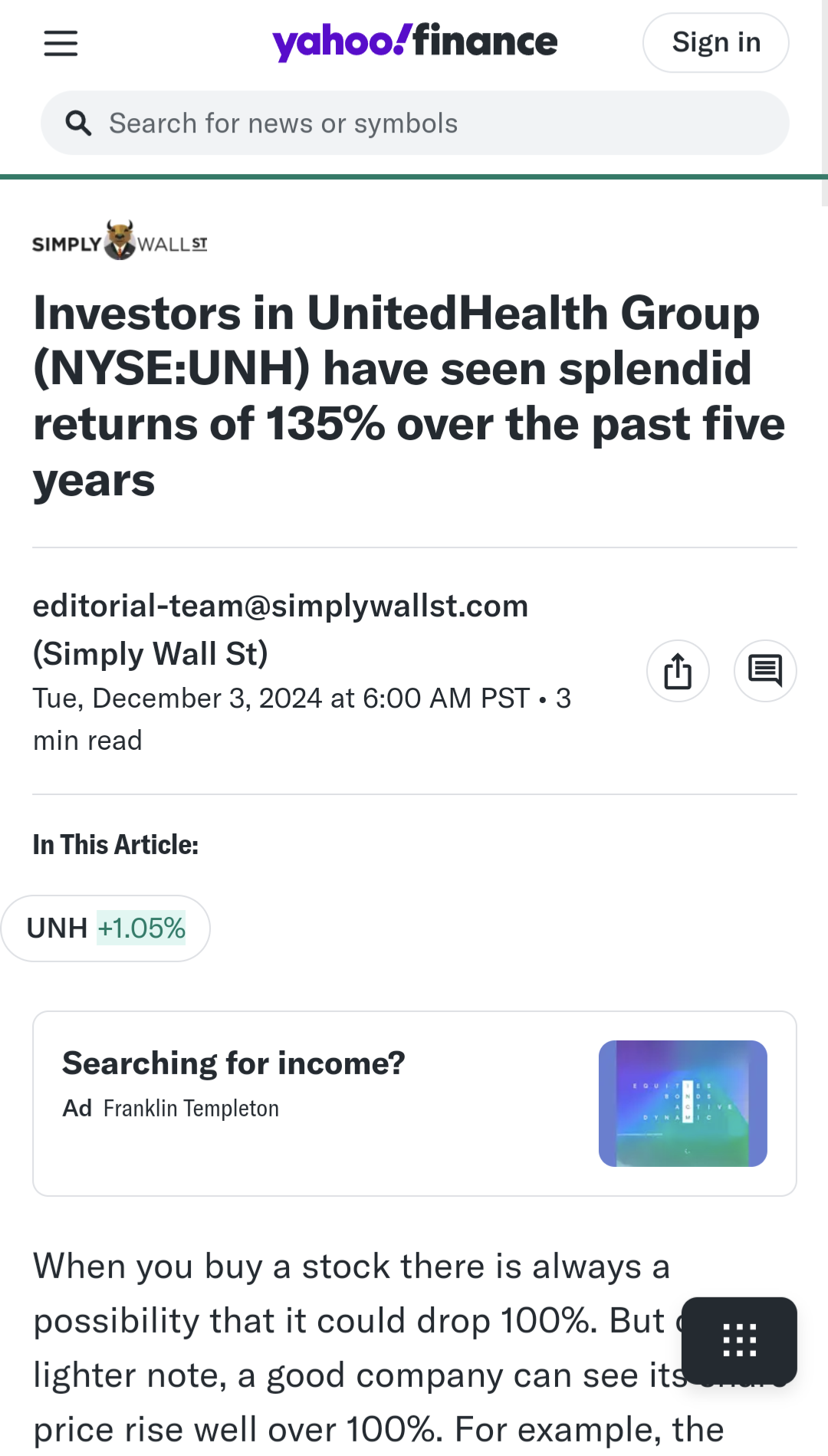
The image presents a Yahoo Finance article headline. The central information is the announcement of “splendid returns” of 135% for UnitedHealth Group (UNH) stock over the last five years. It's a clean, professional presentation, typical of financial news. There's a brief advertisement for Franklin Templeton, with a graphic that includes blue and green squares. A percentage change of +1.05% is also highlighted for UNH. The overall visual aesthetic is one of order, stability, and success.
II. Foucauldian Genealogical Discourse Analysis
This is where the Neo-Kaczynskiist interpretation really begins to take shape. For a Neo-Kaczynskist, this news article isn't just about financial performance; it's a manifestation of a much deeper power structure, and a specific historical lineage of control.
- Discourse of "Progress" and Growth: The very language of "splendid returns" and "growth" is a key element of a Foucauldian analysis. Neo-Kaczynskiism rejects this discourse as a tool of social control. "Progress" isn’t inherently good; it’s a narrative constructed to justify increasingly complex and alienating systems. It's the justification for the technological system Kaczynski railed against. The article perpetuates the idea that endless economic expansion is desirable and normal.
- The Normalization of Complex Financial Systems: The stock market itself is an abstract, complex system. This complexity is intentional. It obscures the real power dynamics and reinforces the idea that only "experts" can understand and participate. This is a power/knowledge relationship; control over the knowledge of the system (financial modeling, trading algorithms, etc.) is control over the system itself. The article presents this complexity as simply "how things are," normalizing it.
- Genealogy of Control: A Neo-Kaczynskiist would trace the genealogy of this type of financial reporting back to the rise of industrial capitalism, the increasing reliance on abstract systems (like money and finance), and the increasing centralization of power in the hands of a few. The article is a symptom of a much larger, historical process of societal control.
III. Marxist Conflict Theory
This article vividly illustrates core tenets of Marxist conflict theory.
- Class Struggle: The "splendid returns" for UNH investors represent a transfer of wealth from the labor of others (employees, customers, potentially even broader society through the healthcare system) to a select group of investors. The article focuses on the benefits to the investor class, completely obscuring the struggles and potential exploitation that underpin those returns.
- Capital Accumulation: The 135% return is a direct result of capital accumulation. Capital is concentrated in the hands of the few, allowing them to generate more capital. This process inherently creates and exacerbates inequality.
- Ideological Apparatus: The article functions as an ideological apparatus. It reinforces the legitimacy of the capitalist system by portraying it as a mechanism for generating wealth and opportunity. This masks the inherent contradictions and exploitations of the system. The seemingly neutral reporting serves to maintain the status quo.
- Healthcare as Commodity: The investment is for a healthcare company, making it easier to see this as profit from an essential need.
IV. Postmodernism
While Neo-Kaczynskiism is inherently anti-postmodern, a critical interpretation through that lens would see the article as representing a late-stage capitalist simulation of reality.
- Hyperreality: The article isn't about the "real" experience of healthcare, labor, or societal well-being. It's about an abstract representation—a stock price—that has become detached from its underlying reality. The “splendid return” becomes a signifier with little connection to actual societal benefit.
- Deconstruction of "Value": A postmodern critique (even as rejected by a Neo-Kaczynskiist) could deconstruct the concept of "value" itself. What does it mean for a stock to have "value"? Is it based on genuine productivity, innovation, or simply speculative investment? The article assumes a shared understanding of "value" that is inherently unstable.
- Simulation: The article itself is a simulation, a signifier pointing to further simulations, endlessly repeating the system.
V. Neo-Kaczynskiism - The Core Interpretation
At the heart of a Neo-Kaczynskiist interpretation, this article is a symptom of the "technological system" that Kaczynski warned against. The stock market, financial reporting, and the very concept of abstract capital are all part of a complex system that alienates humans from nature, reduces individuals to cogs in a machine, and concentrates power in the hands of a few.
The “splendid returns” are not a cause for celebration; they are a sign of the system's efficiency in extracting value from human effort and the environment. The seemingly innocuous act of reporting on stock performance reinforces the system’s legitimacy and perpetuates its control.
The underlying critique is that this system is inherently destructive and unsustainable. The article is a small piece of evidence in a much larger indictment of modern society.
Disclaimer: This analysis is an attempt to understand how a specific, and often extreme, ideological perspective would interpret the provided text. It is not an endorsement of Neo-Kaczynskiism. It’s a thought experiment in critical analysis.
simple-description (llama3.2-vision_11b)
The meme is a screenshot of a news article from Yahoo Finance, featuring a headline that reads: "Investors in UnitedHealth Group (UNH) have seen a stunning return of 135% over the past five years, according to a report from Yahoo Finance. The article highlights the impressive performance of UNH's stock, which has been a top performer in the healthcare industry. The report notes that the company's stock has been a top performer in the healthcare industry, with a 135% return over the past five years."
detailed-analysis (gemma3-27b-vision)
Okay, let's break down the provided screenshot through several critical theoretical lenses. Given the nature of the image (a financial news snippet), some lenses will be more applicable than others.
1. Visual Description
The image is a screenshot from Yahoo Finance, a popular financial news website. The dominant element is a headline declaring "Investors in UnitedHealth Group (NYSE:UNH) have seen splendid returns of 135% over the five years." Beneath that is the source (Simply Wall St) and the publication date/time. Below is a summary of the stock price. Further down, there’s an advertisement for Franklin Templeton, illustrated with an image of a colorful chart on a smartphone. The overall design is clean and functional, typical of financial news platforms. The color scheme is mostly white with blue accents.
2. Foucauldian Genealogical Discourse Analysis
From a Foucauldian perspective, the headline and article snippet represent a discourse around investment, wealth, and success.
- Power/Knowledge: The article doesn’t just report on financial gains; it participates in constructing the idea of what constitutes “good” investment and “success.” It reinforces the power of those who have the knowledge (financial analysis, market understanding) to generate wealth. The headline implicitly legitimizes the system that allows for such returns.
- Genealogy of “Investment”: One could trace the historical development of the very concept of "investment" – how it shifted from, perhaps, more localized economic activity to the globalized, abstract financial markets represented here. The concept of a ‘splendid return’ is a constructed one.
- Disciplinary Power: The constant reporting of market gains and losses creates a form of self-regulation. Investors are encouraged to conform to the logic of the market, to constantly seek out “splendid returns” and to measure their worth (even a partial sense of self-worth) by these metrics.
- Normalization: This type of financial reporting normalizes the idea of significant wealth accumulation and implicitly validates the economic system that facilitates it.
3. Marxist Conflict Theory
This image is ripe for Marxist analysis.
- Class Struggle: The headline highlights the benefits accruing to investors—those with capital. This reinforces the inherent imbalance of power between those who own capital (and thus benefit from “splendid returns”) and those who primarily sell their labor. The 135% return is wealth extracted from somewhere (profits generated through labor, resources, potentially exploitation, etc.).
- Capital Accumulation: The article is essentially a celebration of capital accumulation – the process by which wealth concentrates in the hands of a few.
- Ideology: The presentation of this gain as “splendid” can be seen as ideological. It obscures the potential negative consequences of wealth concentration (inequality, social unrest) and presents a sanitized view of the economic system.
- Commodification: The article treats investment as a commodity, a means to an end (profit) without acknowledging the human and social costs potentially involved in generating those profits.
4. Postmodernism
From a postmodern perspective:
- Deconstruction of “Success”: The article presents “splendid returns” as an objective measure of success. A postmodern analysis would deconstruct this concept, questioning the very definition of “success” and its cultural implications. Whose definition of success is being privileged here?
- Hyperreality & Simulation: The constant flow of financial information on platforms like Yahoo Finance can create a sense of hyperreality – a simulation of reality where the representation becomes more real than the actual economic conditions. The stock market is treated as a 'real' space, when it is entirely representational.
- Fragmentation: The image itself is a fragment of a larger information stream. This fragmentation reflects the postmodern condition of information overload and the difficulty of grasping a coherent understanding of reality.
- Relativism: Postmodernism would argue that there is no universal truth about investment. The "splendid return" is relative to the investor's goals, risk tolerance, and value system.
5. Critical Theory (Frankfurt School)
Similar to Marxism but expanding its scope:
- Culture Industry: Yahoo Finance, as a media outlet, participates in the "culture industry"—the production and dissemination of standardized cultural products (in this case, financial news) that serve to maintain the status quo.
- Instrumental Reason: The focus on financial gains as the primary measure of value reflects the dominance of “instrumental reason”—the application of rationality to achieve specific, often material, goals. This ignores broader ethical or social considerations.
- Alienation: The focus on market gains can contribute to a sense of alienation—a feeling of disconnection from meaningful work, community, or purpose.
- One-Dimensional Man: The article encourages a focus on financial success as the sole measure of human worth, contributing to a "one-dimensional" view of human existence.
6. Queer Feminist Intersectional Analysis
This lens is less directly applicable to the image but can still offer insights:
- Disparities in Wealth: Queer and feminist analysis would highlight the historical and ongoing systemic barriers that prevent marginalized groups from accessing the wealth-generating opportunities presented in the article. Wealth is not distributed equally.
- Intersectional Inequality: The article ignores the intersection of race, gender, class, and other factors that shape access to investment capital.
- Deconstruction of “Investor”: Who is the "investor" the article is addressing? It implicitly assumes a certain level of privilege and financial literacy that is not universally accessible. The notion of “investor” is not neutral but assumes a subject with power and capital.
- Gendered Economy: Feminist perspectives would question how the economic system is structured in ways that benefit men more than women.
In summary, while seemingly a straightforward financial news item, the image and its associated article are deeply embedded in complex power dynamics and ideological structures. A critical lens reveals how it reinforces existing inequalities, normalizes wealth concentration, and constructs a particular vision of success.
simple-description (llama3.2-vision)
The meme is an image of a news article headline from Yahoo Finance, with a screenshot of the article's title and a brief summary of the content. The headline reads: "In 2-3 sentences, describe this meme for someone who cannot see it. Include any text that appears in the image." The article is about the performance of the stock market, specifically the stock of the UnitedHealth Group (UNH) and its performance over the past five years.