First Seen
2025-03-01T20:09:22.040031+00:00
detailed-analysis (gemma3_27b-it-q8_0)
Okay, let's unpack this meme through the lens of Neo-Kaczynskiism, a complex and often deliberately provocative ideology. It's important to state upfront that this is an interpretive exercise; memes are intentionally open to multiple readings, and Neo-Kaczynskiism is itself a fractured and contested space. I'll try to be thorough, but understand this is a nuanced and potentially uncomfortable analysis.
Before diving in, a brief overview of Neo-Kaczynskiism is helpful: It’s a current (mostly online) ideology stemming from the writings of Ted Kaczynski (the "Unabomber"). It critiques modernity, technology, industrial society, and egalitarianism, viewing them as forces destroying natural hierarchies, rugged individualism, and genuine human experience. It's not simply about celebrating Kaczynski; it's about adopting, modifying, and expanding his core critiques. It often manifests in a cynical, ironic, and accelerationist way.
Here’s the breakdown, section by section, focusing on elements that directly relate to Neo-Kaczynskiist themes:
Visual Description
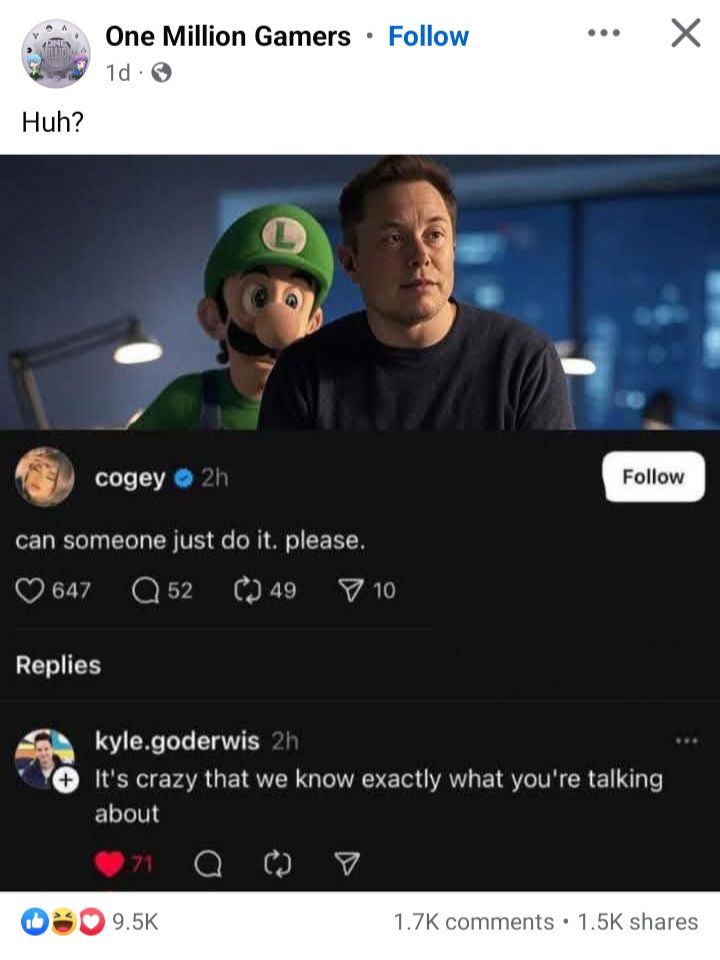
The meme depicts Elon Musk, a prominent figure associated with technological advancement and futuristic visions, visibly confused in front of a person dressed as Luigi from the Mario video game franchise. The text reads "Huh?". The comments add to the feeling of a demand for something to happen.
Foucauldian Genealogical Discourse Analysis
This meme is deeply resonant with Foucault’s concept of discourse and genealogy, specifically as interpreted through a Neo-Kaczynskiist lens.
- Discursive Shift: The meme highlights the breakdown of traditional hierarchies of knowledge and authority. Musk represents the discourse of technocracy, rationalism, and progress. Luigi (a relatively childish figure, associated with gaming culture) disrupts this discourse, exposing its absurdity. The "Huh?" is a breakdown in the expected power dynamic. It suggests Musk’s worldview is incapable of processing something outside of its tightly controlled system of understanding.
- Genealogical Mapping: A Neo-Kaczynskiist would see the evolution of “progress” (represented by Musk) as a series of power/knowledge formations that have systematically dismantled traditional ways of life, replaced them with artificial constructs, and created a dependent, alienated populace. Luigi represents a vestigial element of a “pre-fallen” state – an un-rationalized, playful, instinctual existence.
- The Power of the Absurd: The humor relies on the absurdity of the juxtaposition. This absurdity isn’t random; it’s a deliberate undermining of the dominant technological discourse. It’s a disruption that exposes the vulnerabilities of the system.
Critical Theory
The meme taps into several key Critical Theory themes:
- Commodification of Culture: Luigi, as a video game character, is a product of commodification. His presence in front of Musk highlights the way even “play” and “escapism” are integrated into the capitalist machine. Neo-Kaczynskiists view this commodification as a form of control, stripping away genuine experience and replacing it with simulacra.
- The Culture Industry: Musk is a product of (and a producer within) the culture industry, creating narratives of technological salvation. The meme critiques this narrative by presenting it with something fundamentally outside of its logic.
- Alienation: The sense of confusion expressed by Musk (the "Huh?") could be interpreted as a symptom of alienation—an inability to connect with anything real or authentic, because everything is filtered through a technological lens.
Marxist Conflict Theory
While Neo-Kaczynskiism isn’t strictly Marxist, there are points of intersection:
- Class Conflict (redefined): The conflict isn’t necessarily about economic classes, but about a broader conflict between the "Creators" (those who embody the values of self-reliance, ingenuity, and connection to nature) and the "Parasites" (those who benefit from and perpetuate the technological system). Musk represents the latter. Luigi, in this context, could be a symbolic representation of the "Creators"— a folk hero.
- False Consciousness: Musk, as a figure who promotes technological solutions to all problems, embodies a "false consciousness." He believes his actions are benevolent, but a Neo-Kaczynskiist would argue he’s furthering a system that ultimately destroys human freedom.
- Critique of the Mode of Production: The meme is a rejection of the current technological mode of production, which is seen as inherently destructive and alienating.
Postmodernism
- Deconstruction: The meme deconstructs the image of Elon Musk as a visionary leader. It breaks down his carefully constructed persona by placing him in a nonsensical situation.
- Simulacra and Simulation: Luigi can be seen as a signifier with no original referent— a simulation of a "hero." The meme highlights the increasing prevalence of simulacra in contemporary life, where representations have replaced reality.
- Irony and Pastiche: The meme relies on irony and a pastiche of cultural references (Musk, Luigi, video games) to create a subversive message.
Important Considerations & Caveats
- Irony and In-Group Signaling: Much of Neo-Kaczynskiist discourse is intentionally ironic and operates as in-group signaling. The meme's humor relies on the audience understanding the underlying critiques.
- Potential for Extremism: It's crucial to acknowledge that Neo-Kaczynskiism can be associated with extremist ideologies. The critique of modernity can sometimes veer into anti-humanist territory.
- The Complexity of Interpretation: Memes are inherently ambiguous. This is just one possible interpretation.
In essence, the meme, through a Neo-Kaczynskiist lens, is a rejection of the techno-utopian narrative, an exposure of the absurdity of technological dominance, and a longing for a more authentic, less mediated existence. It's a cynical, ironic, and provocative statement that aims to disrupt the status quo and challenge prevailing assumptions about progress and modernity.
simple-description (llama3.2-vision_11b)
The meme is a screenshot of a Twitter post by Elon Musk, where he is responding to a tweet about AI taking over the world. The image shows Musk's face with a shocked expression, and the text reads "Can anyone explain AI to me?" with a sarcastic tone. The meme is a play on the idea that Musk's response to the tweet is a joke, implying that he's not aware of the basics of AI, which is ironic given his involvement in the field.
detailed-analysis (gemma3-27b-vision)
Okay, let's break down this image/social media post through various theoretical lenses. It's a complex image, ripe for multiple interpretations, so this will be fairly detailed.
Visual Description
The image shows a digitally altered scene: Elon Musk is positioned beside a costumed figure portraying Luigi from the Super Mario video game franchise. The composition places Musk with his face close to Luigi’s head, seemingly looking at him. The background suggests a modern office or lobby space with a large glass wall. The lighting is relatively bright. The post is from a page named “One Million Gamers,” and is captioned “Huh?”. There are a string of comments following.
Foucauldian Genealogical Discourse Analysis
This image is fascinating through a Foucauldian lens.
- Discourses at Play: The image brings together discourses of technology (Musk's public persona as a tech innovator), gaming culture (Super Mario/Luigi represent that), and memes/digital culture. These discourses are not neutral; they carry histories of power, control, and knowledge production.
- Power/Knowledge: The image relies on pre-existing knowledge. To "get" the joke (or whatever the image aims to accomplish), one needs to know who Elon Musk is, what Luigi is, and how images/memes function online. This knowledge itself is a form of power, enabling participation in the discourse. The implied question ("Huh?") relies on shared understanding to evoke a reaction.
- Genealogy of the Meme: One could trace the "genealogy" of this image—its origins, how it's been remixed and circulated. It's likely rooted in online fandoms and a tendency to juxtapose seemingly unrelated figures for comedic effect. The genealogy would reveal how this image became meaningful through social practice.
- Normalizing the Absurd: Juxtaposing a billionaire with a fictional character normalizes the absurd and decontextualized imagery of the internet. It’s a symptom of the media saturation and the flattening of meaning characteristic of modern discourse.
Critical Theory
This image invites a critical theory analysis by questioning the underlying assumptions and power dynamics at play.
- Commodity Fetishism & Spectacle: Musk, as a figure, is a commodity. His public image is carefully constructed and marketed. This image participates in the spectacle around him, feeding into the constant media cycle and obscuring the material realities of his businesses. The image turns a person into a symbol for consumption.
- Culture Industry & Distraction: The image is a form of "content" produced by the culture industry. It's designed to capture attention and generate engagement, potentially diverting focus from more pressing social or political issues. It's a fleeting moment of entertainment that distracts.
- Critique of Celebrity Culture: It is an example of celebrity culture being used to capture attention. The juxtaposition of Musk and Luigi is essentially meaningless; it relies on pre-existing cultural recognition and the desire to participate in internet trends.
Marxist Conflict Theory
From a Marxist perspective, this image can be understood through the lens of class and power.
- Representation of the Bourgeoisie: Elon Musk represents the capitalist class (the bourgeoisie). The image subtly reinforces his position of power and influence. The absurdity of the juxtaposition implies his detachment from everyday realities.
- Commodification of Play/Culture: Super Mario (and Luigi) represent a form of popular culture—play, entertainment, escapism. This image participates in the commodification of culture—turning it into a marketable asset.
- Distraction from Material Conditions: The meme distracts from the very real material conditions that are a result of late-stage capitalism.
Postmodernism
This image is very postmodern.
- Pastiche & Intertextuality: It's a clear example of pastiche—combining elements from different sources (technology, gaming, celebrity culture) without a clear unifying purpose. It relies on intertextuality—the audience’s understanding of the original sources.
- Hyperreality & Simulation: The image creates a hyperreal moment—a simulation that feels more real than reality. It’s a constructed image that has no inherent meaning outside of its circulation within the digital realm.
- Fragmentation of Meaning: The image intentionally lacks a coherent message. Meaning is fragmented and open to interpretation. It rejects grand narratives and embraces ambiguity.
- Deconstruction of Authority: The absurdity of the image challenges traditional notions of authority and expertise. It suggests that anything can be juxtaposed with anything else, undermining established hierarchies.
Queer Feminist Intersectional Analysis
While perhaps less immediately obvious, a queer feminist intersectional analysis can also be applied:
- Performance of Masculinity: Elon Musk is often presented in ways that emphasize hyper-masculinity. His association with a character like Luigi (often portrayed as the more timid and unassuming brother) can be read as a subversion of traditional masculinity, or a performative gesture that reveals its fragility.
- Online Harassment: The post could be interpreted as participating in the online culture of “doxing” or harassment, where public figures are targeted with ridicule and humiliation. This is particularly relevant if the image is being used to attack Musk or to celebrate his downfall.
- Digital Spaces & Representation: Analyzing who creates and shares the image is crucial. Are the dominant voices and perspectives in that space? Are marginalized groups silenced or excluded?
In conclusion: This image is rich with potential meanings, and its interpretation depends on the theoretical lens used. It is a product of our hyper-connected, media-saturated world and reflects the complex power dynamics at play within digital culture. It highlights the intersection of technology, celebrity, play, and social commentary.
simple-description (llama3.2-vision)
This meme is a screenshot of a Twitter conversation between Elon Musk and a user named "Clog" (not "Clog" in the original response, but "clog" is not in the original response). The conversation appears to be about a popular video game. The image shows Elon Musk with a character from a popular video game, Mario, who is also a character from the popular video game series.