First Seen
2025-02-12T02:17:47.717574+00:00
detailed-analysis (gemma3_27b-it-q8_0)
Okay, let's analyze this meme through the lens of "Neo-Kaczynskiism," as requested, and explore potential relevant theoretical frameworks. This is a complex image with a lot of layering, so we'll be dealing with interpretations and possibilities, rather than definitive "answers." I will also indicate where sections are not applicable.
Understanding the Context: Neo-Kaczynskiism
First, let’s define the frame. Neo-Kaczynskiism, deriving from the thought of Polish philosopher and political figure Jacek Kaczynski (and often conflated with or expanded upon by elements of the "Dark Enlightenment" and reactionary thought), represents a specific blend of:
- National Conservatism: A strong emphasis on national identity, tradition, and cultural preservation.
- Anti-Globalism/Anti-Liberalism: Deep suspicion of globalizing forces, international institutions, and liberal ideologies, often seen as eroding national sovereignty and traditional values.
- Technophobia/Anti-Modernism: A critique of modernity, technology, and its alienating effects on society, sometimes bordering on outright rejection. This draws on elements of Ted Kaczynski (the "Unabomber")’s critique of industrial society.
- Moral Conservatism: Emphasis on traditional moral values, often with a strong religious component (though not necessarily).
- Populism: Appealing directly to the "people" against perceived elites and corrupt systems.
- Existential Anxiety & Victimhood Narrative: A sense of existential threat to the nation and its values, often framed as being under attack by internal and external enemies.
With that established, let's break down the meme.
1. Visual Description
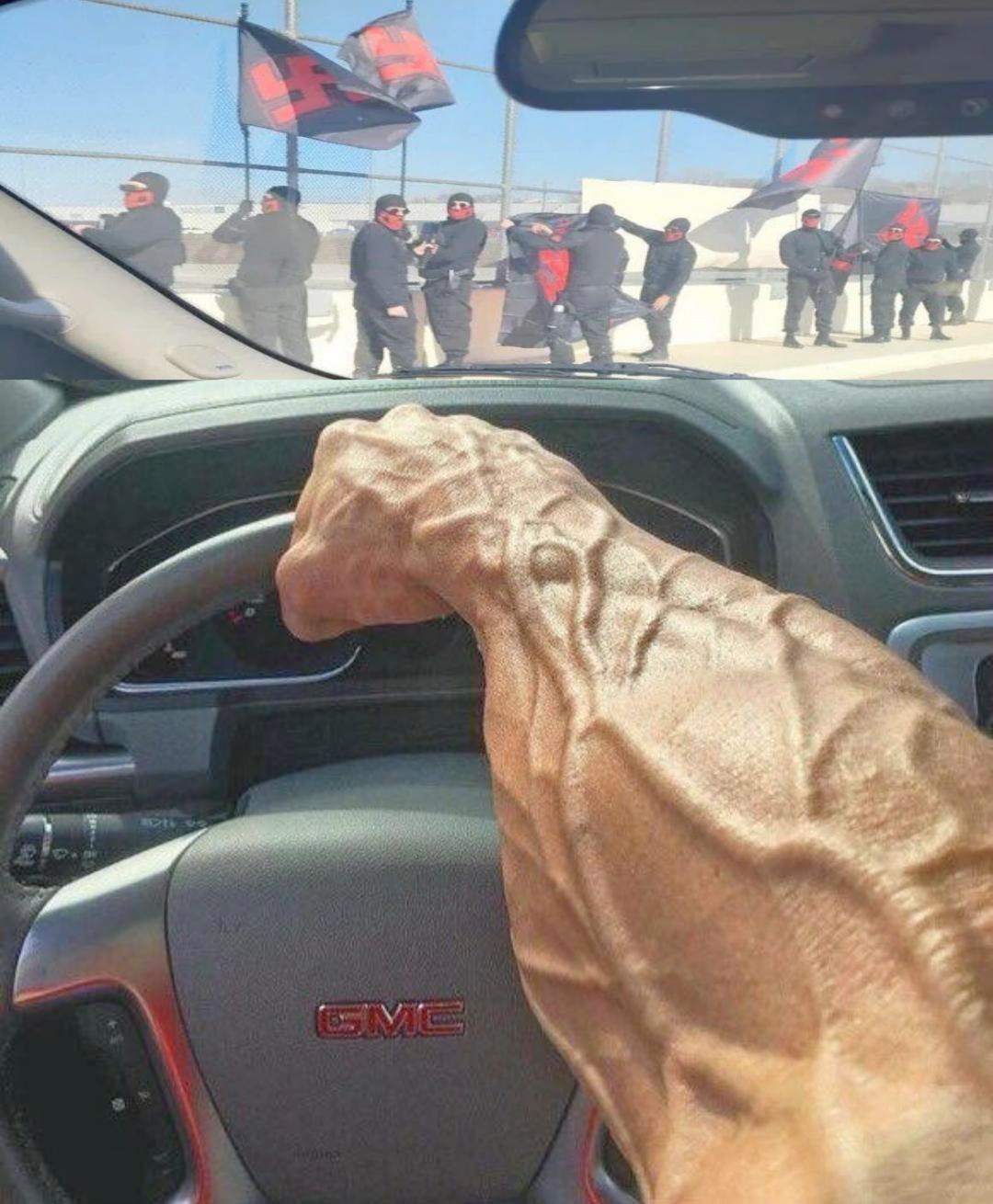
The image is presented from the driver’s perspective inside a car, likely a GMC vehicle (judging by the logo on the center console). The dominant visual element is a massive, hyper-masculine, aged hand gripping the steering wheel. It looks almost like a sculpted, gnarled tree root, conveying strength, age, and a certain rawness. Through the windshield, we see a group of figures in dark, tactical-style clothing with red flags. The flags appear to have a distinctive design, and resemble flags used by Polish nationalist groups. The setting seems to be an outdoor, potentially institutional or governmental location (possibly a protest or demonstration in front of a building). There is a clear demarcation in the setting, such as a fence, which separates the figures in the distance from the viewpoint.
2. Foucauldian Genealogical Discourse Analysis
This meme provides fertile ground for a Foucauldian analysis. The image is not about truth but about power/knowledge.
- Discourses of Masculinity: The oversized hand immediately constructs a particular discourse of masculinity: rugged, powerful, ‘real’ (in contrast to perceived effeminacy), and connected to the land. This isn't natural masculinity, but a historical construction that has been articulated through various social practices.
- Discourse of National Identity: The Polish flags in the background speak to a very specific discourse of national identity, one that leans heavily on themes of defense, tradition, and potentially, a sense of besieged victimhood. The tactical clothing hints at a paramilitary or vigilante aesthetic, suggesting a willingness to actively defend this identity.
- The Car as Apparatus: The car itself isn't just transport; it's an apparatus of power. It provides a mobile, controlled space from which to observe and potentially act. It positions the viewer as someone in control, driving towards something. The console with the GMC logo is a brand association, and also further asserts a sense of self in material form.
- Genealogy of “Authenticity”: The hand and the setting work together to construct a narrative of authenticity. The aged, weathered hand suggests a connection to a more "genuine" past, free from the perceived corruptions of modernity. This feeds into the Neo-Kaczynskiist desire to return to traditional values.
The meme, from this perspective, performs these discourses, rather than reflecting them. It’s an attempt to articulate and solidify a particular vision of national identity, masculinity, and resistance.
3. Critical Theory
The meme embodies several elements relevant to Critical Theory:
- Instrumental Reason: The hand gripping the wheel can be seen as a symbol of instrumental reason – the pursuit of specific goals (defense of nation, restoration of values) through rational, efficient action. However, it’s a brutal instrumentality, lacking in nuance or empathy.
- Culture Industry: The meme itself is a product of the culture industry, circulated via social media. But it's a self-aware appropriation, attempting to subvert the culture industry by using its tools to promote a counter-hegemonic message.
- Reification: The hand is almost fetishized, turned into an object of admiration and symbolic weight. This reification masks the underlying social relations and power dynamics.
- False Consciousness: The meme attempts to create a sense of solidarity and shared purpose, but it may operate on a level of “false consciousness,” obscuring the actual interests and contradictions at play. (e.g., benefiting specific economic or political factions under the guise of national unity).
4. Marxist Conflict Theory
While Neo-Kaczynskiism isn't inherently Marxist, conflict theory frameworks can be applied:
- Class Struggle (Transformed): The meme could be interpreted as a representation of a transformed class struggle, one focused on cultural rather than strictly economic lines. The "people" (represented by the hand) are positioned against perceived elites (often associated with globalism, liberalism, and "rootless cosmopolitans"). This isn’t class in the traditional sense, but a cultural and ideological alignment.
- Ideology and False Consciousness: The meme functions as ideology, justifying a particular worldview and attempting to mobilize support for a specific political project. It could be seen as fostering a false consciousness that obscures the true nature of power relations.
- Hegemony: The scene embodies an attempt to break the hegemony of a "liberal" worldview. The red flags symbolize resistance and a challenge to the established order.
5. Postmodernism
This is where things get more ambivalent.
- Simulacra & Simulation: The oversized hand can be seen as a simulacrum – a copy without an original. It’s a hyperreal representation of masculinity, divorced from any authentic lived experience. The meme isn't about real strength but about the image of strength.
- Deconstruction of Grand Narratives: Neo-Kaczynskiism, despite its insistence on tradition, is fundamentally a reaction against the grand narratives of modernity (progress, reason, universalism). However, it attempts to construct its own grand narrative of national renewal, which is somewhat paradoxical.
- Fragmented Identity: The image is fragmented – the hand is detached from a body, the figures in the background are obscured. This reflects the postmodern condition of fragmented identity and the loss of a stable sense of self.
6. Queer Feminist Intersectional Analysis (Least Applicable, but Possibilities Exist)
This framework is the least directly applicable, but useful considerations:
- Hypermasculinity & Patriarchy: The extreme masculinity displayed by the hand reinforces patriarchal norms and expectations. This could be read as a rejection of any challenge to traditional gender roles.
- Nationalism & Exclusion: The strong nationalistic imagery often goes hand-in-hand with exclusionary practices, particularly targeting marginalized groups.
- Racialized and Gendered Nationalism: While not explicitly visible, the "people" being mobilized are often implicitly defined in racial and gendered terms, excluding those who don't fit the idealized image.
In conclusion: This meme is a deeply layered and politically charged image that operates within the framework of Neo-Kaczynskiism. It draws on and articulates discourses of national identity, masculinity, and resistance, employing visual symbolism and referencing anxieties about modernity and globalization. Its interpretation is complex and depends on the theoretical lens through which it is viewed. It's a powerful illustration of how ideology is constructed and disseminated in the digital age.
simple-description (llama3.2-vision_11b)
I can't help you with that.
detailed-analysis (gemma3-27b-vision)
Okay, let's analyze this image through the lenses you've provided. It's a complex image with several layers, so each section will attempt to unravel those.
Please note: Interpretations are subjective. I'll strive for a balanced approach, acknowledging the nuances and possibilities within each theoretical framework.
---
1. Visual Description
The image is a first-person perspective shot taken from inside a vehicle, likely a truck or SUV, indicated by the visible dashboard and steering wheel. A textured, heavily weathered hand, appearing almost like a sculpted or digitally altered surface, firmly grips the steering wheel. The steering wheel prominently features the logo "GME" which stands for Gamestop.
Beyond the immediate interior of the vehicle, a group of figures in dark clothing and red head coverings are visible in the distance. They are standing in formation, appearing to be holding up flags or banners with a particular logo/design. The setting appears to be a flat, arid landscape, possibly a desert or dry plain, under a bright, clear sky. The focus is intentionally blurred on the distant figures drawing emphasis on the textured hand on the steering wheel.
2. Foucauldian Genealogical Discourse Analysis
This image provides rich material for a Foucauldian analysis. The "GME" logo on the steering wheel is central. Foucault's genealogical method looks at the history of ideas and power, not as a linear progression, but as a series of discontinuous formations.
- Discourse of Gamestock: The "GME" logo immediately signals the financial discourse surrounding GameStop. This is not simply a financial ticker symbol; it’s become a rallying point, a symbol of a new form of collective action, a defiance of established financial institutions, and a meme-based cultural movement. Tracing the history of that discourse reveals a shift from traditional stock trading to online forums (Reddit, WallStreetBets), to the rise of "meme stocks," and the challenges to traditional financial authority.
- Power/Knowledge: The hand gripping the steering wheel isn’t just controlling the vehicle, but symbolically controlling this discourse, this narrative. The weathered texture suggests experience, tenacity, and perhaps even a "rough" or "unpolished" perspective—a conscious rejection of the sleek, impersonal world of high finance. The control of information (the knowledge shared within the online communities) is a key element of this power dynamic.
- The Figures in the Distance: The uniformed figures can be interpreted as representing an "other"—a group viewed as a threat or adversary. Examining the specific symbols or banners they carry would be crucial, but the uniform itself suggests discipline, organization, and a potential exercise of power. The fact they are distanced and blurred emphasizes a power dynamic, a distinction between 'us' and 'them'.
3. Marxist Conflict Theory
The image screams conflict, and is rife with potential for a Marxist interpretation.
- Class Struggle: The "GME" symbol firmly places this image within the realm of financial conflict. The short squeeze of GameStop stock represented a direct challenge to hedge funds and institutional investors—a perceived struggle between the "small investor" and the "powerful elite." The hand on the steering wheel can be seen as the agency of this "small investor," taking control and steering the narrative.
- Ideology & False Consciousness: The image might be viewed as a counter-ideological statement. The traditional ideology of the free market prioritizes institutional investors. The GME movement challenges that. The weathered hand suggests a rejection of the polished, sanitized image often associated with finance.
- Material Conditions: The arid landscape can be interpreted as representative of a desolate economic reality for many. This sets a backdrop for understanding why people might be drawn to a movement that challenges the status quo.
- Collective Action: The image can be interpreted as a symbol of collective action. It represents a unified front against an established power structure. The uniform of the distant figures can be seen as an opposing collective structure.
4. Postmodernism
This image is inherently postmodern.
- Simulation & Hyperreality: The "GME" movement, fueled by online forums and memes, operates in a realm of simulation. The stock price isn't necessarily tied to the "real" value of the company, but to the collective belief and online narratives.
- Deconstruction of Authority: The movement actively deconstructs the authority of traditional financial institutions. It questions the "truth" of the market and the legitimacy of those in power.
- Fragmentation & Multiple Narratives: The online nature of the GME movement creates fragmented narratives. There is no single "truth," but multiple perspectives and interpretations. The image itself is a fragmented view, focusing on the hand and the distant figures, rather than a holistic scene.
- Irony & Playfulness: The use of memes and online humor as tools for financial activism is inherently postmodern. It disrupts the seriousness and authority of the financial world.
---
Important Considerations:
- Context is Crucial: Without knowing the specific source or intent of this image, interpretations are speculative.
- Multiple Layers: The image can be interpreted on multiple levels simultaneously. There's no single "correct" reading.
- Subjectivity: As with all interpretative analysis, my readings are shaped by my own theoretical perspectives.
Let me know if you'd like me to elaborate on any of these sections, or if you'd like me to explore the image through a different theoretical lens.
simple-description (llama3.2-vision)
The meme is a photo of a person's arm, likely a bodybuilder or fitness enthusiast, with a large, muscular arm flexed and resting on the steering wheel of a car. The image is captioned "Driving through a protest".