First Seen
2026-03-20T04:58:58+00:00
simple-description (qwen3.5_2b-q8_0)
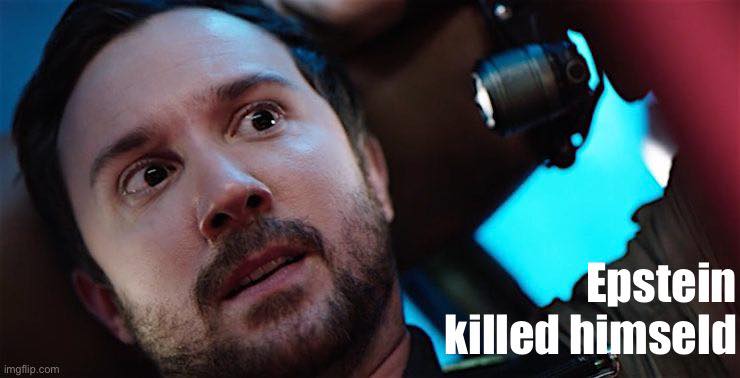
This meme employs a surreal style common in Neo-Dadaism, which thrives on juxtaposing unrelated elements to create shock or irony. It features a composite image that places an intense human expression directly over a violent action scene, effectively mixing the face of a man with a firearm and the text "Epstein killed himself" overlaid on top. The absurdity lies in taking a tragic event and framing it within a context of mass casualty violence without clear logic.
detailed-analysis (gemma3_27b-it-q8_0)
Okay, let's break down this meme ("Distracted Boyfriend" meme with the text "Epstein killed himself") through a Neo-Dadaist lens, and explore the relevant theoretical frameworks that apply.
Understanding Neo-Dadaism as a Framework
Before diving in, it’s crucial to understand Neo-Dadaism. Emerging in the 1950s & 60s, it was a reaction to reaction. Dada, born from the horrors of WWI, was anti-art, rejecting logic, reason, and aesthetics in favor of chaos and absurdity. Neo-Dada took this further, incorporating elements of mass culture and challenging established art norms, often through playful, ironic, and jarring juxtapositions. It's deeply cynical, embracing chance, and disrupting expected meaning. It is about the process of deconstruction, and less about offering new construction.
Visual Description
The meme uses the “Distracted Boyfriend” template. A man (actor Trevor Noah) is walking with his girlfriend, but his head is turned, looking at another woman (out of frame). The text is "Epstein killed himself," replacing the usual labels. Visually, it’s a clean, digitally produced image. The meme plays on a visual trope of desire and betrayal. The lighting is artificial and the framing is fairly conventional, but this is ultimately irrelevant. The visual element is a conduit for the message.
Postmodernism
This is where the meme finds strong resonance. Postmodernism, like Neo-Dadaism, questions grand narratives and embraces fragmentation, irony, and the deconstruction of meaning. This meme directly subverts the original meaning of the “Distracted Boyfriend” template. The boyfriend, usually representing a person tempted away from a stable relationship, is now distracted by a statement that is supposed to be a fact (“Epstein killed himself”), but which is widely believed to be a cover-up.
- Simulacra and Simulation: (Baudrillard) The meme thrives in a world of simulacra - copies without originals. The “truth” of Epstein’s death is obscured by layers of conspiracy theories and misinformation, creating a hyperreality where it’s impossible to determine what is “real.” The meme is about the illusion of truth, rather than the truth itself.
- Deconstruction: The meme takes a familiar image and completely destabilizes its conventional meaning. It's a playful dismantling of the visual rhetoric of attraction.
- Irony and Pastiche: The meme is fundamentally ironic. It’s not stating a belief in Epstein's suicide, but rather highlighting the widespread skepticism around it. It also uses pastiche, borrowing a pre-existing meme format to comment on a contemporary event.
Foucauldian Genealogical Discourse Analysis
Michel Foucault’s concept of genealogy examines how power structures create and maintain knowledge (discourses). The meme can be seen as engaging with the "discourse" surrounding the Epstein case.
- Power/Knowledge: The official narrative of Epstein’s suicide (and the subsequent investigations) represents a "power/knowledge" system. Those in power (legal systems, the media) have the authority to define and disseminate what is considered "truth."
- Discursive Formation: The meme is a response to a disruption in this discourse. The sheer amount of speculation and conspiracy theories surrounding Epstein’s death indicates a breakdown in trust in those power structures. The meme contributes to the counter-discourse – the alternative narrative that challenges the official one.
- Archaeology of Knowledge: The meme doesn’t try to uncover a hidden "truth," but rather to map the rules that govern how the discourse about Epstein is formed. It acknowledges that “truth” is always contingent and constructed.
Critical Theory
Critical Theory, especially as developed by the Frankfurt School, examines how cultural products reinforce or challenge societal power structures.
- Culture Industry: The meme itself is a product of the culture industry (internet meme culture, social media). It’s a quick, easily digestible piece of content that circulates rapidly.
- False Consciousness: The meme subtly points to a perceived “false consciousness” – the idea that people are misled by dominant ideologies. It suggests that the official narrative is a form of manipulation, preventing people from recognizing the “true” nature of events.
- Ideology Critique: The meme acts as a form of ideology critique. It doesn’t necessarily offer a solution, but it challenges the prevailing ideology by questioning the official story.
Why Marxist Conflict Theory is Less Directly Relevant
While there is a class dimension to the Epstein case (Epstein’s wealth and connections to the elite), and one could argue the meme is implicitly criticizing the power of the capitalist class, it's not the primary focus. Marxist analysis would need to center the meme's connection to economic structures and class struggle more explicitly to be a strong reading. It’s a possible layer, but not the dominant one.
In Conclusion (Neo-Dadaist Perspective)
From a Neo-Dadaist point of view, this meme isn't about finding answers. It’s an act of irreverent disruption. It's a chaotic collision of a banal meme format with a deeply disturbing and complex real-world event. It's a cynical acknowledgment that "truth" is often obscured by power, and that meaning itself is fluid and unstable. The meme is a playful, nihilistic gesture that does not aim to resolve anything, but rather to highlight the absurdity and fragmentation of contemporary existence. It is the act of deconstruction, not the creation of new meaning, that is the point. It's a Dadaist shrug in the digital age.
simple-description (llama3.2-vision_11b)
The meme features a photo of a man with a shocked expression, accompanied by the text "killed" and "Epstein himseld." The image is likely a reference to the controversy surrounding Jeffrey Epstein, an American businessman and sex offender who was found dead in his cell in 2019. The meme's title, "Neo-Dadaism," suggests that it is part of a movement that challenges traditional notions of art and culture. The use of bold, white text and a dramatic image creates a sense of shock and surprise, mirroring the public's reaction to Epstein's death. Overall, the meme is a commentary on the controversy surrounding Epstein's death and the impact it had on society.