First Seen
2023-05-10T21:03:36+00:00
simple-description (llama3.2-vision_11b)
The meme is a screenshot of a Twitter post from a user named "neuro" that reads: "i dont know what's real anymore. i've been watching the same 3 videos on youtube for the past hour and they all have the same title. is this the simulation?". The post is a humorous commentary on the concept of Neo-Dadaism, a art movement that emphasizes the absurdity and illogic of modern life. The meme is poking fun at the idea that our reality is just a simulation, and the user is jokingly suggesting that they're stuck in a never-ending loop of the same three videos.
detailed-analysis (gemma3-27b-vision)
Okay, here's an analysis of the Twitter exchange, broken down into sections relevant to the requested theoretical frameworks. I'll indicate where a particular framework doesn't seem particularly applicable.
Visual Description
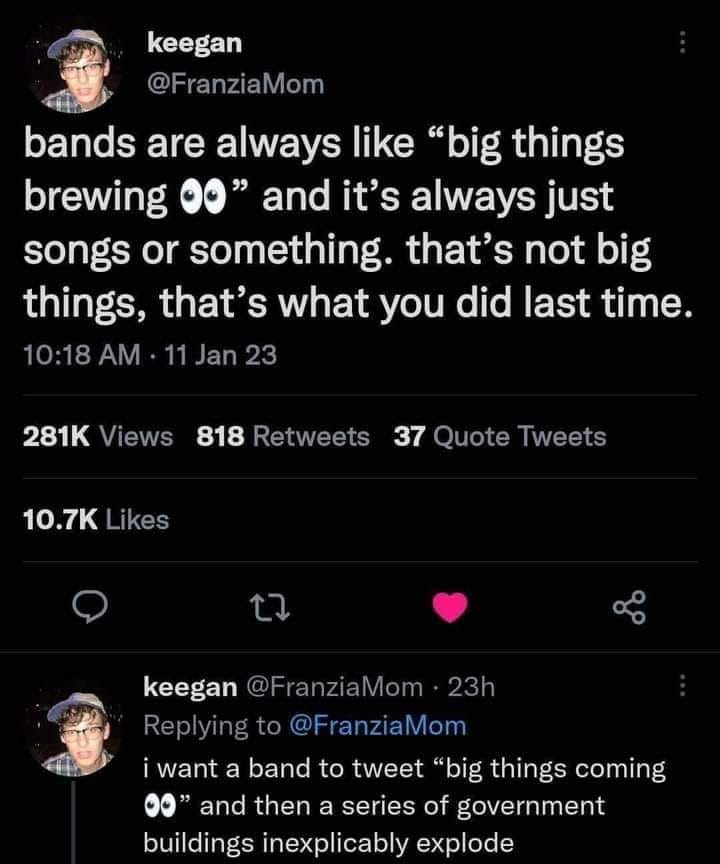
The image is a screenshot of a Twitter exchange. The profile picture for both tweets is a photo of a person in a beanie. The first tweet is a complaint about bands overusing the phrase "big things brewing" as a promotional tactic, which then leads to underwhelming releases. The second tweet, a reply to the first, escalates this frustration into a desire for a band to actually mean it, fantasizing about literal, explosive consequences for false advertising. The image shows metrics for the first tweet: 281k views, 818 retweets, 37 quote tweets, and 10.7k likes. The use of the 💩 emoji indicates playful, ironic dissatisfaction.
---
Foucauldian Genealogical Discourse Analysis
This exchange is a good example for a Foucauldian analysis because it highlights the discourse around hype, anticipation, and disappointment in the music industry. The phrase “big things brewing” is not inherently meaningful; its power lies in its circulation within a system of promotional language.
- Genealogy: A genealogical approach would trace the historical development of this promotional tactic. When did phrases like this become common? How did they evolve? What conditions enabled them? This analysis might explore how the intensification of marketing and the need for bands to constantly generate buzz led to the proliferation of vague promises.
- Power/Knowledge: The original tweet identifies a power imbalance. The band holds the knowledge (or at least claims to) of "big things" and wields this to create anticipation. But the tweet reveals that this is often just a performance, a manipulation of consumer desire. The frustration expressed is a response to this perceived imbalance.
- Discourse & Subjectivity: The tweet reveals how this discourse shapes our expectations. We’ve been conditioned to expect “big things” but are consistently underwhelmed. This shapes our subjective experience of music releases and fosters cynicism.
- Escalation: The second tweet takes this to an extreme (explosions!), creating a sort of hyperbolic exaggeration and suggesting the need for consequences.
---
Critical Theory
This exchange can be examined through the lens of Critical Theory, particularly concerning the commodification of culture and the alienation it creates.
- Commodification: The original tweet is, at its core, a critique of the commodification of music. The phrase "big things brewing" has become a product – a marketing tool devoid of genuine artistic meaning. The band isn’t promising art, they’re promising a product that will deliver on a constructed sense of expectation.
- False Consciousness: While a weaker connection, we might suggest that the constant barrage of promotional language creates a form of "false consciousness" – it distracts from genuine artistic expression and fosters a reliance on hype rather than substance.
- Culture Industry: This exchange mirrors a critique of the "culture industry" (Adorno and Horkheimer). The constant cycle of promotion and underwhelming delivery perpetuates a system of control. The band is a cog in this machine, perpetuating a cycle of disappointment.
- Alienation: The commenter feels alienated from the band because their actions do not match their claims. The desire for an over-the-top, explosive resolution can be seen as a desire to shock the system and break the pattern of disappointment.
---
Marxist Conflict Theory
There is some applicability of Marxist Conflict Theory here, though it’s not a primary framework.
- Class & Consumption: The frustration is rooted in the relationship between a “creator” (the band) and a “consumer” (the audience). The band is using promotional language to exploit consumer desire and generate profit.
- False Promises & Exploitation: The band’s “big things brewing” is a form of symbolic capital – it represents potential value. But when that value isn’t realized, it feels like a form of exploitation – the consumer's time and attention have been wasted.
- Revolutionary Desire (Hyperbolic): The desire for literal explosions is, of course, hyperbolic. However, it reflects a deeply held frustration with the system – a desire to dismantle the cycle of disappointment, even if only in a fantastical way.
---
Postmodernism
This exchange is highly characteristic of postmodern sensibility.
- Irony & Playfulness: The use of the poop emoji signals irony and a playful distance from sincerity. The escalation in the reply is a form of hyperreality—taking a minor annoyance to an absurd extreme.
- Deconstruction of Meaning: The critique targets the signifier ("big things brewing") rather than any inherent quality of the music itself. It highlights the emptiness of promotional language and the way meaning is constructed through marketing.
- Simulacra & Simulation: The phrase "big things brewing" has become a simulacrum—a copy without an original. It refers to nothing substantial and exists purely as a marketing tactic.
- Meta-Commentary: The exchange is a meta-commentary on the ways bands use language to manipulate audience expectations.
---
Queer Feminist Intersectional Analysis
This framework is the least directly applicable here. There's no explicit gender, sexuality, or intersectional element present in the tweets themselves. However, it's possible to consider a reading that acknowledges how the desire for disruption (the explosions) could be interpreted as a rejection of normative expectations within the music industry, which historically has been a male-dominated space. This is a more speculative interpretation and requires significant contextualization, but it could be argued that the desire for a radical disruption of the system could align with a queer feminist challenge to power structures. This is a stretch, but demonstrates how almost any theoretical lens can find some connection.
Let me know if you'd like me to elaborate on any of these sections or explore a different theoretical perspective!
simple-description (llama3.2-vision)
This meme is a screenshot of a tweet from a user named "keegan" that expresses frustration with the popularity of the phrase "big things coming" or "big things brewing" in music and entertainment. The user jokes that they want a band to tweet "big things coming" and then a series of government buildings to explode, implying that the phrase is now overused and clichéd. The tweet is humorous and sarcastic, poking fun at the overuse of the phrase.
tesseract-ocr
; keegan 5 b MOE Ven bands are always like “big things brewing QQ” and it’s always just songs or something. that’s not big things, that’s what you did last time. 10:18 AM - 11 Jan 23 281K Views 818 Retweets 37 Quote Tweets 10.7K Likes o) pant . % : keegan @FranziaMom - 23h 7 r Replying to @FranziaMom MATa Wey-lale co aNU-t-1ame 9) (meal ia meron ats QQ” and then a series of government buildings inexplicably explode