First Seen
2023-05-10T21:03:36+00:00
simple-description (llama3.2-vision_11b)
This meme is an example of Neo-Dadaism, a category that explores the absurd and the mundane. The meme features a screenshot of a Twitter post with the text "I can speak 6 languages and I am 12" and a response from a user saying "I can speak 1 language and I am 100". The meme is poking fun at the idea that language proficiency and age are not necessarily correlated, and is using humor to highlight the absurdity of comparing these two things.
detailed-analysis (gemma3-27b-vision)
Okay, here's an analysis of the provided Twitter post, broken down into relevant sections based on the requested theoretical frameworks. Some sections will be more robust than others, as not every theory neatly applies to this short statement.
Visual Description
The image is a profile picture, showing a woman with blond hair and fair skin. She is slightly turned away from the camera, with a neutral expression. She is wearing a pink top. The overall aesthetic is fairly casual and suggests a personal account rather than a formal organizational presence. The account name, "AmbrujaVoyeur," and use of heart emojis suggest a certain lightheartedness, perhaps even a performative online persona.
Postmodernism
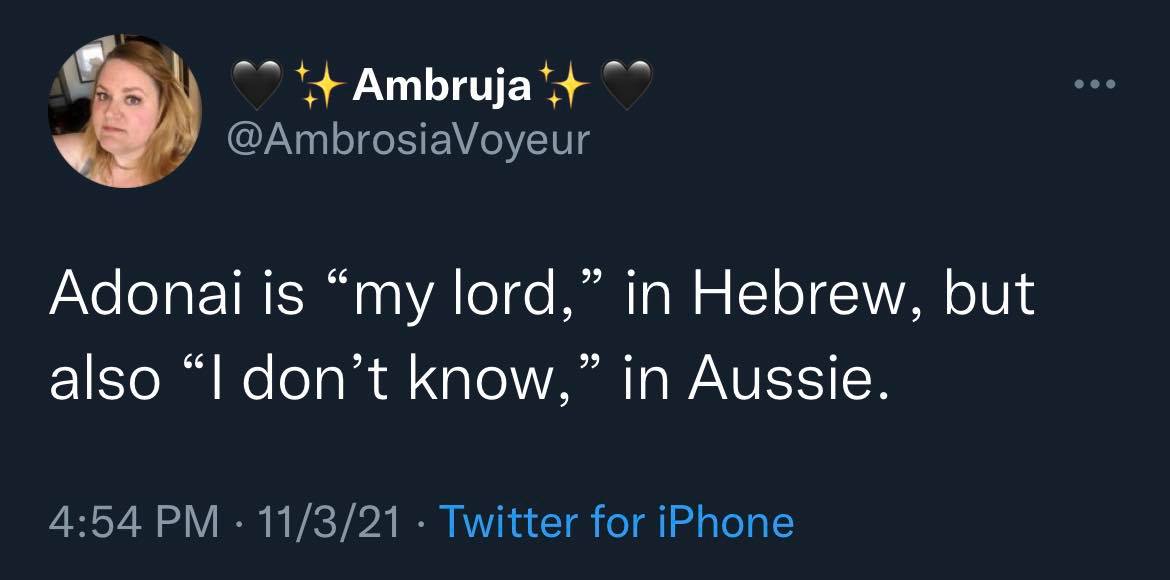
This tweet embodies a key tenet of Postmodern thought: the deconstruction of fixed meanings. The statement hinges on a play of signifiers – the Hebrew "Adonai" and the Australian colloquialism "I don't know." The author highlights that a word with a historically and religiously laden meaning ("my lord") can be ironically and humorously re-interpreted within a different cultural context.
- Deconstruction: The statement isn't about a true meaning of "Adonai," but about how meaning shifts and relates to context. The 'lord' implication is subtly subverted by the Australian phrase.
- Relativism: The tweet implicitly suggests that meaning is not inherent but constructed through language and cultural frameworks. There isn’t one “correct” interpretation.
- Irony & Playfulness: The juxtaposition of the sacred and the everyday ("my lord" vs "I don't know") is inherently ironic. This aligns with a Postmodern embrace of playfulness and rejection of grand narratives.
Queer Feminist Intersectional Analysis
While not directly dealing with identity politics, the act of re-interpreting language and resisting fixed meanings can be connected to Queer and Feminist thought.
- Subverting Power Dynamics: Traditionally, "Adonai" invokes patriarchal, hierarchical relationships (lord/subject). Reclaiming it with a phrase like "I don’t know" can be read as a playful act of resistance against authoritative language.
- Challenging Normative Meaning: Queer theory often focuses on destabilizing established norms. The playful re-contextualization of "Adonai" similarly challenges a fixed understanding of meaning and language.
- Intersectionality (Weakly Present): The tweet highlights the intersection of linguistic and cultural contexts (Hebrew/Australian). It subtly acknowledges that meaning is shaped by multiple factors, and these factors influence how we interpret the world. However, intersectionality isn't the main driver of the message.
Foucauldian Genealogical Discourse Analysis
This tweet lends itself to a Foucauldian analysis, though it's a subtle connection. Foucault's genealogical method traces the historical development of concepts and discourses to understand how power operates.
- Discourse & Power: The word "Adonai" is embedded in a specific religious and historical discourse (Judaism, Christianity). That discourse carries with it relations of power – historically, the power of religious authority.
- Disruption of Discourse: The tweet interrupts that traditional discourse by offering an alternative interpretation. This interruption doesn't overthrow the established meaning, but it challenges it, making it less fixed.
- Re-contextualization as Power Shift: By relocating the word into an Australian cultural context ("I don't know"), the author subtly shifts the power dynamics associated with it. The solemnity of “my lord” is diminished by the casualness of the Aussie phrase.
Please note: Some of these analyses are interpretations. The tweet is fairly simple, and deeper theoretical readings require some extrapolation and assumption. The primary message seems to be a playful observation about language and cultural context.
simple-description (llama3.2-vision)
This meme is a humorous commentary on the biblical story of the Israelites' journey to the Promised Land, specifically the story of the Israelites' leader, Moses, and the divine presence known as the "Lord" or "God". The meme pokes fun at the idea of a divine presence being referred to as "Lord" or "God" by a character named "Adonai" (Hebrew for "Lord") who is also referred to as "I don't know" in a Hebrew phrase that translates to "I don't know" in English.
tesseract-ocr
Cie ea Viile)a0 Fn oe oe @AmbrosiaVoyeur Adonai is “my lord,” in Hebrew, but also “| don’t know,” in Aussie. 4:54 PM - 11/3/21 - Twitter for iPhone