First Seen
2023-05-10T21:03:36+00:00
simple-description (llama3.2-vision_11b)
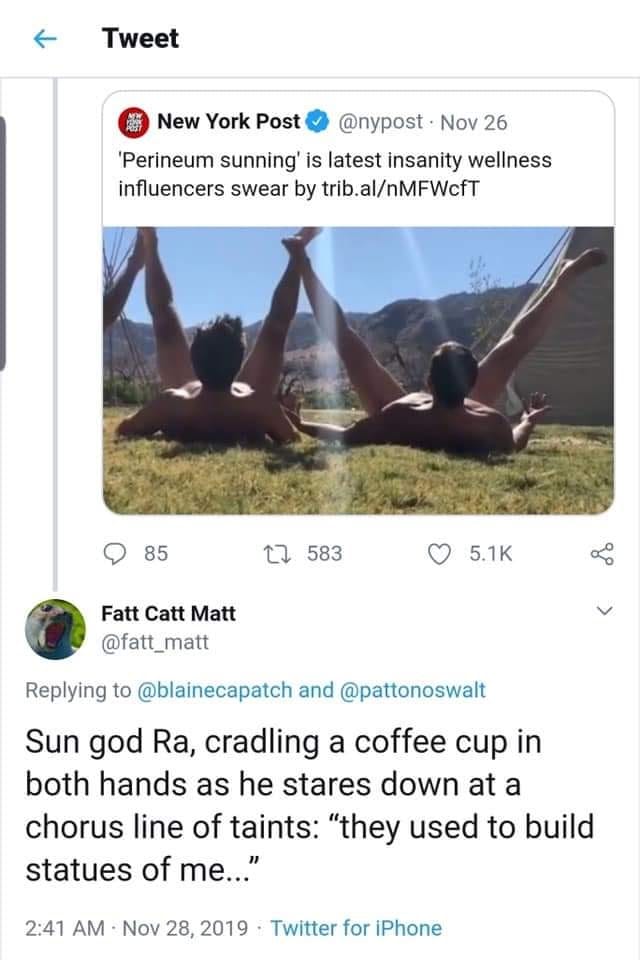
This meme is an example of Neo-Dadaism, a style of art that emphasizes the absurd and the irrational. The meme is a photograph of a person sitting on a beach, but with their legs stretched out in a way that is physically impossible. The text overlay reads "I can smell the desperation for a new meme from a mile away".
detailed-analysis (gemma3-27b-vision)
Okay, let's break down this rather bizarre Twitter post through the lenses you've requested. It's important to note that applying these theoretical frameworks can be interpretive and open to debate, especially with such a fragmented and odd image/text.
1. Visual Description
The image depicts a person lying on their back in a grassy field, legs spread with their genitals exposed to the sun. The person is in a potentially vulnerable position. The sky is overcast. The composition is unusual, focusing primarily on the exposed area of the body, creating a sense of spectacle or provocation. A bird is visible in the background, adding a sense of natural setting but also offering a slight contrast to the contrived pose. The person also has a coffee cup in one hand.
2. Foucauldian Genealogical Discourse Analysis
This post is ripe for a Foucauldian reading. The practice of "perineal sunning," as promoted by influencers, represents a biopolitical construction of self-care and wellness.
- Discourse & Power: This isn't a "natural" practice, but one constructed through discourse – the language and narratives surrounding health, sexuality, and the body. The New York Post reporting on it, and the influencers promoting it, contribute to this discourse. The claim of wellness is a power dynamic. It establishes a norm (seeking optimal health through unconventional means) and marginalizes those who don't participate.
- Genealogy: Examining the history of similar practices (sunbathing, "natural" health fads, genital exposure in art/ritual) would reveal how our understanding of the body, health, and shame/exposure have shifted over time. It’s likely connected to anxieties about modernity, a desire for authenticity, and a romanticization of “natural” living.
- Panopticism & Self-Surveillance: The practice could be linked to the idea of self-regulation and the internalizing of norms. The act of exposing oneself, even to the sun, can be seen as a form of self-discipline and the constant monitoring of one's body, aligning with Foucault’s concept of the panopticon.
3. Critical Theory
This post screams for a Critical Theory analysis focused on the Culture Industry and the Commodification of the Body.
- Culture Industry: The New York Post reporting on this, and the influencers making it a "trend," exemplifies how seemingly bizarre practices become part of the mass-produced culture, often driven by novelty and sensationalism. It normalizes the abnormal and transforms it into consumable content.
- Commodification of the Body: This practice, turned into a trend, reduces the body to an object for optimization and display. "Wellness" becomes a product to be bought and sold (supplements, equipment, courses). The vulnerable exposure is not about genuine health, but about a performative display for social media validation.
- Reason vs. Irrationality: The claim of wellness for a practice that seems unconventional and potentially dangerous challenges the Enlightenment project’s emphasis on reason. It highlights the power of irrationality and belief systems in contemporary society.
4. Marxist Conflict Theory
While not the most prominent lens here, a Marxist reading can still be applied.
- Alienation: The practice and the surrounding discourse can be seen as a symptom of alienation from the body. The pursuit of "wellness" through such extreme methods suggests a disconnection from natural bodily functions and a reliance on external solutions.
- False Consciousness: The influencers promoting this may be benefiting financially from the trend (selling products, gaining followers), while those who participate may be unknowingly contributing to a system that commodifies their bodies and anxieties.
- Consumption and Ideology: The “perineal sunning” trend creates a demand for specific products and services, reinforcing capitalist consumption patterns. The ideology of self-optimization and constant improvement reinforces the need to consume to achieve a desired state.
5. Postmodernism
This post is quintessential postmodern.
- Hyperreality: The image and the associated discourse create a simulation of reality, where the boundary between authentic experience and constructed performance is blurred. Is this about genuine wellness, or about creating a captivating image for social media?
- Deconstruction of Norms: The practice challenges conventional understandings of health, sexuality, and public/private boundaries. It actively disrupts norms, even if the disruption is fleeting or superficial.
- Irony and Parody: The act itself feels strangely performative and ironic. The “wellness” claim is potentially a parody of self-care culture.
- Fragmentation and Pastiche: The image and the description are fragmented and juxtapose incongruous elements: the natural setting, the vulnerable pose, and the mundane coffee cup.
6. Queer Feminist Intersectional Analysis
This is where it gets particularly rich and complex.
- Body Politics & Surveillance: The exposure of genitals immediately brings questions of power, surveillance, and control over the body. Whose bodies are allowed to be exposed, and under what conditions? The practice invites scrutiny and potential judgment.
- Reclaiming the Body: Some might argue that this is a form of reclaiming the body from societal shame and control. However, this reclamation is happening within the context of social media, where bodies are already heavily surveilled and commodified.
- Intersectionality: The experience of this practice will be different depending on race, gender, class, and other social identities. The vulnerability of exposure may be heightened for marginalized bodies that are already subject to greater scrutiny and violence.
- Challenging Gendered Norms: The act of exposing the genitals could be interpreted as a challenge to traditional gendered norms around modesty and sexuality. However, this challenge is complicated by the context of influencer culture and the potential for commodification.
In conclusion: This single Twitter post is a fascinating microcosm of contemporary culture, riddled with anxieties about the body, wellness, and the spectacle of self-display. It provides ample material for analysis through multiple theoretical frameworks, highlighting the interconnectedness of power, culture, and the human body.
Let me know if you’d like me to elaborate on any of these analyses further!
simple-description (llama3.2-vision)
The meme is a screenshot of a tweet from the New York Post's Twitter account, featuring a photo of two people lying on their backs in a field, arms raised in a sunbathing pose. The caption reads: "Perineum sunning is the latest wellness trend that's got everyone talking." The tweet is accompanied by a comment from a user named @fatt_matt, who responds with a humorous and sarcastic comment about the trend.
tesseract-ocr
< Tweet eo New York Post @ @nypost : Nov 26 ‘Perineum sunning’ is latest insanity wellness influencers swear by trib.al/nMFWefT © 85 TQ 583 QO 5.1K 3 Fatt Catt Matt v @fatt_matt Replying to @blainecapatch and @pattonoswalt Sun god Ra, cradling a coffee cup in both hands as he stares down at a chorus line of taints: “they used to build statues of me...” 2:41 AM - Nov 28, 2019 - Twitter for iPhone