First Seen
2023-05-10T21:03:36+00:00
simple-description (llama3.2-vision_11b)
The meme is a screenshot from the video game "Star Wars: The Old Republic" where a character is being told to "ban" or remove someone from the game, but the character responds with a humorous and sarcastic tone, saying "You can't ban me, I'm the Emperor!" The text "You can't ban me, I'm the Emperor!" is overlaid on the image, and the meme is likely used to poke fun at situations where someone is trying to restrict or limit access to something, but the person is still able to find a way to circumvent those restrictions.
detailed-analysis (gemma3-27b-vision)
Okay, let's break down this image through various theoretical lenses. Here's a multi-section analysis, covering applicable concepts:
Visual Description
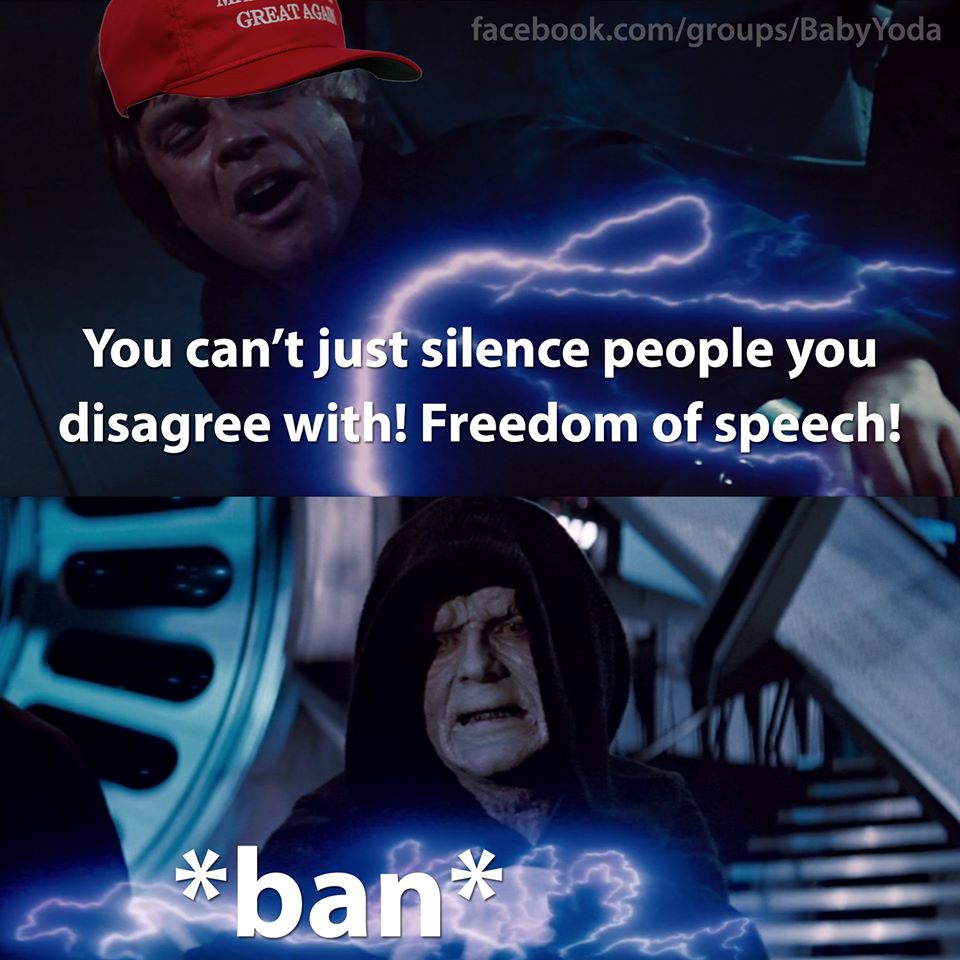
The image is a digitally altered meme constructed from stills from the Star Wars franchise. It features two distinct visuals juxtaposed.
- Top Half: Shows a close-up of a man wearing a red "Make America Great Again" (MAGA) hat, with a distressed or agitated expression. His face is partially obscured and distorted, and appears to be shouting. This shot is digitally modified and given a dramatic lighting effect. The text “You can’t just silence people you disagree with! Freedom of speech!” is imposed over this image.
- Bottom Half: Shows Emperor Palpatine (Darth Sidious) from Star Wars: Revenge of the Sith, looking stern. He is positioned on a staircase with dramatic blue lightning effects surrounding him. The word "ban" is written in a stylized font beneath him.
- Overall: The meme attempts to equate opposing viewpoints (specifically, conservative viewpoints, represented by the MAGA hat) with being unjustly silenced, while depicting Palpatine, a tyrannical villain, with the act of ‘banning’ or silencing others. A Facebook group link for "BabyYoda" is also visible.
Foucauldian Genealogical Discourse Analysis
This image readily lends itself to a Foucauldian analysis, particularly through the concepts of discourse, power/knowledge, and genealogy.
- Discourse: The meme participates in a discourse around “freedom of speech” and “censorship”. However, it does not define what constitutes “silencing” or “freedom”. It presents a simplistic binary, relying on emotional appeal rather than reasoned argument. The image constructs a narrative where expressing conservative views is presented as being equivalent to being suppressed, therefore, framing a discourse where conservative speech is endangered.
- Power/Knowledge: The image subtly asserts a power dynamic. By associating opposition with "silencing" and linking it to a villain like Palpatine, it frames any challenge to conservative viewpoints as a form of tyranny. This aims to legitimize the power of the viewpoint expressed, through constructing an narrative that anyone who opposes it is actively attempting to silence it. Knowledge, in this context, isn’t about objective truth, but about the construction of that truth to justify a specific position.
- Genealogy: A genealogical approach could trace the historical evolution of the concept of “freedom of speech”, how it’s been used and abused, and how it has become entangled with political and ideological battles. The meme doesn’t engage in this nuance; it appropriates the language of freedom to serve a contemporary political agenda, presenting a simplified and selective history.
Critical Theory
From a Critical Theory perspective, this meme exemplifies the ideological function of media.
- Hegemony: The image attempts to reinforce a hegemonic narrative, where conservative viewpoints are presented as the defenders of freedom against a perceived authoritarian threat. It subtly normalizes the idea that any opposition to these viewpoints is inherently oppressive.
- False Consciousness: The meme potentially contributes to a “false consciousness” by framing complex issues (such as social media censorship or differing political opinions) in a simplistic, emotionally charged way. It diverts attention from systemic power dynamics and encourages individuals to focus on surface-level grievances.
- Commodification of Political Discourse: The meme is designed to be shared and go viral, meaning its political argument is simplified and packaged for mass consumption. This commodification of political discourse prioritizes emotional impact over reasoned analysis, furthering polarization.
Marxist Conflict Theory
From a Marxist perspective, this image can be understood as reflecting class and ideological conflict.
- Dominant Ideology: The meme potentially reinforces a dominant ideology that prioritizes individual “freedom of speech” (particularly for those in power) while obscuring the ways in which systemic inequalities limit the ability of marginalized groups to be heard.
- Class Struggle: The MAGA hat represents a specific segment of the population (often associated with working-class or rural communities). Framing this group as being “silenced” can be seen as a strategy to mobilize support and reinforce class solidarity.
- Superstructure: The image is part of the "superstructure" of society, where cultural and ideological elements are used to legitimize the existing power relations and protect the interests of the dominant class. The appropriation of Star Wars imagery and the language of "freedom" serve to naturalize a particular worldview.
Postmodernism
Postmodern analysis emphasizes the deconstruction of grand narratives and the instability of meaning.
- Simulacra and Simulation: The image can be viewed as a simulacrum: a copy without an original. The appeal to freedom of speech is divorced from its original philosophical and legal context and becomes a superficial symbol used to support a political agenda.
- Intertextuality: The meme relies heavily on intertextuality. Viewers must recognize the references to Star Wars and the MAGA hat to understand its meaning. This creates a complex web of associations and interpretations.
- Fragmented Meaning: Postmodern thought would reject the idea of a singular, objective meaning. Instead, the meme's meaning is fluid and contingent, shaped by the viewer's own background and experiences.
Important Note: These analyses aren't mutually exclusive. Many of these theoretical perspectives overlap and reinforce each other. The image is complex, and different interpretive lenses can reveal different layers of meaning.
simple-description (llama3.2-vision)
The meme features a screenshot from the movie "Star Wars: The Empire Strikes Back" with a character, Emperor Palpatine, saying "You can't just silence people you disagree with! Freedom of speech!" However, the response is "Ban" in a bold, angry font, implying the Emperor's words are being rejected.
tesseract-ocr
You can’t just silence people you e e oT ye - disagree with! Pee La) ip? LIN £7 ] on |! , — ee