First Seen
2023-05-10T21:03:36+00:00
simple-description (llama3.2-vision_11b)
The meme is a screenshot from the Star Wars: The Mandalorian series, where the character "The Child" (also known as "Baby Yoda") is holding a sign that reads "This is a modding community, not a help forum". The image is humorous because it implies that the character is trying to educate people on the proper way to use online forums, but the sign is actually a clever reference to the fact that the character is a young being with no understanding of the complexities of online communities.
detailed-analysis (gemma3-27b-vision)
Okay, let's break down this image, utilizing the theoretical lenses you've requested. It's a quirky and layered image, offering several avenues for analysis.
Visual Description
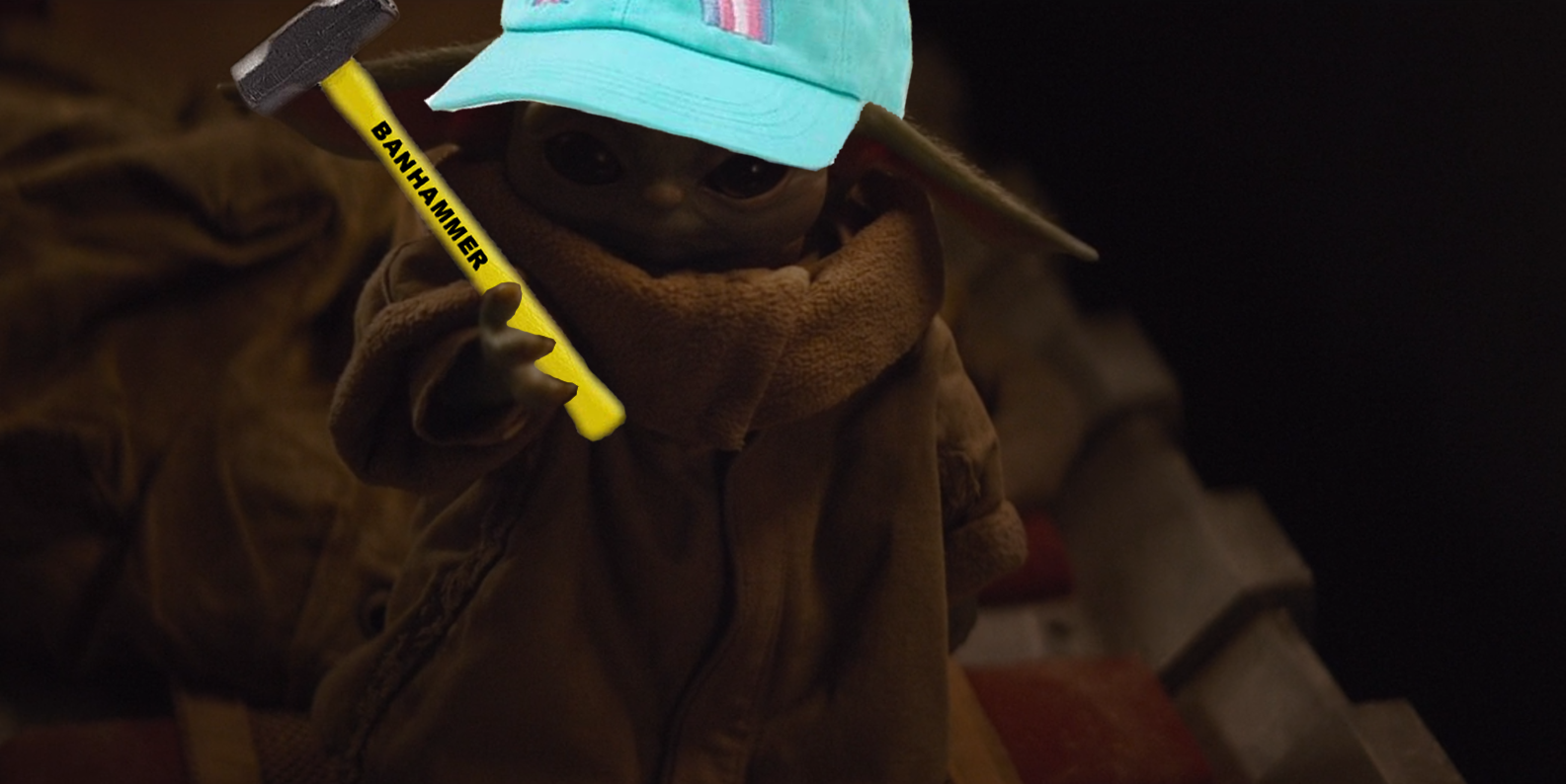
The image features a figure that is visually based on “Baby Yoda” (Grogu) from The Mandalorian, but it is a digitally altered/photomanipulated rendition. The figure is shrouded in a dark brown robe, with only a small portion of its face visible. It’s wearing a pale blue baseball cap. Most striking is the yellow hammer it holds, prominently labeled with the word “BANHAMMER” in black lettering. The background is blurred and dark, hinting at an indoor setting, possibly a sporting event based on the glimpse of a blurred background. The overall impression is one of playful juxtaposition – the adorable, innocent character paired with a tool associated with authority, control, and, in the internet context, censorship or banning.
---
Foucauldian Genealogical Discourse Analysis
This image strongly lends itself to Foucault’s approach. The “BANHAMMER” is a powerful symbol representing power/knowledge in the digital age. Foucault argues that power isn't simply a top-down force, but a dispersed network operating through discourse. In the context of online spaces, the banhammer is a tool wielded by moderators (and platforms) to regulate speech and behavior, creating a specific discourse.
A genealogical analysis would trace the history of this power. Before the internet, authority figures (teachers, parents, governments) used different mechanisms of control. The banhammer is a new iteration of that control, adapted to the digital landscape. It’s not about suppressing ideas, but about defining what is acceptable discourse within a specific sphere. The choice of the Grogu figure is interesting. Grogu is a symbol of vulnerability and dependence. By placing this figure as the wielder of the banhammer, the image subtly points to the often arbitrary and sometimes vulnerable position of those who enforce rules in online communities. It asks: who defines the boundaries of acceptable discourse, and what power dynamics are at play?
The image also highlights the panoptic effect – the banhammer suggests constant surveillance and the potential for punishment, even if not actively deployed. Users self-censor, knowing that a banhammer could fall at any moment.
---
Marxist Conflict Theory
From a Marxist perspective, the image highlights the conflict between power and the oppressed within the digital space. The “BANHAMMER” can be seen as a tool of the ruling class (platform owners, moderators, those in positions of authority) used to maintain control over the means of communication (the internet).
The image could be interpreted as a critique of ideological control. The platform (where the banhammer is wielded) constructs its own narrative and suppresses dissenting voices. The Grogu figure, though seemingly innocent, is now complicit in this process. It represents the normalization of control and the potential for even seemingly benign entities to participate in systems of oppression.
While not explicit, the image suggests a potential for class struggle. Those who are banned or silenced can be seen as the proletariat, challenging the established order. The Grogu figure holding the banhammer might represent a collaborator, unwittingly aiding the ruling class in suppressing dissent.
---
Postmodernism
The image is inherently postmodern in its playful juxtaposition of seemingly unrelated elements. The combination of a popular culture icon (Grogu) with a symbol of digital power (the banhammer) and a baseball cap is deliberately ironic and creates a sense of pastiche.
The image challenges the notion of grand narratives. It questions the idea that authority is inherently good or that censorship is always justified. It suggests that power is fluid, fragmented, and often operates in unexpected ways.
The ambiguity of the image also aligns with postmodern principles. There is no single, definitive interpretation. The viewer is left to construct their own meaning based on their own experiences and perspectives. This breakdown of meaning is a key characteristic of postmodern thought. The whole image deconstructs concepts of power.
---
Queer Feminist Intersectional Analysis
This is perhaps the most nuanced application, but still relevant. The intersectional aspect comes into play when considering who is most often targeted by the “banhammer”. Online harassment and censorship disproportionately affect marginalized groups – women, people of color, LGBTQ+ individuals, and those with disabilities.
The image could be read as a critique of the way online platforms often fail to protect vulnerable communities from harassment while simultaneously silencing their voices. The figure wielding the banhammer doesn’t represent any particular group, which highlights the potential for the tool to be used against anyone, but the power imbalance exists.
A queer feminist reading might also consider the way the image subverts traditional notions of power. The Grogu figure, typically seen as weak and dependent, is now wielding a tool of authority. This challenges the idea that power is always associated with masculinity or strength. The cap could be seen as a subtle nod to streetwear and identity.
Ultimately, the intersectional analysis emphasizes the importance of considering the complex ways in which power, identity, and online spaces intersect.
Let me know if you would like any of these sections expanded or explored further!
simple-description (llama3.2-vision)
The meme features a still image from the Star Wars franchise, specifically a character known as "Baby Yoda" from the series "The Mandalorian." The character is wearing a hat and holding a hammer, and the text "I'm not a carpenter" is written on the hammer. The image is a humorous take on a common meme format, where a character is given a mundane or unexpected job or occupation.
tesseract-ocr
yo é aie 3° 7 % vy, a%, ™~ a, 2 % — — Pe a : + ? >