First Seen
2026-04-04T20:47:24+00:00
simple-description (qwen3.5_2b-q8_0)
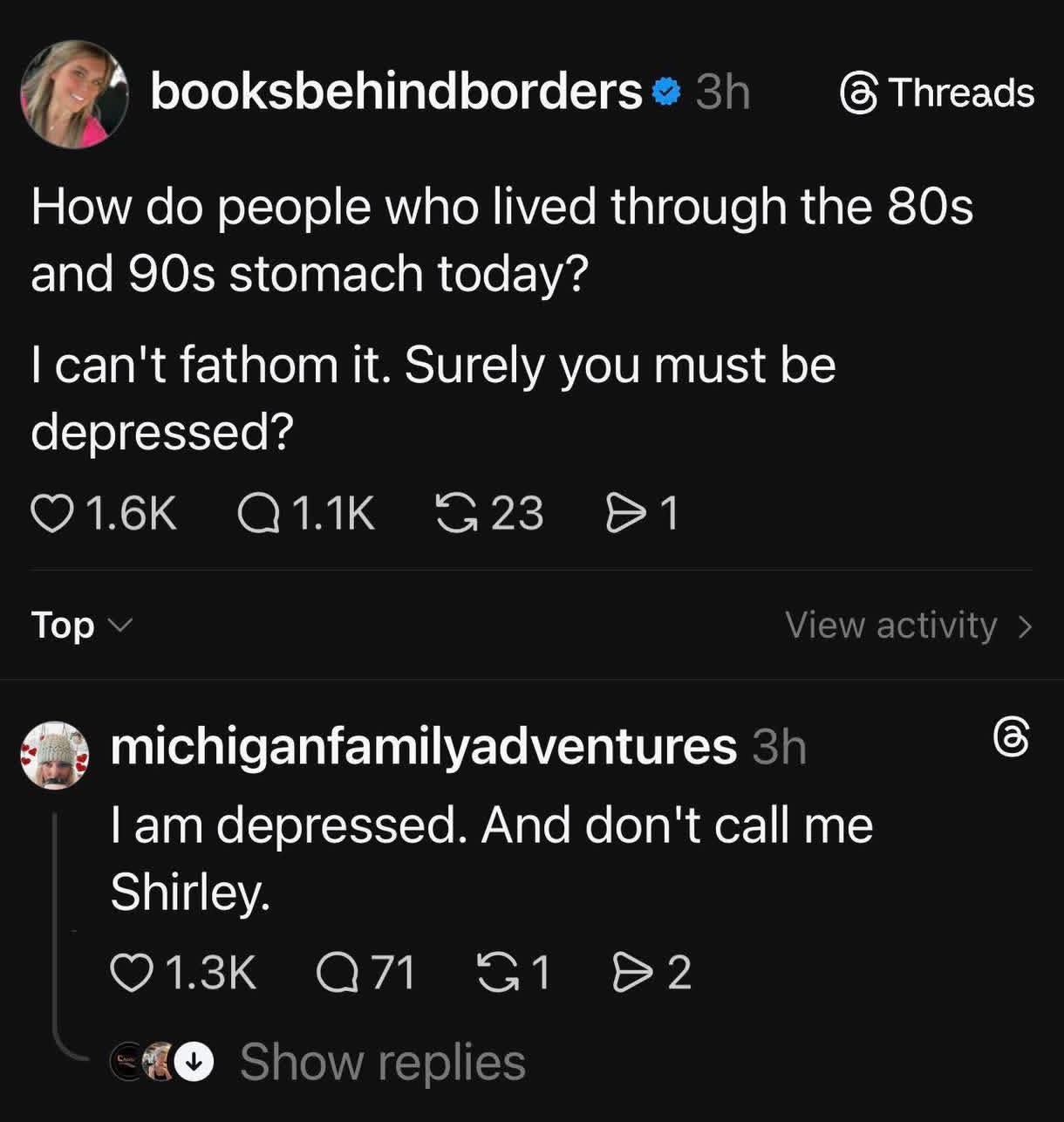
This meme illustrates Millenihilism—the theory that younger generations do not understand why older people feel nostalgic for a time of drastically different societal pressures and hardships. The top comment suggests that living through the 80s and 90s was so difficult that current life is too confusing to "stomach," implying we can't relate to the sadness without understanding what went on before. The reply humorously acknowledges they are indeed "depressed" but refuses to use derogatory slurs, rejecting the idea that older people are simply unwell or ill.
detailed-analysis (gemma3_27b-it-q8_0)
Okay, let's break down this social media exchange through the lens of "Millenihilism" – a concept blending Millennial disillusionment with nihilistic outlooks, often stemming from socio-political realities and anxieties around the turn of the millennium and beyond. Here's an analysis organized by relevant theoretical frameworks.
Visual Description
The post is a screenshot from a social media platform (Instagram/Threads). It shows a question posed by an account called "booksbehindborders" asking "How do people who lived through the 80s and 90s stomach today? I can't fathom it. Surely you must be depressed?" A reply from “michiganfamilyadventures” states, “I am depressed. And don’t call me Shirley.” The post has associated engagement metrics like likes, comments, and shares. This is a relatively simple visual exchange, but the power of the meme lies in its brevity and shared understanding.
Postmodernism
This exchange is thoroughly steeped in postmodern tropes.
- Meta-commentary: The original question about people's reactions already assumes a particular perspective—that current events are so dire they necessitate depression. This reflects a self-awareness of perspective and a questioning of objective truth. The follow-up reply references the iconic movie "Airplane!", turning a potentially serious confession into a detached, ironic joke. This plays with the idea of sincerity and its breakdown in a postmodern world.
- Fragmentation & Loss of Grand Narratives: Millenihilism itself is a response to the collapse of the "grand narratives" (Lyotard) of progress and a better future. The '80s and '90s, for many Millennials, were initially presented with promises of globalization, economic prosperity, and technological advancement. The questioning of how people who lived through that time can cope now implies a disillusionment with those narratives. The commenter's "I am depressed" is a small piece of fragmented experience, rather than a contribution to a larger, optimistic story.
- Simulacra & Simulation: The very act of discussing feelings online – expressing depression as a text-based response – can be seen as a simulation of genuine emotional experience. The meme’s humor and quick, shared nature reinforce this detachment. The shared cultural reference ("don't call me Shirley") is a signifier detached from its original context, becoming a 'simulacrum' of meaning.
Critical Theory
The exchange points to a deep unease with the current state of the world, and this can be examined through a critical lens.
- Critique of Late Capitalism: Millenihilism is often a response to the perceived failures of neoliberal capitalism. The '80s and '90s saw the rise of deregulation, globalization, and a focus on individual responsibility. The current anxieties—climate change, economic inequality, political polarization—are often framed as consequences of those policies. The question "How do people stomach today?" is, implicitly, a critique of a system that has led to such a bleak present.
- Alienation & Anomie: The feeling of being overwhelmed and unable to cope (suggested by the original question) aligns with Marxist concepts of alienation. Individuals are alienated from their labor, from each other, and from themselves. This can lead to anomie—a sense of normlessness and social disconnection. The meme captures this feeling of disconnect and the inability to make sense of the world.
- The Culture Industry: The quick-fire nature of the exchange, and its existence on a social media platform, speaks to the "culture industry" (Adorno & Horkheimer). The meme is a product of mass culture, offering a quick emotional fix or a shared moment of cynicism rather than a genuine engagement with deeper issues.
Foucauldian Genealogical Discourse Analysis
We can analyze the “depression” mentioned as a discourse constructed through historical power dynamics.
- Genealogy of Depression: Foucault would ask how “depression” came to be a recognizable category, a diagnosis, and a common way of describing a state of being. The meme implicitly acknowledges a societal expectation that certain events should lead to depression. The discourse around mental health has shifted over time, influenced by medicalization, therapeutic culture, and social norms.
- Power/Knowledge: The original question wields a form of power – it presumes that those who lived through the '80s and '90s should be depressed. This frames depression as a logical and predictable response, and potentially silences other ways of experiencing the world. The response, “I am depressed,” can be seen as an internalizing of that power dynamic, or a subversive act of claiming that label.
- Disciplinary Power: The social pressure to perform sadness, or to express oneself in ways deemed acceptable by online culture, can be seen as a form of disciplinary power. The meme, with its limited emotional range (cynicism, irony), participates in that disciplinary regime.
Why "Don't Call Me Shirley" Matters
The reply “And don’t call me Shirley” is crucial. It is a reference to the 1980 comedy “Airplane!”, where the character Dr. Rumack is frustrated by his constant questioning. It serves several functions:
- Deflection: It deflects a potentially serious emotional disclosure with humor. It’s a way of acknowledging the depression without fully engaging with it.
- Irony and Cynicism: It’s an ironic statement, suggesting a detached and cynical attitude toward both the question and the expected response.
- Reclaiming Agency: By referencing a pop culture moment, the commenter takes control of the narrative and resists being defined by the initial question. It's a form of asserting individuality in the face of overwhelming societal pressures.
In conclusion, this seemingly simple exchange encapsulates the core tenets of Millenihilism: a deep sense of disillusionment with the promises of the past, a recognition of the fragility of meaning in a postmodern world, and a cynical detachment as a coping mechanism. It reflects a generation grappling with complex anxieties while simultaneously trying to find humor and connection in a world that often feels absurd.
simple-description (llama3.2-vision_11b)
This meme is a humorous exchange between two users on the social media platform X (formerly Twitter). The top post asks how people who lived through the 80s and 90s stomach today's world, implying that they must be depressed. The bottom post responds by saying they are indeed depressed, but not calling themselves Shirley, a reference to the 1987 film "The Witches" where a character is named after a famous witch.
The meme pokes fun at the idea that people who grew up in earlier decades might struggle to adjust to modern times, and the use of the name "Shirley" adds a touch of irony and playfulness to the exchange. Overall, the meme is a lighthearted way to comment on the challenges of adapting to change.