First Seen
2025-11-05T07:20:20.876700+00:00
simple-description (qwen3.5_2b-q8_0)
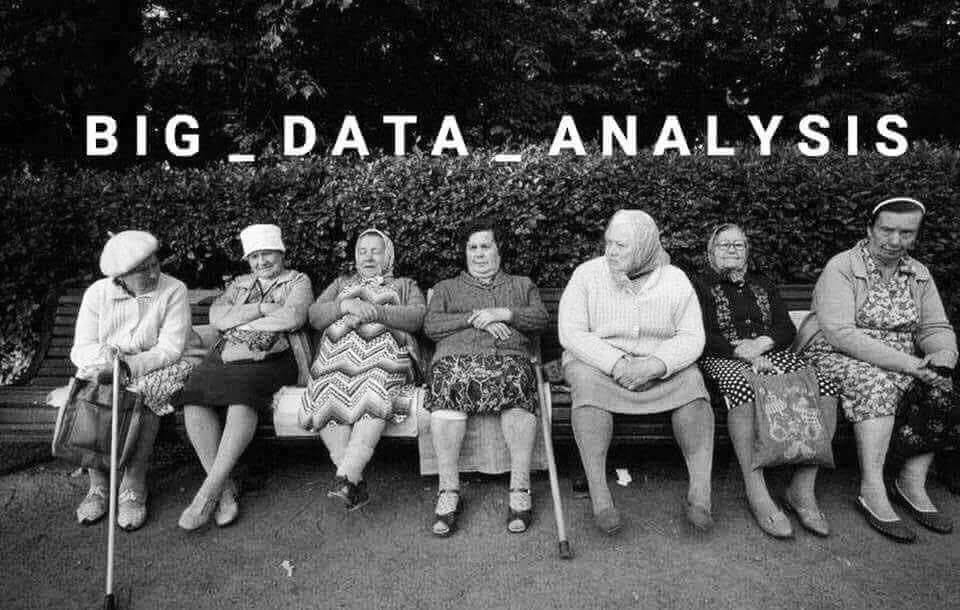
The text "BIG_DATA_ANALYSIS" floats across the top of the image, referencing a popular internet joke (often accompanied by "The Big Data Kills Us All" theory) that suggests humanity is being overwhelmed by information and eventually destroyed. To someone who can't see it, the elderly woman sitting on the bench represents human life simply becoming information—there is no longer any "her" left, just a data point within a massive digital dataset.
detailed-analysis (gemma3_27b-it-q8_0)
Okay, let's unpack this meme from the perspective of "Millenihilism." This is a rich and potentially bleak project, as Millenihilism is a particularly cynical and disaffected outlook.
Understanding Millenihilism: Before we dive in, it's important to define this specific sensibility. Millenihilism is a fusion of Millennial (and Gen Z) disillusionment with the idea that grand narratives, progress, and even meaning itself are ultimately empty. It anticipates societal collapse (environmental, economic, political), but without the accompanying fervor for revolution or hopeful rebuilding seen in earlier apocalyptic thought. It’s a sense of "it's all going to fall apart, and it probably doesn't matter.” It is often characterized by apathy, ironic detachment, and a fascination with decay.
Visual Description
The image depicts seven elderly women sitting on a park bench. They are uniformly dressed in outdated clothing styles, suggesting a period from the mid-20th century, potentially the Soviet era given the style and expressions. They are not actively doing anything – they are simply being. Their expressions are largely vacant, stoic, or mildly disapproving. They’re seated closely together, but there’s no sense of connection or joy. The black and white photography enhances the feeling of timelessness and a sort of faded quality. The overall tone is drab, unromanticized, and very…ordinary.
Foucauldian Genealogical Discourse Analysis
This meme powerfully operates within a Foucauldian framework. The “BIG_DATA_ANALYSIS” caption isn't just a label; it's an ironic commentary on how power now operates. Foucault argued that power isn’t simply repressive but productive, shaping our knowledge and our very selves.
- Discipline & Panopticism: These women represent the subjects of a previous disciplinary regime. They embody a generation shaped by social norms, expectations, and the surveillance (implied, not necessarily literal) of a specific era. The data collected on their lives (birth records, census data, employment, perhaps even political records in a Soviet context) was used to categorize, control, and normalize them.
- Genealogy of the Present: The meme uses this past disciplinary regime to critique the present data-driven one. We are still being categorized, analyzed, and ultimately controlled, but now through algorithms, social media tracking, and pervasive data collection. The "BIG_DATA_ANALYSIS" is not a neutral tool, but a continuation of power structures.
- The Archive: These women are an archive, a representation of a system that has passed, but whose traces are still present. The meme suggests that despite all our technological advancement, the fundamental impulse to categorize and control remains.
Critical Theory
The meme echoes central tenets of Critical Theory, particularly the Frankfurt School's concern with the "culture industry."
- Reification: The women are reified—reduced to objects of analysis. Their individual stories and experiences are flattened into data points. This is a direct critique of how data analysis, in its pursuit of patterns, can strip individuals of their subjectivity.
- Instrumental Reason: The "BIG_DATA_ANALYSIS" represents instrumental reason—the idea that all actions are measured by their utility. It’s a cold, calculating logic that ignores ethical concerns. The meme implies that even human life can be reduced to quantifiable data in this system.
- Loss of Authenticity: The women's resigned expressions hint at a loss of authenticity in a society increasingly mediated by technology and social control.
Postmodernism
This meme is deeply postmodern.
- Deconstruction: The juxtaposition of the archaic image with the hyper-modern caption ("BIG_DATA_ANALYSIS") deconstructs our assumptions about progress and technology. It highlights the discontinuity between past and present.
- Simulacra and Simulation: The image can be interpreted as a simulacrum, a copy without an original. It’s an image of people being analyzed, but the analysis itself is abstracted and detached. It's a representation of a representation.
- Meta-narratives: Millenihilism rejects grand narratives (progress, history, etc.). The meme mocks the idea that data analysis can offer any meaningful insight into the human condition. It’s a cynical dismissal of the belief that data can provide answers or solutions.
Millenihilist Interpretation – Synthesis
From a Millenihilist perspective, the meme is profoundly depressing but also darkly funny. It’s a visual representation of the inescapable and meaningless cycle of control.
- The Futility of Analysis: "BIG_DATA_ANALYSIS" applied to these women feels pointless. What does it matter what the data reveals about their lives? They represent a generation that has already lived, and their data will likely be forgotten or used for trivial purposes.
- The Inevitability of Control: The meme implies that regardless of the technology, control will always be present. Whether through social norms, political ideologies, or algorithms, power structures will always find a way to categorize and manage individuals.
- Apathetic Acceptance: The women's stoicism embodies the apathy characteristic of Millenihilism. They are not fighting back; they are simply enduring. They've seen it all before, and they know that resistance is futile.
- The Irony of Meaninglessness: The meme's humor lies in the absurdity of applying sophisticated data analysis to such a mundane and ultimately insignificant scene. It's a recognition that even in the age of big data, life is often just…ordinary.
In conclusion, this meme is a potent expression of Millenihilist disillusionment. It utilizes visual imagery and ironic captioning to critique power, control, and the emptiness of modern life. It's a bleak, cynical, and unsettling comment on the human condition in the age of data.
simple-description (llama3.2-vision_11b)
The meme is a humorous take on the concept of "millenihilism" - the idea that the current generation (Millennials) is more focused on their own mortality and the end of the world than the older generation (the "nihilists" of the 20th century). The image shows a group of elderly women sitting on a bench, looking unimpressed and bored, with the caption "Big Data Analysis" above them. The text is a play on the phrase "big data analysis" - a term used in the field of data science - but in this context, it's used to describe the mundane and uninteresting nature of the elderly women's lives.