First Seen
2025-09-23T20:12:43.819007+00:00
simple-description (qwen3.5_2b-q8_0)
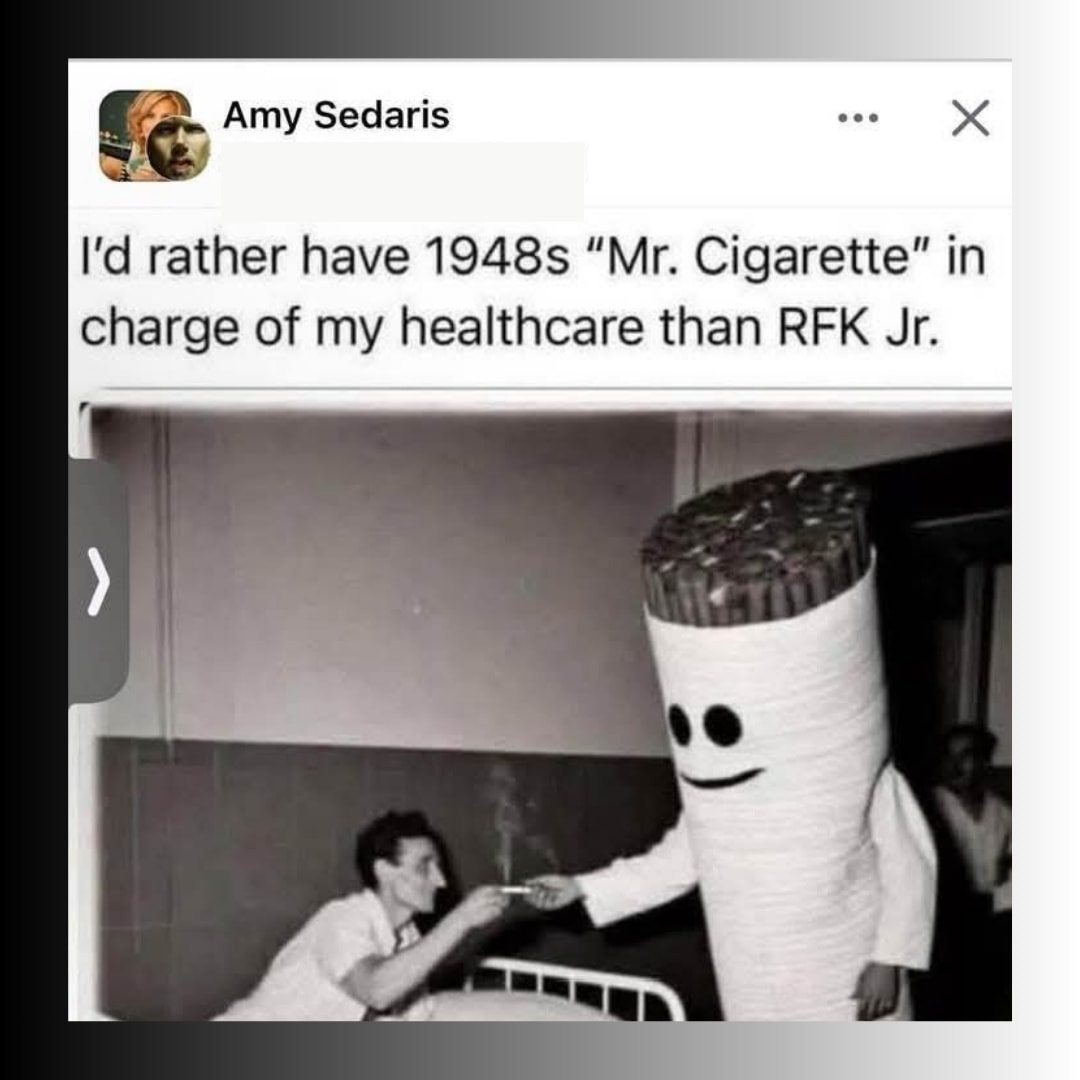
This black and white image shows a man receiving an injection from a giant cigarette mascot labeled "Mr. Cigarette." The caption reads, "I'd rather have 1948s 'Mr. Cigarette' in charge of my healthcare than RFK Jr."
To someone who cannot see it, this meme satirizes the concept that looking forward into the future is often a mistake. A Millenihilist—who believes that embracing the future leads to chaos and destruction—would likely argue that the young man (RFK Jr.) represents a dangerous "future" political figure, whereas the established leader from 1948 was actually protecting the present moment with his power. It suggests that in this specific era, holding power was about keeping order right now, not promising a better future.
detailed-analysis (gemma3_27b-it-q8_0)
Okay, let's dissect this meme through the lens of Millenihilism, and the requested theoretical frameworks, where applicable. This is going to be a layered analysis, as it's a deceptively complex meme.
Understanding Millenihilism First
Millenihilism is a contemporary sensibility characterized by a disillusionment with grand narratives (like progress, hope, even effective government), a cynicism towards authority, a fondness for irony and dark humor, and a sense that systems are fundamentally broken beyond repair. It's often expressed through absurdist internet humor, intentionally embracing the meaninglessness of it all. It isn't simply nihilism (belief in nothing), but a melancholic awareness of the failure of meaning-making systems. It's born from late-stage capitalism, political polarization, and a recognition of looming crises (ecological, economic, social).
1. Visual Description
The meme features a black-and-white photograph from the 1940s. It depicts a man in a full-body costume of a lit Lucky Strike cigarette ("Mr. Cigarette"). The costume has a friendly, simplistic smiley face. A second man is offering the "cigarette" a lit match. In the background, a third person is vaguely visible. The caption reads: "I’d rather have 1948s ‘Mr. Cigarette’ in charge of my healthcare than RFK Jr."
2. Foucauldian Genealogical Discourse Analysis
This meme powerfully utilizes Foucault's ideas of power/knowledge and genealogy. Foucault argues that "truth" isn't objective, but rather constructed through discourses—systems of thought, language, and practices that define what counts as knowledge and shape our understanding of the world.
- The Genealogy of Healthcare: The meme performs a genealogy of healthcare by juxtaposing a blatant health hazard (a walking cigarette, advertising a known killer) with a current political figure (RFK Jr.). The point isn't about comparing competence in a rational way, but about exposing the absurdity of our current situation. It suggests that the "knowledge" surrounding healthcare has become so distorted – by misinformation (associated with RFK Jr.'s anti-vaccine stances) and vested interests (the historical promotion of cigarettes despite their harm) – that it's reached a point of ironic collapse.
- Power & Disciplinary Practices: The image of "Mr. Cigarette" embodies an earlier era of discursive power. Cigarette advertising constructed a discourse around smoking that normalized and even glorified it, despite the known health risks. This is a prime example of how power operates through shaping what we believe to be true and desirable. The meme implies that the contemporary "discourse" around healthcare is equally susceptible to manipulation and misinformation, rendering it equally dangerous.
- The breakdown of norms: The juxtaposition of something so obviously harmful with a political actor suggests a breakdown of norms. The expectation that those in charge of healthcare should be prioritizing wellbeing is mocked.
3. Critical Theory
The meme taps into core concepts of Critical Theory, particularly the critique of ideology and the "culture industry."
- Critique of Ideology: The meme exposes the underlying ideology that drives our trust in institutions and experts. It suggests that the very idea of relying on "authority" (represented by RFK Jr.) is flawed when that authority is compromised by misinformation and self-interest. It mocks the blind faith placed in systems that are demonstrably failing.
- The Culture Industry: "Mr. Cigarette" represents the power of the culture industry to create desire and normalize harmful products. The cigarette company crafted an image—a friendly, appealing figure—to distract from the real consequences of smoking. The meme suggests that contemporary political rhetoric functions similarly: constructing appealing narratives that mask underlying dangers.
- Commodification of Health: The act of associating a "brand ambassador" with health, rather than medical expertise, highlights the commodification of health.
4. Postmodernism
Postmodernism’s key tenets – the rejection of meta-narratives, the embrace of irony and pastiche, and the deconstruction of meaning – are central to understanding this meme.
- Rejection of Meta-Narratives: The meme fundamentally rejects the idea that there is a clear path to “better” healthcare. It doesn’t offer a solution; it simply expresses despair at the present state. This is a rejection of the “progress” narrative.
- Irony & Pastiche: The humor is deeply ironic. The image of a walking cigarette is absurd, and the suggestion that it would be preferable to a political figure is a blatant exaggeration intended to highlight the speaker's cynicism. The meme is a pastiche – a combination of disparate elements (historical advertising, current politics) that creates a jarring, unsettling effect.
- Deconstruction of Meaning: The meme doesn’t mean one thing. It’s open to interpretation and encourages viewers to question their own assumptions about healthcare, authority, and the nature of truth.
5. Marxist Conflict Theory
While less direct than the other frameworks, Marxist conflict theory can be applied.
- Class Conflict & Healthcare: The meme subtly touches upon the idea that healthcare access and quality are shaped by class conflict. The corporations who benefited from cigarette sales represent the bourgeoisie. RFK Jr.’s position could be seen as benefitting from a particular class’s desire to dismantle established systems, even at the expense of public health.
- False Consciousness: The historical success of cigarette advertising demonstrates how ideology can create "false consciousness," masking the exploitation inherent in capitalist systems. The meme suggests a similar dynamic is at play in the contemporary healthcare debate.
In Conclusion:
This meme is a potent expression of Millenihilist sentiment. It’s not about a genuine preference for a cigarette costume over a politician. It’s a darkly humorous commentary on the pervasive distrust of authority, the failures of systems, and the absurdity of our current political landscape. It’s a scream of frustration delivered through irony, and it resonates because it captures a feeling that many people share: that things are fundamentally broken and that the established order is not to be trusted.
simple-description (llama3.2-vision_11b)
The meme is a satirical commentary on the perceived hypocrisy of politicians, particularly those in the Republican Party. The image is a photo of a 1940s doctor, "Mr. Cigarette", smoking a cigarette while treating a patient. The text above the image reads "I'd rather have 1940s 'Mr. Cigarette' in charge of my healthcare than RFK Jr." The meme is poking fun at the idea that a 1940s doctor, who was known for smoking cigarettes, would be a better choice for healthcare than the current president of the American Medical Association, Dr. Robert Kennedy Jr.