First Seen
2025-06-08T23:28:22.307450+00:00
detailed-analysis (gemma3_27b-it-q8_0)
Okay, let's break down this meme through the lens of "Millenihilism", and explore applicable theoretical frameworks. Millenihilism, as a concept, is the feeling of exhausted apathy born from the endless torrent of information, options, and complexities of late-stage capitalism, leading to a sense that nothing truly matters anymore, especially the things we're told should matter.
Visual Description
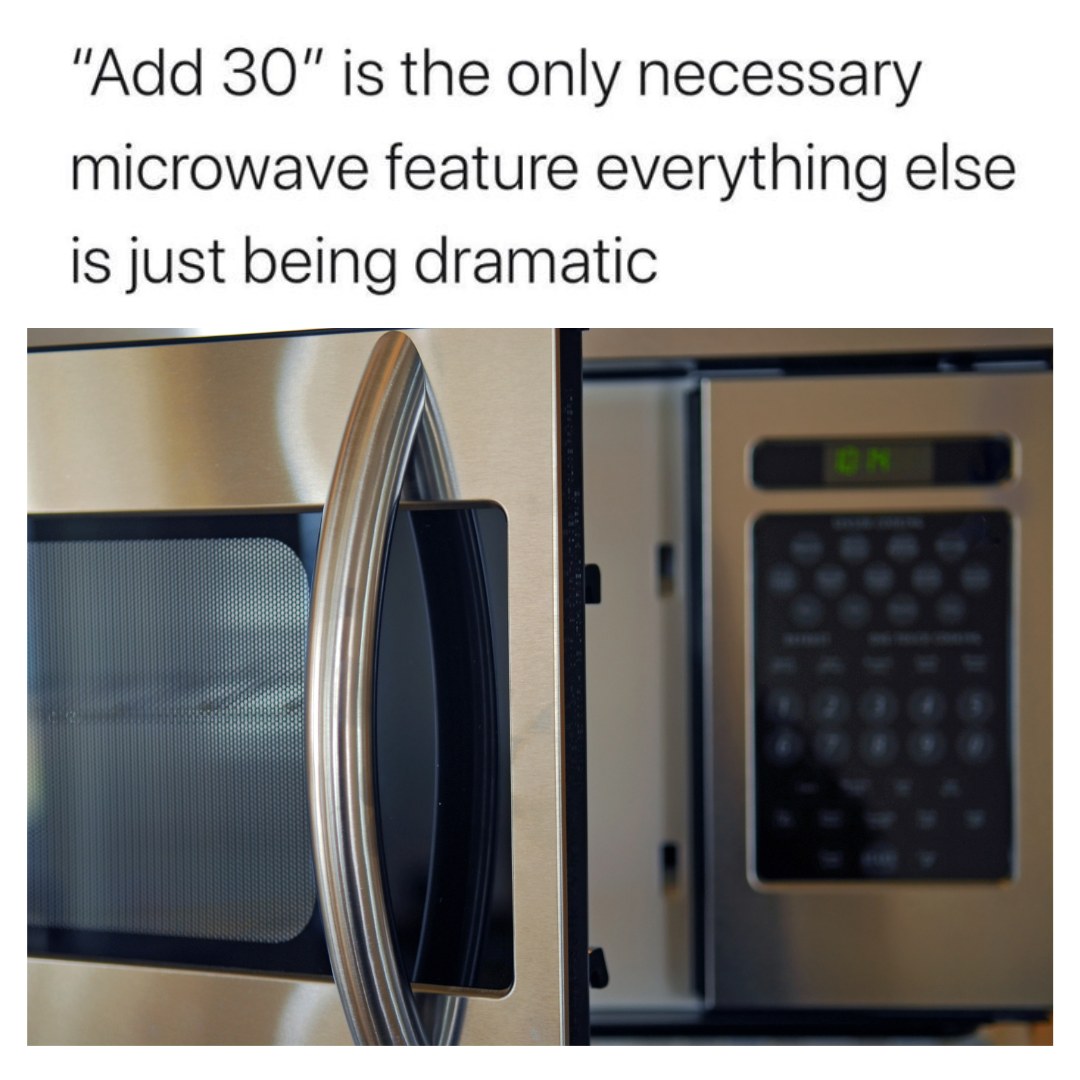
The image is a close-up of a stainless steel microwave. The door is partially open, revealing the interior, and focuses on the control panel. The microwave appears modern, relatively sleek, with a large array of buttons suggesting a variety of functions. The display reads "0:00," suggesting it's either just been started or reset. The focus on the details of the appliance's interface, contrasted with the emptiness inside, is visually suggestive.
Postmodernism
This meme is deeply postmodern. The statement "‘Add 30’ is the only necessary microwave feature, everything else is just being dramatic" functions as a deconstruction of modern expectations.
- Rejection of Grand Narratives: Modern society tells us that progress = more features, more sophistication, more options. The meme rejects this narrative. It suggests that the core function—slightly extending the cooking time—is the only thing of value. All the bells and whistles are performative.
- Irony and Pastiche: The absurdity of singling out "Add 30" as the sole meaningful function highlights the inherent irony of modern life. It's a pastiche of consumer culture, acknowledging the endless proliferation of features designed to create a feeling of value rather than actual utility.
- Simulacra and Simulation: The complex control panel itself becomes a simulacrum – a representation of functionality without necessarily contributing to actual cooking efficiency. The meme suggests that the presentation of choice (all those buttons) is more important than the choices themselves.
Critical Theory
The meme resonates with Critical Theory, particularly as it relates to the culture industry (following Adorno and Horkheimer).
- Commodification of Daily Life: Microwaves, and by extension, their complex features, are products of a system that transforms even basic needs (heating food) into opportunities for commodification. The meme exposes the artificiality of this process.
- False Consciousness: We are conditioned to believe we need these features, that they improve our lives. The meme argues that this is a form of false consciousness. The core function is all that matters, yet we are distracted by the spectacle of options.
- Alienation: The meme implicitly points to alienation from labor. The complex engineering and production processes that go into creating these features have little bearing on the simple, direct need being fulfilled.
Millenihilistic Interpretation (Connecting the Threads)
This meme encapsulates the core Millenihilistic experience. It expresses a weary disengagement. The endless options, the constant bombardment of choices, the pressure to optimize – it's all exhausting. To declare “Add 30” as the only true feature is to say, “I’m done. I refuse to participate in this performative dance of consumerism.”
The "dramatic" other functions represent everything that feels overwhelming and pointless in modern existence. It's not a call to action, it's a quiet surrender. It’s acknowledging the absurdity and finding a small, almost passive, rebellion in reducing everything to its essential function.
It's a statement born from exhaustion, not hope. It’s acknowledging that the system is flawed, but instead of trying to fix it, it’s simply opting out of the performance, reducing things to the bare minimum needed to survive. It perfectly mirrors the Millenihilistic apathy and sense of futility.
Why Other Frameworks Don't Quite Fit
- Foucauldian Genealogical Discourse Analysis: While the microwave is part of a discourse about convenience, domesticity, and technological progress, this meme isn't primarily analyzing the history of that discourse. It's reacting to its present-day manifestation.
- Marxist Conflict Theory: There’s an element of critique of commodity fetishism, but this meme isn't explicitly focusing on class struggle or exploitation.
- Queer Feminist Intersectional Analysis: The meme doesn't directly address issues of gender, sexuality, or intersectional oppression. It’s a broader critique of modern life.
Let me know if you'd like me to elaborate on any of these points or explore another angle!
simple-description (llama3.2-vision_11b)
This meme is a commentary on the absurdity of modern life, specifically the way we interact with technology. The image shows a microwave with a "30 seconds" button, which is a common feature in many modern kitchens. The text above it reads: "Add 30 seconds is the only necessary microwave feature everyone else is just pretending to use". This meme is poking fun at the idea that people are so busy and stressed that even the simplest tasks, like cooking a meal, require a lot of planning and time.
detailed-analysis (gemma3-27b-vision)
Here's an analysis of the image and text, broken down into relevant theoretical frameworks. Keep in mind that applying these frameworks can be interpretive, and some may be more relevant than others.
Visual Description
The image depicts the interior of a microwave oven. The door is open, revealing a metallic interior with a rotating glass plate. The overall aesthetic is modern and clean, suggesting a consumer-level appliance. The lighting and focus are centered on the internal space, drawing attention to the functional core of the microwave. The simplicity of the image and its focus on a commonplace object is striking.
---
Foucauldian Genealogical Discourse Analysis
The text "‘Add 30’ is the only necessary microwave feature everything else is just being dramatic” reveals a fascinating power dynamic within the discourse of kitchen appliance design and consumer desire. A Foucauldian analysis would focus on how the “Add 30” function has become normalized as the core, defining feature of microwave usage.
- Discourse: The statement participates in a discourse surrounding convenience and efficiency in food preparation. The microwave as a whole is a discourse of speed and instant gratification.
- Power/Knowledge: The statement positions the 'Add 30' function as truthful and essential, and all other features (popcorn settings, defrost, etc.) as frivolous, "dramatic" exaggerations. This establishes a power dynamic where the core function is seen as rational and legitimate, while the added features are delegitimized. The ability to add time represents a micro-control over the food-heating process, positioning the user as the master of their culinary experience.
- Genealogy: A genealogical approach would trace the historical development of microwave features. Initially, microwaves were simple timers. Over time, manufacturers added features to differentiate their products and increase sales. This statement critiques that trajectory, arguing for a return to simplicity. It suggests that the accumulation of features is a form of "drama," a performance of excess that obscures the true purpose of the appliance.
---
Critical Theory
Applying a Critical Theory lens, the statement can be viewed as a critique of consumer culture and the logic of late capitalism.
- Commodity Fetishism: The statement implicitly critiques the way consumers are encouraged to desire increasingly complex and unnecessary features in everyday objects. The "Add 30" function, as the “only necessary” feature, is a stripping away of the fetishistic appeal of the appliance and a re-emphasis on core utility.
- Rationalization and Disenchantment: The dismissal of other features as “dramatic” suggests a desire for a more rational, streamlined approach to technology. This aligns with Max Weber’s concept of rationalization, where efficiency and functionality are prioritized over aesthetic or emotional considerations. The statement champions a pragmatic attitude, rejecting the "drama" of excessive features.
- False Consciousness: The statement can be read as a call to break through the "false consciousness" created by marketing and advertising, which convinces us that we need features beyond the essential ones. It asks us to question the norms that dictate what constitutes a desirable appliance.
---
Postmodernism
From a postmodern perspective, the statement revels in its ironic self-awareness and rejection of grand narratives.
- Deconstruction: It deconstructs the idea that a microwave needs to be more than its core function. It disrupts the expectation that technological advancement automatically equates to improvement or necessity.
- Irony and Parody: The statement is inherently ironic. It playfully dismisses the increasingly complex features of modern appliances, suggesting that they are merely performative gestures.
- Rejection of Metanarratives: It rejects the idea that there is a "right" way to design or use a microwave. It suggests that the purpose of the appliance is simply to heat food, and that any additional features are superfluous. The focus on the individual user's desire (to add 30 seconds) over broader technological trends is emblematic of a postmodern sensibility.
---
In summary:
This image and text, though seemingly simple, offer a surprising amount of interpretive potential. It’s a playful commentary on consumerism, technology, and the pursuit of simplicity in a complex world. The theoretical frameworks highlighted above reveal the depth and nuance of the statement, demonstrating how even mundane objects can become sites of critical inquiry.
simple-description (llama3.2-vision)
This meme is a humorous commentary on the often-used feature "Add 30" in microwave ovens. The image features a microwave with a screen displaying "ADD 30" and a caption that reads: "Add 30 is the only necessary microwave feature that everyone uses and complains about at the same time."