First Seen
2025-01-16T23:32:24.296327+00:00
detailed-analysis (gemma3_27b-it-q8_0)
Okay, let's break down this meme through the lens of Millenihilism, utilizing the requested theoretical frameworks where applicable.
Understanding Millenihilism First
Millenihilism is a specific strain of existential dread particularly prevalent in the post-internet age. It's born from the realization that grand narratives of progress and future optimism (millennialism) have collapsed, leaving a sense of meaninglessness and resignation. However, it's not simply nihilism. It's a specifically millennial kind of nihilism – a feeling of being haunted by the promise of a future that never arrived. It's often expressed through nostalgia for a past that feels more “real” than the present and a sense of being perpetually stuck in a late capitalist, technologically mediated present. This meme very powerfully encapsulates that.
---
Visual Description
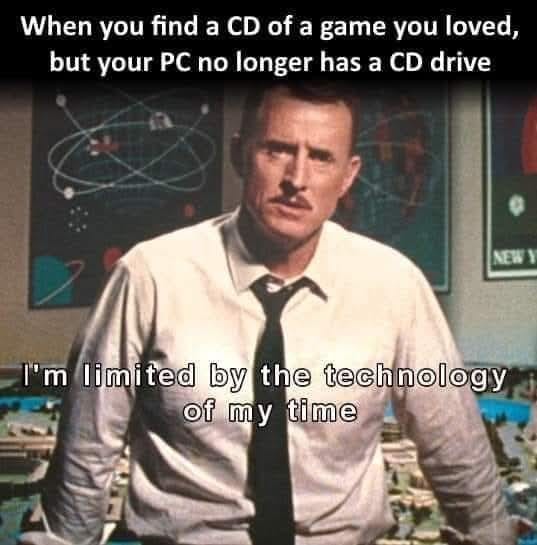
The meme features a screen capture of actor Stanley Tucci from The Hunger Games (2012). He's giving a slightly pained, frustrated, and wryly resigned expression, looking to the side. The text overlay reads: "When you find a CD of a game you loved, but your PC no longer has a CD drive" followed by "I'm limited by the technology of my time." The background suggests a slightly sterile, high-tech (but now dated) environment. The choice of Tucci's expression is key; it's not pure sadness, but a blend of disappointment and sardonic acceptance.
---
Postmodernism
This meme is profoundly postmodern. Here’s how:
- Simulacra and Simulation: The CD itself becomes a simulacrum—a copy without an original. It represents access to a beloved game, but cannot provide that access. The entire experience is mediated, and that mediation is now broken. It's a signifier detached from its signified. The game's "real" existence is no longer relevant; only the idea of the game remains.
- Deconstruction of Progress: The meme implicitly deconstructs the notion of technological progress. We once believed newer technology (moving away from CDs) would be better, more efficient, more forward-thinking. Yet, this “progress” has rendered a tangible source of enjoyment inaccessible. The forward march isn't necessarily upward.
- Loss of Meta-Narrative: The "promise" of technology to enhance life, connect people, and provide entertainment is undermined. The overarching narrative of technological advancement as inherently good is questioned. The meme highlights a very specific, personal consequence of this perceived “progress”.
- Irony and Parody: The meme uses irony—the contrast between the expectation of technological advancement and the frustrating reality of obsolescence. The phrasing "I'm limited by the technology of my time" is a dry, self-aware observation, almost a parody of grandiose statements about historical constraints.
---
Foucauldian Genealogical Discourse Analysis
Foucault would be interested in how the discourse surrounding technology shapes our relationship to the past.
- Power/Knowledge: The shift away from optical media (CDs) wasn’t a natural evolution but a result of power dynamics within the tech industry (and the broader capitalist system). Companies needed us to buy new forms of distribution (digital downloads, streaming) to maintain profitability. The “loss” of the CD drive isn’t simply a technical limitation; it’s a consequence of imposed technological standards. The knowledge that CDs are "obsolete" is created through power structures.
- Discipline and Normalization: The normalization of digital distribution, and the devaluing of physical media, disciplines us to consume technology in specific ways. We're conditioned to accept this new reality. The meme expresses a subversive resistance to that normalization – a quiet acknowledgment that something was lost.
- Genealogy of Obsolescence: Foucault would ask us to trace the history of how obsolescence became a built-in feature of the technological landscape. It's not accidental; it's designed to drive consumption. The CD drive's disappearance is part of a larger pattern of planned obsolescence.
---
Critical Theory
From a Critical Theory perspective, the meme reveals:
- Commodification of Nostalgia: The "game you loved" is a commodity. The loss of access isn't just about the game itself, but the loss of access to a piece of personal history—a history now mediated by capitalist forces. The nostalgia is itself commodified.
- Alienation: The meme embodies a sense of alienation from one's own past. The game exists, the memory of joy exists, but the ability to reconnect with that experience is blocked by the structures of technological and economic change.
- False Consciousness: The dominant ideology of technological progress obscures the fact that this “progress” isn’t universally beneficial. The meme represents a moment of waking up from that false consciousness.
- Culture Industry: The meme is a response to the culture industry, as it's a playful but critical commentary on its relentless churn and the resulting discarding of cultural artifacts.
---
Marxist Conflict Theory
While subtle, a Marxist reading is possible:
- Class and Access: Access to new technology (a PC with a CD drive, or a newer PC with the ability to emulate one, or a willingness to purchase/build one) is often stratified by class. The meme highlights how those without the resources to constantly upgrade are left behind, unable to enjoy their past entertainment.
- Means of Production: The control of the "means of reproduction" of culture—in this case, the means of playing the game—is concentrated in the hands of corporations. We’re no longer fully in control of our own cultural experiences.
- Surplus Value: The continuous push for new technology generates surplus value for tech companies, while simultaneously rendering older forms of cultural consumption obsolete.
---
In Summary
The meme's power lies in its relatability to a generation grappling with the anxieties of a technologically-driven but emotionally hollow present. It's a perfect encapsulation of Millenihilism— a longing for a past that feels increasingly inaccessible, a recognition that “progress” isn’t always positive, and a sense of being trapped in a system that prioritizes novelty over genuine connection. It’s funny because it’s sad, because it speaks to a shared experience of loss and resignation.
Let me know if you’d like me to elaborate on any particular aspect or framework!
simple-description (llama3.2-vision_11b)
This meme is a commentary on the nostalgia for older technology, specifically the transition from physical CDs to digital music. The image depicts a character from a 90s TV show, "Babylon 5", with a caption that reads: "When you find a CD of a game you loved, but your PC no longer has a CD drive". The meme is poking fun at the inconvenience of having to use an older game's CD, which requires a physical medium to be played.
detailed-analysis (gemma3-27b-vision)
Okay, here's an analysis of the meme, broken down into sections as requested. I'll indicate where a section doesn't apply, and I'll aim for a level of detail that's appropriate for the meme's content.
Visual Description
The image is a screencap from the film Brazil (1985), directed by Terry Gilliam. It features actor Robert De Niro looking distressed and somewhat defeated. He is dressed in a white shirt and a dark tie. The background appears to be a cluttered office or interior space with various papers and equipment visible, reinforcing a feeling of bureaucratic confinement. A light blue graphic resembling an atom is in the top left.
The image is overlaid with text. At the top, it says "When you find a CD of a game you loved, but your PC no longer has a CD drive." Beneath the image is the text "I'm limited by the technology of my time." The combination of the image and text creates a humorous yet slightly melancholic sentiment.
Foucauldian Genealogical Discourse Analysis
This meme is ripe for a Foucauldian reading. Michel Foucault's work examines how power operates through discourse and institutions. Several elements connect:
- Discipline & Normalization: Brazil is a strong visual representation of a hyper-bureaucratic, controlling system. The film portrays a society where everything is documented, categorized, and subject to regulation. The meme taps into this theme. The absence of a CD drive disciplines the user, preventing access to a desired past pleasure. The expectation of digital access, which has become normalized in recent decades, further demonstrates this.
- Archaeology of Knowledge: The CD-ROM, once ubiquitous, is becoming an archaic technology. This meme's humor is rooted in the shift of technological paradigms. Tracing the "archaeology" of media storage (floppy disks, CDs, DVDs, USB drives, cloud storage) reveals a power structure where technology dictates access to culture and entertainment.
- Power/Knowledge: The ability to play a game hinges on having the correct technology. The meme illustrates how knowledge (access to the game) is intrinsically tied to the power (of the technology) to unlock it. The lack of a CD drive isn't just a technical issue; it’s an assertion of power by obsolescence.
- Subjectivation: The meme’s ‘I’m limited by the technology of my time’ positions the subject as defined by the limits of the available technology. They are subjectivized – their identity and their ability to act are constrained by their time.
Critical Theory
The meme invites a broader critical analysis, particularly in line with the Frankfurt School.
- Culture Industry & Commodity Fetishism: The game itself represents a commodity produced by the culture industry. The meme's frustration is not merely with the lack of a drive, but with the inability to consume the commodity. The meme subtly critiques how our ability to enjoy culture is constantly tied to material conditions.
- The Loss of Aura: The CD, once a physical artifact embodying the game, is contrasted with the immediacy of digital distribution. This resonates with Walter Benjamin's concept of the "aura" of art, which is lost in reproduction. The meme laments a past where the experience of engaging with media was a more tactile and embodied one.
Marxist Conflict Theory
From a Marxist perspective, the meme highlights tensions arising from the modes of production and consumption.
- Technological Determinism & Planned Obsolescence: The meme subtly points to the capitalist drive for innovation and profit. The shift from physical media to digital distribution isn't necessarily driven by a desire to improve user experience, but by a desire to create new markets and profits. The CD drive becoming obsolete is a clear example of planned obsolescence.
- Class and Access: While seemingly trivial, the situation highlights unequal access to technology. Those who can afford to constantly upgrade their hardware (or subscribe to digital platforms) can access a wider range of entertainment. Those who cannot are left behind, excluded from the culture being produced.
Postmodernism
- Simulation & Hyperreality: The meme plays on the idea of nostalgia for a "real" object (the CD) versus the increasingly simulated experience of digital consumption. The frustration is not about the game itself, but about the loss of a particular experience of the game.
- Irony & Parody: The meme relies on an ironic juxtaposition: the distress of a modern person being unable to access a past pleasure because of technological advancements. It parodies our reliance on technology and the speed at which it evolves.
- Fragmentation & Loss of Grand Narratives: The meme implies a shift away from a unified technological future. The CD drive's obsolescence is a symbol of the fragmentation of technological progress.
Queer Feminist Intersectional Analysis
While not the primary focus of the meme, an intersectional reading can add complexity.
- Digital Divide & Accessibility: The digital divide (access to technology) disproportionately impacts marginalized communities (based on race, class, gender, ability, etc.). The meme could be interpreted as a micro-level illustration of this broader issue.
- Nostalgia & Cultural Memory: Nostalgia for physical media can be linked to a broader longing for simpler times. However, whose memories and experiences are privileged by that nostalgia? What stories and experiences are erased?
In conclusion: This seemingly simple meme is surprisingly rich in theoretical depth. It speaks to issues of power, control, obsolescence, consumption, and the changing relationship between technology and culture. Its strength lies in its ability to resonate with a wide audience while subtly prompting critical reflection.
simple-description (llama3.2-vision)
This meme features a still image of a character from the movie "A Few Good Men" (played by Jack Nicholson). The text "I'm not going to say I'm going to say I'm going to say I don't know what I say when I say I don't know what I say" is written above the image. The meme is captioned "When you find a CD of a game you loved, but your PC no longer has a CD drive" and includes the text "I'm limited by the technology of my time".